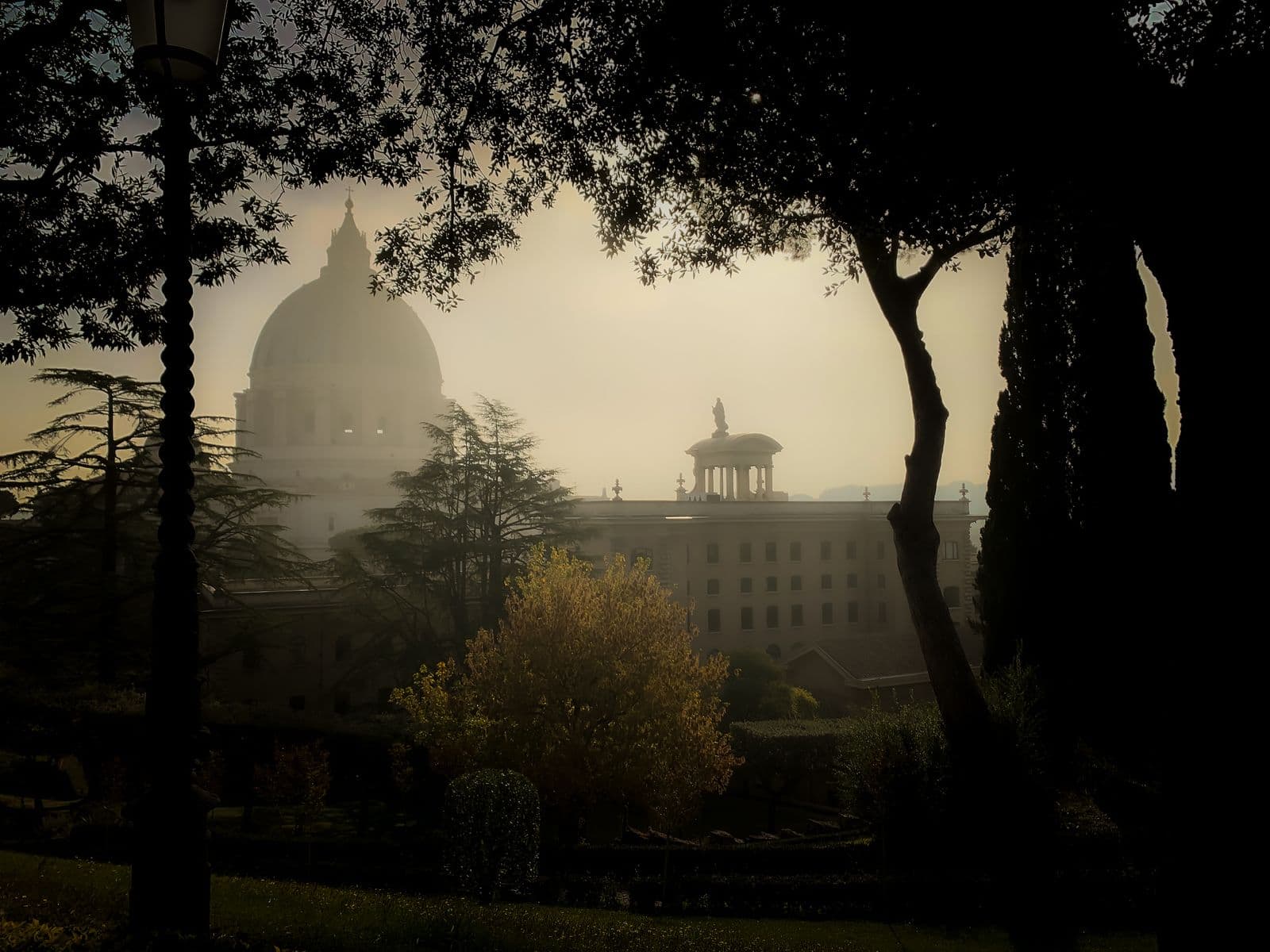
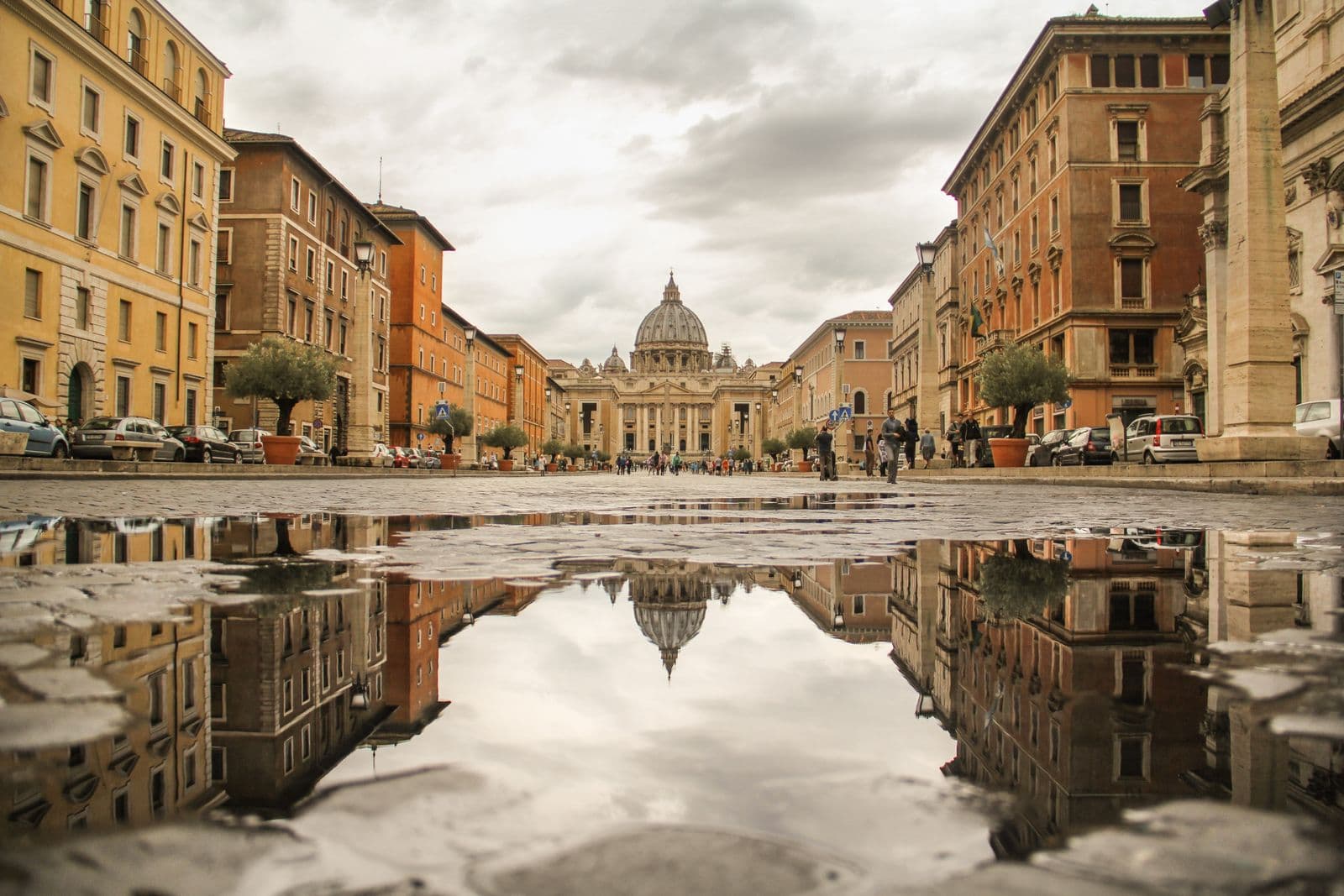
The Pantheon was designed to get wet. The oculus at the top of the dome is a real opening, about nine metres across, and when it rains the water does come in: that is why the floor of the rotunda is slightly convex towards the edges and concave at the centre, where twenty-two drainage holes open into the channels below. It is the right way to start: here rain is not a glitch in the plan, it is a variable accounted for for almost two thousand years.
And it rains in Rome more than the postcards suggest. The averages from the Roma Urbe station, 1971-2000, give 798.5 millimetres of rain a year over 79 days; those from Ciampino airport are almost identical, 792.8 millimetres again over 79 days. This is not a rainy city in the northern European sense: it is a city that takes a lot of water in a short time.
When it actually rains: autumn, and by a wide margin
The figure that matters is not the total, it is the distribution. In July the Urbe station records 21 millimetres on average; in October 107 and in November 109.9. Those two months alone are more than a quarter of the year's rain, and Ciampino agrees, with November at 112.6. In days: between October and December, eight or nine a month.
So if you come to Rome for four days in November, the odds that at least one is wet are high. That is not a problem: it is a variable to build into the plan before you leave. The difference between a ruined day and a good one is decided the evening before.
The free art is inside the churches, and in the rain they are empty
This is the Roman peculiarity people use least: a huge share of what matters sits inside churches that are open, with no ticket and no booking. On a wet day it is the most underrated resource you have.
A little further on, in Piazza Sant'Ignazio, stands the church that solved a problem with perspective. Sant'Ignazio di Loyola has no dome: in its place Andrea Pozzo painted a fake dome on canvas and, on the vault, the *Glory of Saint Ignatius*, an imaginary architecture opening upwards; the two works span the years between 1685 and 1694. A disc of antique yellow marble in the nave floor marks the exact spot from which the vault's perspective works; a second disc, further on towards the altar, is the one for the dome that does not exist. Entry is free.
A little further on, in Piazza Sant'Ignazio, stands the church that solved a problem with perspective. Sant'Ignazio di Loyola has no dome: in its place Andrea Pozzo painted, in 1685, a fake dome on canvas, and on the vault the *Glory of Saint Ignatius*, an imaginary architecture opening upwards. A golden disc in the floor marks the exact spot from which the perspective works; a second marker, further on, is the one for the dome that does not exist.
If you have twenty minutes near Santa Maria Maggiore, step into Santa Prassede: from the right nave you reach the Chapel of Saint Zeno, a tiny room entirely lined with mosaics, built by Pope Paschal I in the ninth century as a funerary chapel for his mother Theodora. Nobody looks for it when the sun is out; in the rain it stays with you.
The museums that swallow a whole afternoon
When it does not let up for hours you need a place that holds half a day on its own. These do.
- Museo Nazionale Romano – Palazzo Massimo alle Terme, next to Termini. Four floors; on the second, entire painted rooms have been reassembled, including the frescoed garden from an underground room in Livia's villa at Prima Porta.
- Centrale Montemartini (via Ostiense 106). A power station inaugurated on 30 June 1912 and decommissioned in 1968, reopened from 1997 as the second site of the Capitoline Museums: ancient statues among turbines and diesel engines, plus the carriages of Pius IX's train in the old boiler room. Metro B, Garbatella.
- Palazzo Barberini. On the great hall's vault, Pietro da Cortona's *Triumph of Divine Providence*, painted between 1632 and 1639. Flanking the entrance, two staircases: Bernini's square stairwell and the oval helical stair attributed to Borromini.
- Museo Nazionale Etrusco di Villa Giulia. Pope Julius III's sixteenth-century villa, holding the finds from southern Etruria: Vulci, Cerveteri, Veio, Pyrgi. Tuesday to Sunday.
- Palazzo delle Esposizioni (via Nazionale 194). More than ten thousand square metres over three floors, with a cinema and a café: you go in for one exhibition and come out three hours later. Closed on Mondays.
- MAXXI (Flaminio, entrance on via Guido Reni). The national museum of twenty-first century arts, designed by Zaha Hadid on the site of the former Montello barracks, split into art and architecture.
Two practical notes. At the Capitoline Museums the two palaces on Piazza del Campidoglio are linked by an underground gallery dug in the 1930s, which also leads to the Tabularium: you cross from one to the other without stepping outside. And the combined Museo Nazionale Romano ticket, 15 euros full price, is valid a week from first entry and covers Palazzo Massimo, Palazzo Altemps and the Baths of Diocletian; Crypta Balbi remains closed to the public, the sites close on Mondays, and booking is required for each venue you plan to visit.
The interiors nobody looks for when the sun is out
A few minutes from the Trevi Fountain, between via Marco Minghetti and Piazza dell'Oratorio, opens the Galleria Sciarra: a courtyard roofed in iron and glass, built for Prince Maffeo Barberini Colonna di Sciarra to a design by Giulio De Angelis. The walls are painted top to bottom by Giuseppe Cellini, in encaustic, between 1885 and 1888, on the theme of the *Glorification of Woman*. It is a private passage but open on weekdays during office hours: free, with no ticket and no booking.
In the same area two private galleries are still family homes. The Galleria Colonna opens on Saturday mornings for independent visits and on Friday mornings by booking, with a guided tour; on the steps down to the Great Hall a cannonball is still lodged where it landed in 1849, during the French siege of the Roman Republic. The Galleria Doria Pamphilj, at via del Corso 305, still belongs to the family, which lives in the palace and opens the picture gallery to the public: inside hangs Velázquez's portrait of Innocent X.
With children, if it rains all day
- Explora, Rome's children's museum, at via Flaminia 82, a few minutes from Piazza del Popolo. Entry is by timed ticket only, in fixed slots of one hour and forty-five minutes. Closed on Mondays.
- Museo Civico di Zoologia (via Ulisse Aldrovandi 18), Tuesday to Sunday. The whale room, with its sixteen-metre fin whale, holds attention longer than you would expect.
- Rome Planetarium (Piazza Giovanni Agnelli 10, EUR). A dome-screen fourteen metres across and ninety-eight seats on three concentric rings; shows run at fixed times, so check the programme before you leave.
The one activity that genuinely improves in the rain
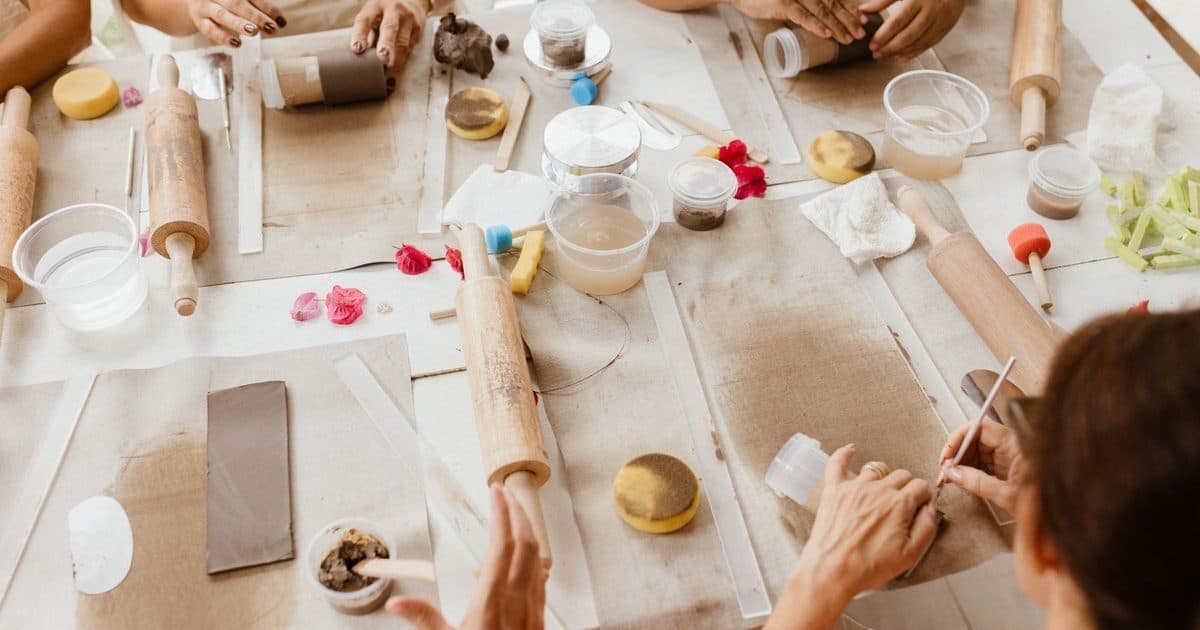
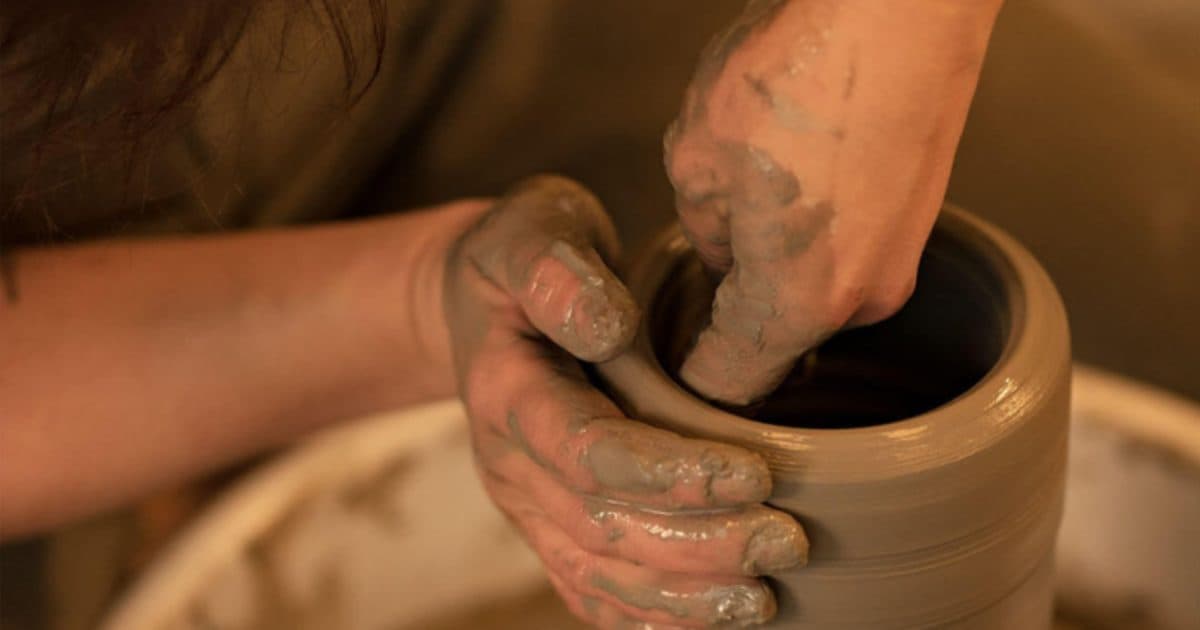
There is a category of things to do that you would never choose in good weather and that, under the rain, becomes the best decision of the day: a craft workshop. Two or three hours at a table, a material in front of you and someone teaching you how to work it. It is not a museum where you look, nor a bar where you wait for the rain to stop: at six in the evening you are holding something that did not exist before.
It works for a practical reason before a romantic one: it has a start time, an enclosed space and a stated duration. It does not depend on the weather and it does not ask you to walk anywhere once you are inside. Plenty of crafts fit inside a single session: wheel-thrown or hand-built ceramics, mosaic, jewellery, bookbinding, leatherwork, screen printing, weaving, perfumery.
One honest warning: ceramics almost never go home with you the same day, because the piece has to dry and be fired. Usually you collect it a few weeks later or have it shipped, and it is better to know that before booking if you are in Rome for a weekend.
Whatever the craft, there are five things worth asking before you confirm:
- How long the session really lasts, from the welcome to the moment the table is cleaned.
- What comes out of your hands, and when you physically have it: same day, later collection or shipping.
- How many people are at the table: under eight you work, over eight you watch other people work.
- How to get there by public transport, because in the rain the journey weighs as much as the workshop.
- What the price includes, materials among them.
On Handsome workshops are booked online and the price you see is the price you pay, with nothing added at checkout. About Rome, though, it should be said plainly: the Roman catalogue does not exist yet. The active Makers today are concentrated across Marche, Romagna and Emilia, and the Rome page exists so people searching in the city can find us while the offer is built. If the craft you want is not listed, check again in a few weeks.
The Roman catalogue is still being built: if you cannot find the craft you want, try again later.
See the Rome page on HandsomeHow to put a rainy day in Rome together
- The evening before, choose one timed thing and book it: the only real commitment of the day.
- Morning: the thing you booked, early, before the rain pushes everyone who planned to be outside indoors.
- Then two or three churches within the same few streets, free and queue-free, remembering that many close for a few hours.
- Lunch: eat where you are, not where you had imagined. Every extra kilometre is wasted time.
- Afternoon: one long block. A museum that holds three hours, or a workshop if you want to go home with something in your hands.
If you want to know where the studios actually are, the piece to read is artisan workshops in Rome: 5 secret districts. And if the ancient floors made you want to try it yourself, the Roman mosaic technique, not the Byzantine one explains what people mean when they say mosaic.
Frequently asked questions
- What can you do in Rome when it rains, without queueing?
- Churches are the quickest answer: San Luigi dei Francesi, Sant'Ignazio and Santa Prassede can all be visited free and without booking. To stay indoors longer, the museums outside the tourist centre work well, such as Centrale Montemartini.
- When is the rainiest time of year in Rome?
- Autumn. According to the 1971-2000 averages from the Roma Urbe station, October brings 107 millimetres and November 109.9, against 21 in July; at Ciampino November reaches 112.6. Between October and December there are eight or nine rainy days a month.
- Where do you take children in Rome if it rains?
- Explora on via Flaminia admits visitors in slots of one hour and forty-five minutes and is closed on Mondays; the Museo Civico di Zoologia has the whale room, Tuesday to Sunday; the Planetarium in EUR runs shows at fixed times, so check the programme first.
- Does it make sense to book a craft workshop as a rainy-day plan?
- Yes: it has a start time, an enclosed space and a stated duration, and it is the only activity the weather does not touch. That said, the Rome catalogue on Handsome is not live yet, so the sensible move is to check the city page and come back later.
A rainy day in Rome is not a lost day: it is the day the city stops being a postcard and becomes a sequence of rooms, courtyards and painted vaults. And if you want something to remain, an afternoon with your hands in a material is the souvenir no shop in the centre can sell you.
The active Makers today are in Marche, Romagna and Emilia: the Roman catalogue is still being built.
See all the workshops on Handsome