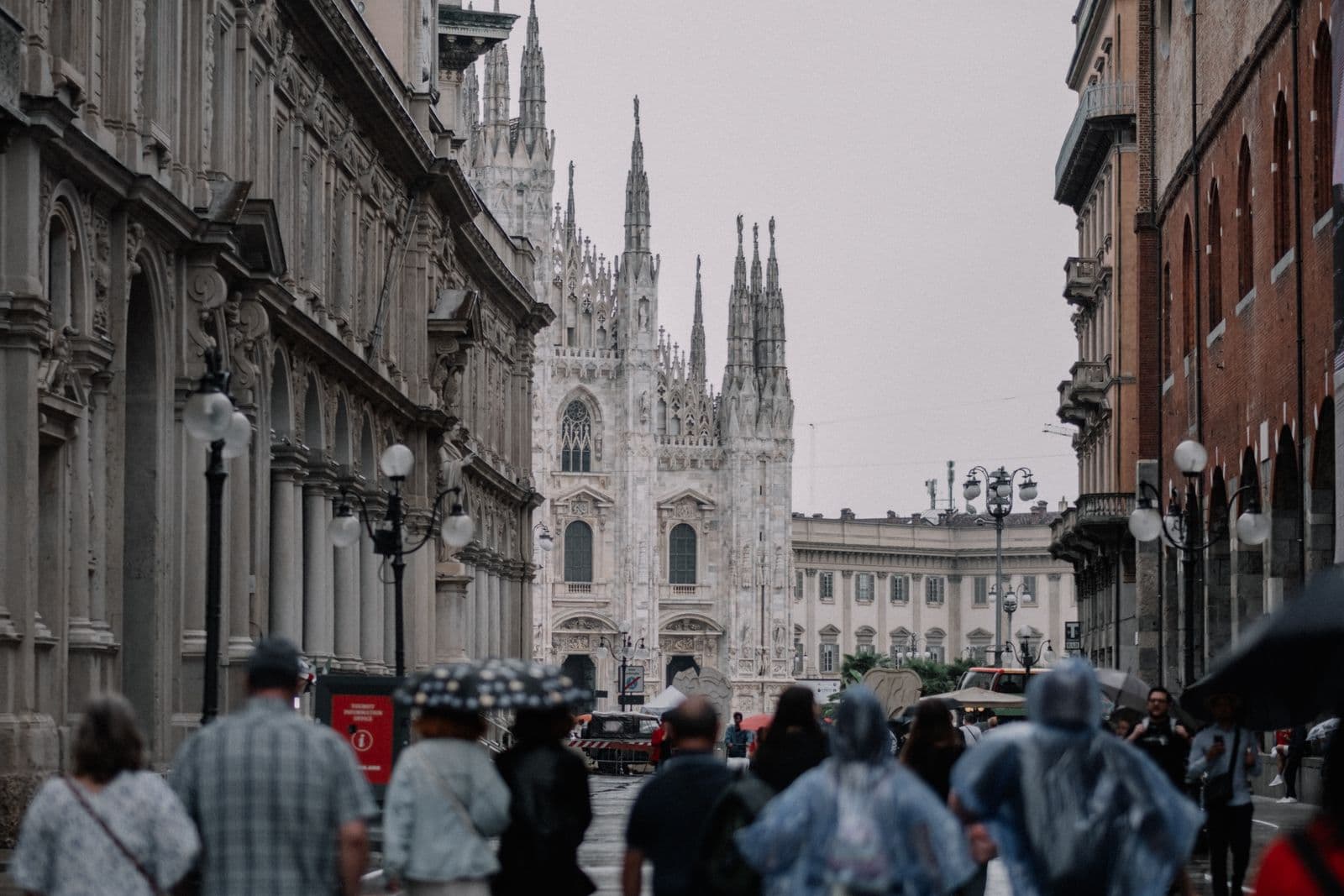
In Milan, rain is not a surprise: it is a line in the budget. The city's climate averages point to roughly 920 millimetres of rain a year, spread across about 82 days, peaking in autumn with a second high in spring. In plain terms: if you live here you already know, and if you are here for three days there is a real chance one of them will be wet.
The good news is that Milan is a city built for interiors. It has no historic core to be crossed entirely on foot like Florence, no seafront promenade to lose: what matters here is almost always behind a door, and often behind a door nobody bothers opening when the sun is out. Rain doesn't take things away here, it moves them. This guide is the list of where they move to, with the few opening times and addresses worth pinning down.
The rule: when it rains, you book — you don't improvise
The fastest way to waste a rainy day is to leave without a time slot. The most obvious indoor places — the Duomo, Brera, whatever big exhibition is on — fill up with the same people who had planned to be outside, and the queue you thought you were avoiding is still there, only wetter.
The fix is dull and it works: the morning for something with a fixed entry time, the afternoon for something long, where you go in and stay. Two blocks, one move in between, no decisions to be made in the rain.
The extreme example of what cannot be improvised is Leonardo's Last Supper at Santa Maria delle Grazie: booking is always compulsory, slots last fifteen minutes, the number of places in each slot is capped, and you are asked to be at the ticket desk around half an hour beforehand. The Last Supper is either in the plan from the night before, or it is not an answer to the rain.
The house museums: the driest, least crowded rooms in the city
On Via Jan, in a building designed by Piero Portaluppi between 1929 and 1931, there is a flat that has stayed a flat: Casa Museo Boschi Di Stefano. Antonio Boschi and Marieda Di Stefano assembled over two thousand works of twentieth-century Italian art; around three hundred of them hang on the walls of their own home, in chronological order, and you move from Sironi to Morandi, from De Chirico to Fontana across a domestic parquet floor, room after room. Admission is free. In the rain it is nearly always half empty, which says more about how little known it is than about how good it is.
A short distance away, Villa Necchi Campiglio is the same idea scaled up: a house designed by Portaluppi again, between 1932 and 1935, for the Necchi Campiglio family, complete with swimming pool and tennis court in the garden, and part of the FAI since 2001. Inside there are works by twentieth-century masters, but what stays with you is how life was lived in a house like this: the handles, the wardrobes, the main bathroom. Interiors and garden comfortably fill an hour and a half. It opens only on some days of the week: check the calendar the night before.
Art without the crowds: the Ambrosiana and the church nobody notices
The Pinacoteca Ambrosiana was the idea of Cardinal Federico Borromeo, who founded it in 1618 next to the library, with an academy attached that opened in 1621: a collection conceived as study material for young painters. Today it holds Caravaggio's Basket of Fruit and Raphael's preparatory cartoon for The School of Athens; the Ambrosiana also keeps Leonardo's Codex Atlanticus, whose sheets are shown in rotation. It sits a few steps from the Duomo, and on a wet morning it is exactly what the blockbuster exhibitions are not: quiet.
A few minutes' walk away, on Corso Magenta, stands San Maurizio al Monastero Maggiore. From outside it is a plain façade you could easily walk past; inside, walls and vault are almost entirely frescoed, which is why people call it the Sistine Chapel of Milan. Bernardino Luini and his workshop worked here between 1522 and 1529, and alongside his frescoes you can pick out the hands of other names in sixteenth-century Lombard painting. Free admission, a few minutes from Cadorna metro. If you have twenty minutes and it is raining, nothing in this city gives you more.
When it rains all day: the places that hold for hours
Some days it simply doesn't stop, and you need places that swallow a whole afternoon. These hold.
- Museo Nazionale Scienza e Tecnologia Leonardo da Vinci (Via San Vittore 21). Opened in 1953 in the former monastery of San Vittore al Corpo, it is the largest science and technology museum in Italy: around 50,000 square metres, twenty-one thousand objects and the submarine Enrico Toti, which you can walk through. With children in tow, half a day disappears without you noticing.
- Pirelli HangarBicocca (Via Chiese 2). A former industrial shed turned contemporary art space, with free admission, open Thursday to Sunday from 10.30am to 8.30pm. It houses Anselm Kiefer's permanent installation The Seven Heavenly Palaces, seven concrete towers between thirteen and nineteen metres tall, made for the venue's opening in 2004. Book the free ticket online to be sure of getting in during your chosen slot.
- Fondazione Prada (Largo Isarco). An early twentieth-century gin distillery reworked to a design by OMA and Rem Koolhaas and opened in 2015, with the Torre inaugurated in April 2018: sixty metres and nine floors. The complex also includes Bar Luce, whose interior was conceived by Wes Anderson.
- Acquario Civico (Viale Gadio, Parco Sempione). Designed by Sebastiano Locati, it is the only pavilion of the 1906 International Exposition still standing in Parco Sempione, and it houses the third oldest aquarium in Europe. Under an hour to visit: a stop to slot in, not one to build the day around.
- MUBA at the Rotonda della Besana. The children's museum has occupied the complex since 2014, running workshops that follow the Remida project and use reclaimed materials. At weekends and on public holidays the programme is for families and changes weekly: check the calendar and book.
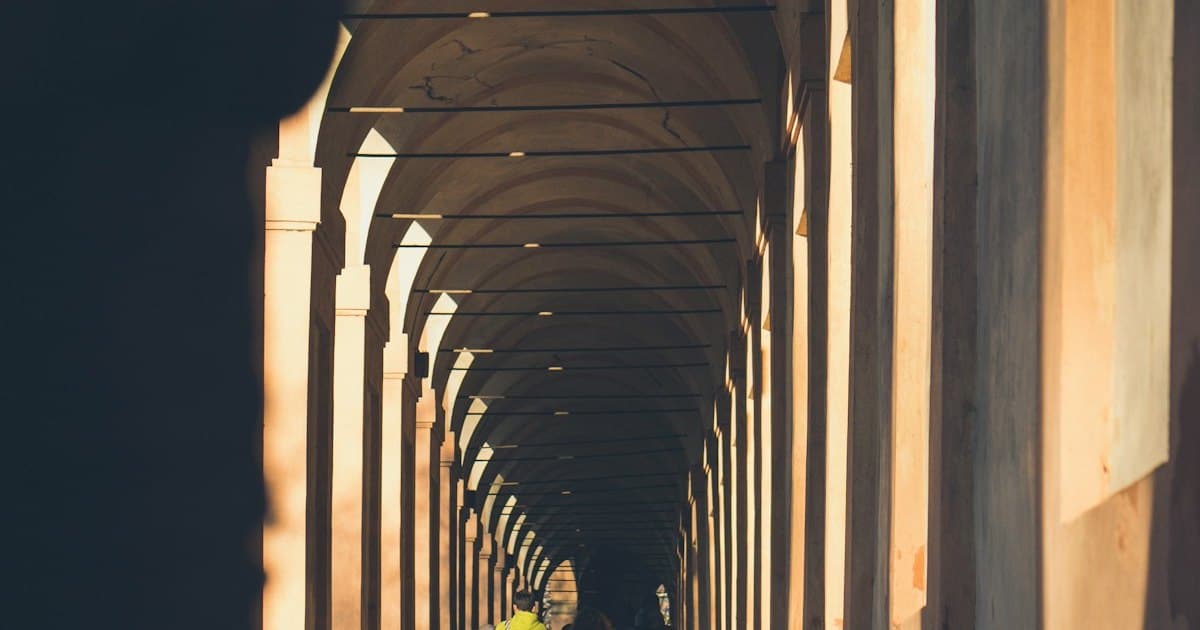
And if all you need is to walk without getting wet, there is the most famous covered street in Italy: the Galleria Vittorio Emanuele II. Work began in 1865 to a design by Giuseppe Mengoni, the inauguration came in September 1867 with the site still open, and the whole thing was finished in 1877. Mengoni never saw it completed: he fell from scaffolding on 30 December 1877, on the eve of the inauguration of the arch onto Piazza Duomo.
The one activity that rain actually improves
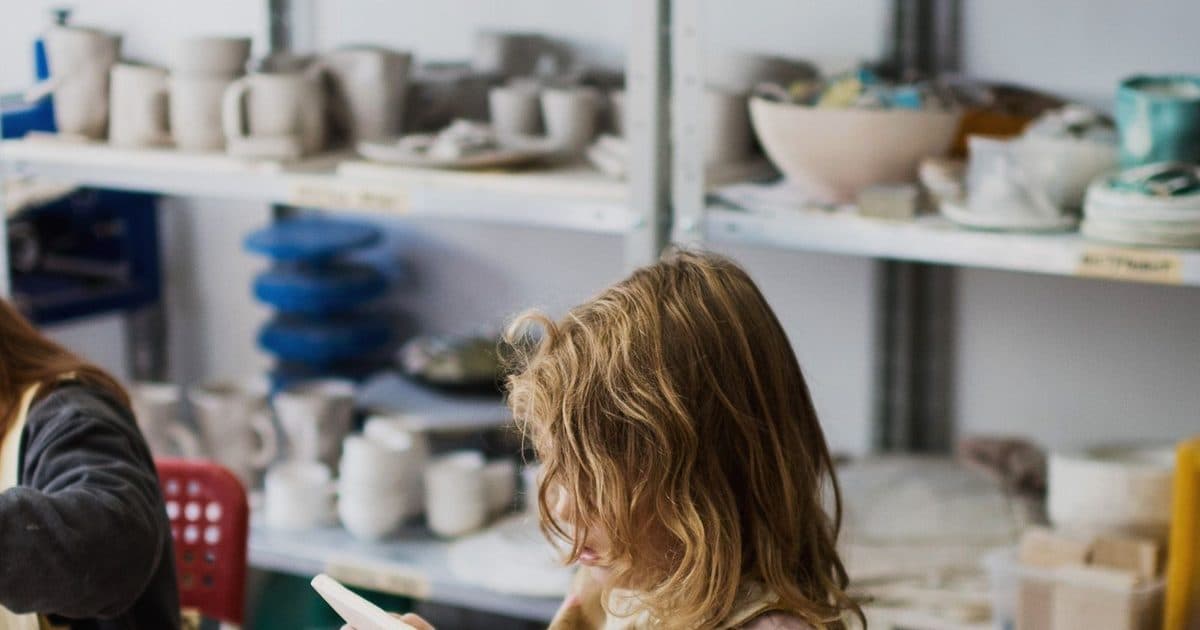
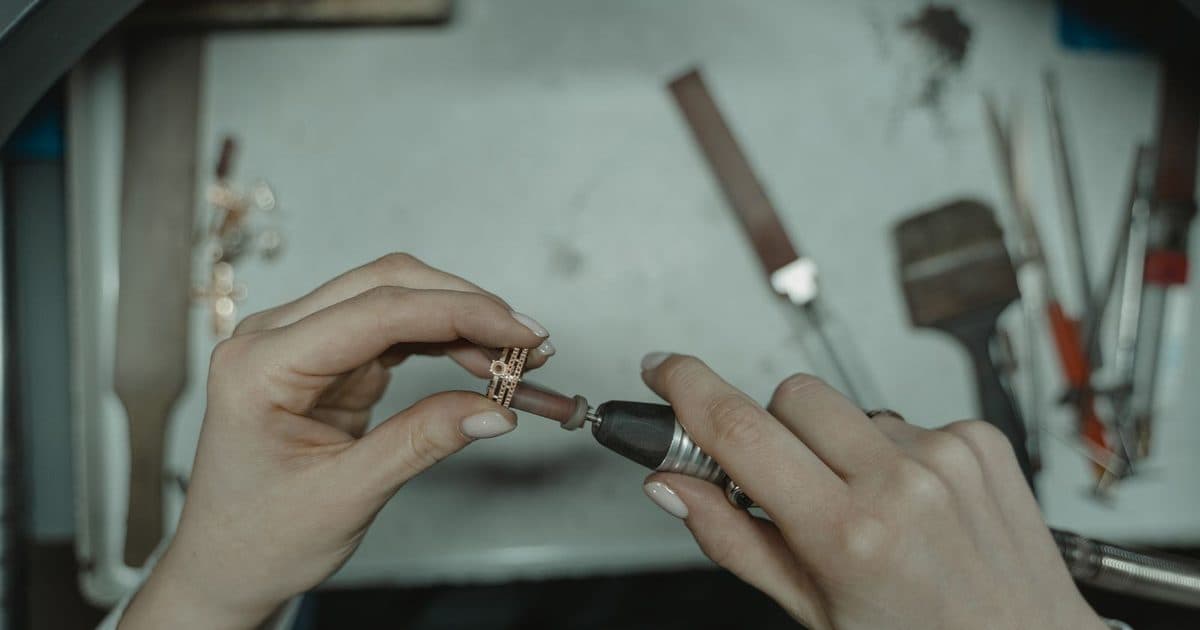
There is a category of things to do that you would never choose in good weather and that becomes the best decision of the day when it rains: a craft workshop. Two or three hours at a table, with a material in front of you and someone teaching you how to work it. It is not a museum where you look, and it is not a shelter where you wait for the sky to clear: it is the only activity that leaves you, at six in the evening, holding something that did not exist before.
It works for a practical reason before a romantic one: it has a start time, an indoor address and a stated duration. It doesn't depend on the weather, and once you are inside it asks you to walk nowhere. Plenty of crafts fit a single session: wheel-thrown or hand-built ceramics, jewellery, bookbinding, screen printing, leatherwork, weaving, perfumery.
One honest warning: ceramics almost never goes home with you the same day, because the piece has to dry and then be fired. In most cases you collect it a few weeks later or have it shipped, and it is worth knowing that before you book, especially if you are in Milan for the weekend only.
Here is what to ask before confirming, whatever the craft:
- How long the session really lasts, from welcome to wiping down the table.
- What comes out of your hands and when you physically have it: same day, later collection or shipping.
- How many people are at the table: under eight you work, over eight you watch other people work.
- How to get there by public transport, because in the rain the journey matters as much as the workshop.
- Whether materials are included in the price: on Handsome the price you see is the final one, but it is always worth reading what it covers.
On Handsome, workshops are booked online and the price you see is the price you pay: nothing is added at checkout. In Milan the catalogue is still being built — the densest coverage today is across Le Marche and Romagna, and Lombard Makers are only arriving now — so the sensible move is to look at what is listed in the city right now, and check again in a few weeks if the craft you want isn't there yet.
The Lombard catalogue is growing: if the craft you want isn't listed, try again in a few weeks.
See the workshops in MilanHow a rainy day fits together
- The night before: pick one timed thing and book it. That is the day's only real commitment.
- Morning: the thing you booked, whether that is the Last Supper, the Ambrosiana or a house museum. Arrive early, before the rain has moved everyone indoors.
- Lunch: eat near where you are, not where you had imagined. In the wet, every extra kilometre is time lost.
- Afternoon: one long block. Either a big venue — the science museum, HangarBicocca, Fondazione Prada — or a workshop, if you want to go home with something.
- Evening: the Galleria Vittorio Emanuele II and the arcades of the centre carry you back towards the Duomo with the umbrella barely open.
If the rain catches you on a weeknight and all you have is the hours after work, the reasoning barely changes but the window narrows: we wrote about that in evening courses in Milan: what really fits into one night. And if the problem is getting there without a car, the guide to craft studios by metro stop is the piece that solves the journey.
Frequently asked questions
- What can you do in Milan when it rains if you don't want a museum?
- A craft workshop is the most concrete answer: two or three hours indoors, a fixed time, an object you take home. Hybrid venues also work well — Pirelli HangarBicocca or Fondazione Prada, where you walk a lot and never queue in front of a display case.
- Which museums in Milan are free?
- Among those mentioned here, Casa Museo Boschi Di Stefano and Pirelli HangarBicocca are free, and so is entry to the frescoed church of San Maurizio al Monastero Maggiore. For HangarBicocca it is worth booking the free ticket online and checking the opening days, which run Thursday to Sunday.
- Can you visit the Last Supper at the last minute if it rains?
- Hardly. Booking is always compulsory, slots last fifteen minutes and take a limited number of people, and you need to be at the ticket desk around half an hour early. It is a visit to plan, not a fallback for a day gone wrong.
- Where do you go in Milan with children when it rains?
- The Museo Nazionale Scienza e Tecnologia Leonardo da Vinci fills half a day on its own, submarine included; the Acquario Civico in Parco Sempione takes about an hour; and MUBA at the Rotonda della Besana runs family workshops with reclaimed materials at weekends, bookable in advance.
A rainy day in Milan is not a lost one: it is the day the city shows you what it keeps inside, which is the best part of it. And if you want something to remain beyond the photographs, an afternoon with your hands in a material is the souvenir no shop sells you.