In Milan, "where is it" is a weaker question than it sounds. Anyone who lives here without a car, which is most people leaving the house at seven in the evening, doesn't choose a studio by district. They choose it by the stop that serves it, and by how they get home once the workshop ends. Two addresses in the same neighbourhood can belong to two different cities: one at the metro exit, the other beyond a railway cutting, with a long walk over a bridge in the dark.
Most guides to craft studios in Milan work as lists: names, streets, disciplines. This one uses the unit of measurement locals actually use: the line running underneath and the number of changes it takes to get there. The city is served by five metro lines plus the suburban rail link, and the quadrants where studios clustered followed the ground-floor units and old industrial sheds still available, which in turn followed the railways.
Why the stop matters more than the neighbourhood
Milanese district names are broad labels, often sliced in half by a railway embankment or a ring road: "the Navigli" can mean the Darsena basin or a street where trams come rarely. People who live here navigate by station, not by name. It matters even more if you are arriving from outside: landing at Cadorna, Centrale or Porta Garibaldi gives you an interchange, not a dot on a map, and from there the studio is zero, one or two changes away. That, not the charm of the district, decides whether you sign up for a weeknight class or only for a Saturday.
North: Isola, Garibaldi and the NoLo belt
Isola changed its face without losing its ground floor: narrow streets, courtyards, small shops with a roller shutter and a back room that doubles as a workshop, all pressed against the towers of Porta Nuova. It is served by the Isola stop on the lilac line and, above all, by Porta Garibaldi, where lilac meets green and the railway station sits one level below. For an evening experience it is one of the easiest points in the city: reachable from almost anywhere, and easy to leave late.
A little further east, past piazzale Loreto, lies the area residents renamed NoLo. Ground-floor units cost less than in the centre, which makes it fertile territory for ceramics, screen printing, textiles and illustration. Loreto is an interchange between the red and green lines, and heading up the red line you pass Pasteur, Rovereto and Turro, stops that sit inside the neighbourhood rather than at its edges. If you want a course you can attend once or twice a week after work, this is where the arithmetic tends to work out.
East: Lambrate and the old industrial belt
East of the centre the geography changes character: shopfronts give way to former production spaces, with high ceilings, proper power supply and courtyards where noise and dust bother nobody. This is the quadrant for crafts that don't fit in a flat: woodworking with machines, glass, the potter's wheel, mosaic cut by hand. Lambrate FS is a stop on the green line and also a railway station, so people coming in from the wider province reach it without crossing the centre. One practical warning: the area is split by the tracks and the exits lead to opposite sides, so ask in advance which side to use.
South-west: Tortona, the Navigli and the San Cristoforo axis
Porta Genova, on the green line, serves two different worlds through the same exit. On one side, the former industrial area around via Tortona, now a district of studios, showrooms and event spaces that fills up during design week and spends the rest of the year as a working neighbourhood. On the other, the Navigli, with the Darsena and the two canal banks, where studios often sit in inner courtyards behind a door that announces nothing from the street. Still on the green line, Sant'Agostino and Romolo cover the two ends of the area.
Then there is the blue line, which crosses the city from Linate airport to the south-western quadrant and meets the other lines in the centre, putting within direct reach a part of Milan that used to mean a tram or a car. On the Navigli, think about timing rather than distance: on Saturday evenings the canals fill with people standing still, and a workshop ending at aperitivo hour only fits if you have already decided to stay for dinner.
Three questions to ask before you book
- What time does it end, and which line takes me home? A studio that feels perfectly placed at six in the afternoon can feel awkward at eleven at night: check the last departure on your line before you confirm.
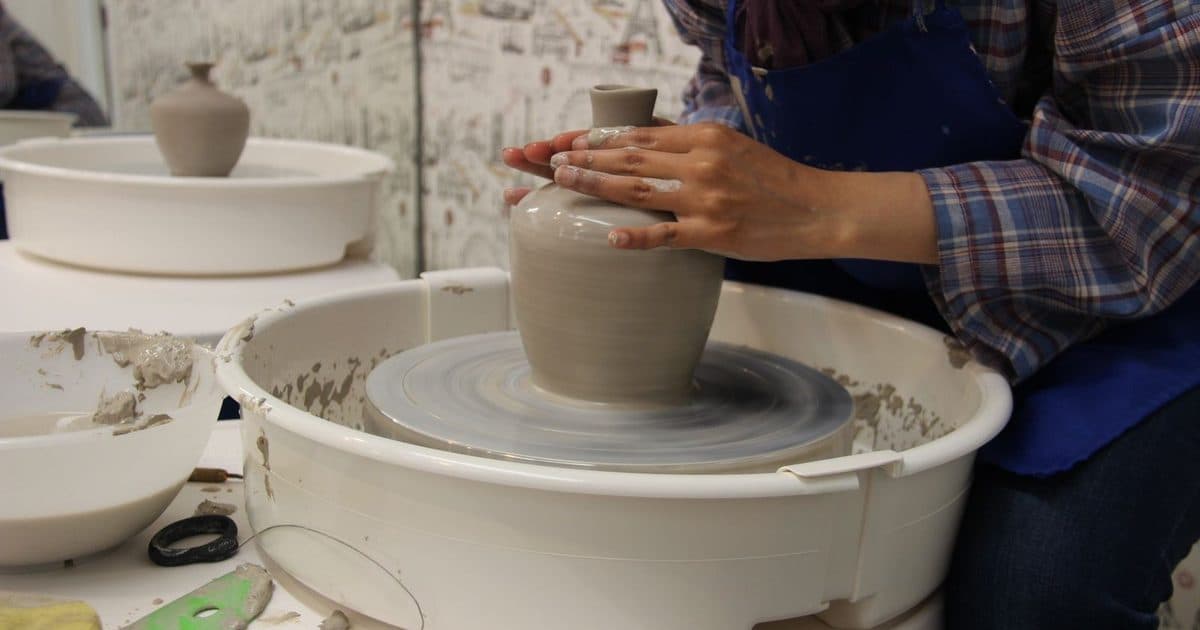
- Do I take the piece home the same evening? With ceramics and glass, almost never: the work has to dry and be fired, and collection happens days or weeks later. That is a second trip, and it belongs in the decision about where to book.
- Where is the actual entrance? Many Milanese studios are in a courtyard, on an upper floor, or inside a shared space. Ask for the name on the buzzer and the correct side of the street: it is the difference between arriving on time and circling the block.
On Handsome you can filter workshops by city and date, and every listing states what you make, how long it takes and what you leave with; the Maker profiles tell you who runs the session. If you are still choosing the craft rather than the district, how to choose the right workshop reasons in the opposite direction to this article; if you already have needle and thread in mind, a more specific Milanese picture is in tailoring, sewing and couture in Milan, while clothes and shoes are covered in what to bring and what to wear.
Frequently asked questions
- Where are the craft workshops in Milan?
- There is no single artisan district: studios spread wherever usable space stayed affordable, producing three clusters: the northern belt between Isola, Porta Garibaldi and the area north of Loreto; the east around Lambrate; and the south-west between via Tortona and the Navigli. On Handsome you can filter by city and see the dates already open.
- How do I reach a craft studio in Milan by metro?
- Almost every craft area has its own stop: Isola and Porta Garibaldi on the lilac line, Loreto and the stops beyond it on the red line, Lambrate FS and Porta Genova on the green line. Before booking, find the stop named in the listing and check how many changes it takes from where you start. That is what makes an evening course sustainable or not.
- Do I need a car for a workshop in Milan?
- In most cases no, and a car is often a liability: the centre is a restricted, charged traffic zone on weekdays, street parking is metered almost everywhere, and finding a space in the denser quadrants at night is a lottery. If you are coming from outside the city, leave the car at a park-and-ride on the line you need.
- After a ceramics workshop, do I have to come back for my piece?
- Usually yes. Clay has to dry and then be fired, often twice if it is glazed, so the piece is ready days or weeks after the session. Ask the studio whether collection is in person or whether they can ship it, and factor that second trip into the area you choose.
- Do I book online, and what if I can no longer attend?
- On Handsome you book and pay online, and the email confirmation carries the exact address and directions. The cancellation terms are set out on the cancellations page and repeated in the confirmation, so read them before booking, especially for a date far ahead.
Filter by city and date, book and pay online
Browse workshops in Milan