Type "mosaic workshop Rome" into a search bar and the picture in your head is probably the wrong one: golden vaults, deep blue glass skies, saints that light up the moment the sun comes in. That picture is real, but it belongs to Ravenna. In Rome, mosaic is something you walk on rather than look up at. It is made of marble and stone, its colours are the colours of the quarry, and the hand that cuts it holds a small hammer, not a pair of glass nippers.
Here is the short answer to the question most people are really asking. Roman mosaic is a floor art made of cut stone, with a palette limited to the natural tones of marble and limestone and very often reduced to black and white. Ravenna's mosaic is a wall art made of coloured glass and gold leaf, designed to catch and scatter light. To try the Roman one you need a studio in Rome that actually works stone, and listings rarely make the difference clear.
Marble versus gold: two families of mosaic
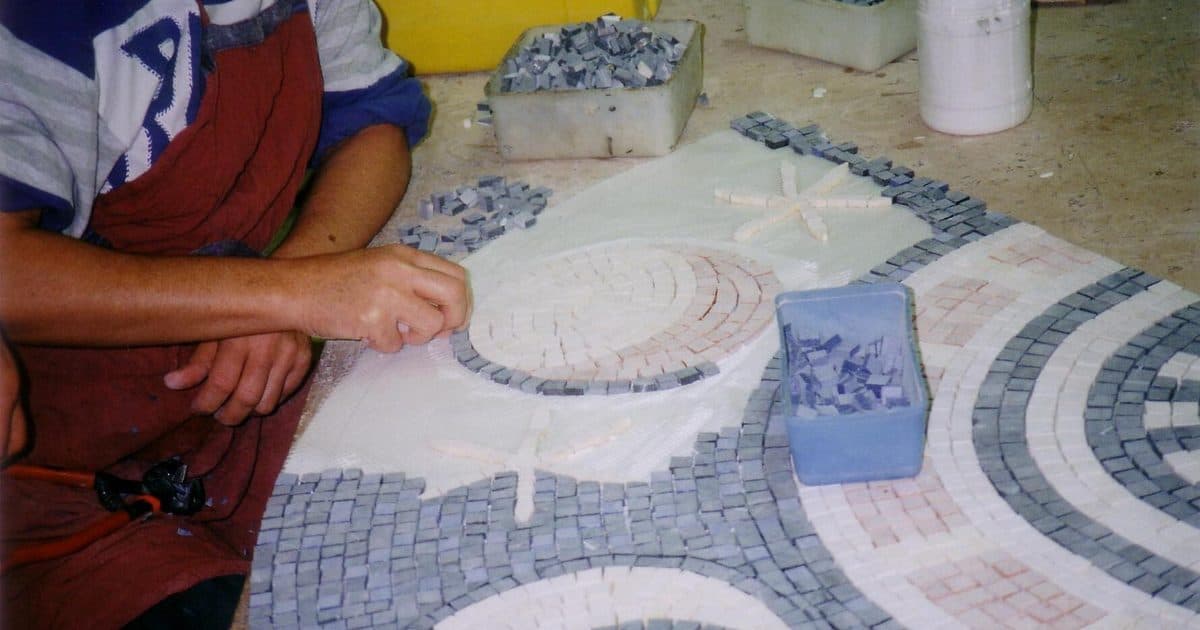
The mosaic the Romans laid in their houses, baths and port warehouses is known to archaeologists as opus tessellatum: little cubes of stone set side by side in a bed of mortar. The raw material was whatever the land provided: white marble, black limestone, travertine, terracotta, the occasional coloured stone when the client could afford it. That is where the most recognisable style comes from: black figures on a white ground, tritons, dolphins, athletes, geometric borders running the length of whole rooms. The Treccani encyclopaedia entry on mosaic (in Italian) traces the technique from its Greek origins through the Roman world.
In Ravenna, and across the Byzantine world more generally, mosaic climbs off the floor and onto walls, apses and domes. The material changes: the tesserae are smalti, glass coloured right through the mass, plus gold tesserae made by sealing a sheet of metal leaf between two layers of glass. The setting changes: tesserae are deliberately tilted so the surface is never flat and candlelight or daylight bounces off in different directions. The subject changes: no more sea creatures to be trodden on, but sacred figures meant to be seen from below, with gold standing in for the sky. Our guide to mosaic in Ravenna covers that tradition.
- Material: stone and marble in Rome; glass, smalti and gold leaf in Ravenna.
- Surface: floors, plus the odd fountain or grotto, in Rome; walls, vaults and apses in Ravenna.
- Colour: the natural range of the quarry, often just black and white, against a practically unlimited glass palette.
- Cutting: stone is split with a hammer and hardie; glass is snapped with wheeled nippers, far more gently.
- Effect: matt and solid, meant to be seen up close in full light; or vibrant and reflective, made for half-darkness and distance.
What changes when you make it yourself
On a workbench the difference between the two traditions stops being academic. Stone has a thickness you feel under your fingers and it is cut with one sharp movement: the tessera rests on the blade of the hardie, the hammer comes down once, and the piece splits along a line that depends on the grain of the material. It takes a few attempts, and the moment the stone starts to answer is what makes people grin. Glass smalto is thin and brittle: you snap off small portions, and the risk is not a missed blow but shattering the whole thing.
The rhythm is different too. With marble you work with relatively large tesserae and a design built on contrast: a black outline on a white field, a key pattern, a braid. In a few hours a small panel can be finished and look finished. With smalti the tesserae are tiny, colours are placed in gradations, and the piece only makes sense once light hits it from the side: slower work for the same surface, and harder to judge while you are doing it. On how a beginner session is put together, see our ideas for mosaic workshops open to everyone.
Marble does not let you cheat: either you cut it well or it shows. That is why you remember your first good tessera.
How to spot a Roman-technique mosaic workshop in Rome
Online listings almost always use the word mosaic without qualifiers, and in Rome that causes confusion: plenty of studios work with smalti, which are easier to cut and photograph more vividly. If what you are after is the technique of the ancient floors, check a few details before you book.
- The material is stated: marble, limestone, travertine, terracotta. If the only words are smalti, glass or vitreous paste, you are looking at the Byzantine family.
- The tools are hammer and hardie, the double-edged mosaic hammer and the small bladed anvil. Wheeled nippers are the glass tool.
- The design speaks Roman: geometry, key patterns, sea creatures, black figures on white. A shaded portrait or golden lettering points elsewhere.
- Setting happens on a flat base, in mortar or with adhesive on a board, without tilting tesserae to chase reflections.
- The Maker leading the session has a background in restoration, marble work or archaeology, and says so in the profile.
Before or after: where to see the real Roman mosaics
A workshop pays off far more if, in the days around it, you stand in front of the originals with an eye that now looks for the cut of the tesserae. In Rome, the Centrale Montemartini, an outpost of the Capitoline Museums, displays ancient statues and mosaic floors among the turbines of a former power station. The Museo Nazionale Romano keeps floors from villas in the Roman countryside across its sites, with figured scenes, chariot races and geometric motifs that show how a composition was built. With half a day to spare, take the train to Ostia Antica: the black-and-white mosaics of the baths and of the merchants' offices on the Square of the Guilds are still in place, out in the open, with grass growing between the edges. That is where you understand this technique was born to be walked on, not contemplated. Back in the city, when choosing where to book, our map of the Rome neighbourhoods where craftspeople still work is a good starting point.
Frequently asked questions
- What is the difference between Roman mosaic and Ravenna mosaic?
- Roman mosaic is made of marble and stone tesserae laid flat in floors, with natural colours and often just black and white. Ravenna mosaic, in the Byzantine tradition, uses glass smalti and gold tesserae, covers walls and vaults, and is set with tilted tesserae to reflect light.
- Do I need experience for a Roman mosaic workshop?
- No. Cutting stone with hammer and hardie is learned in the first minutes under the Maker's guidance, and beginner designs are almost always geometric or two-colour, so they read clearly even with imperfect tesserae. The imperfections are part of the character of the piece.
- What do I take home from a mosaic workshop in Rome?
- Usually a small panel, a coaster or a tile, set on a rigid backing and grouted. If the technique is Roman the piece will be stone, matt and heavy in the hand; if it is smalti, lighter and glossy. Ask whether it is ready at the end of the session or needs drying time.
- Is Roman mosaic suitable for children?
- It depends on the studio. The hammer needs care and a certain amount of strength, so many Makers give younger participants pre-cut tesserae to arrange and glue, keeping the cutting for adults. The listing states the recommended age: check it before booking.
- Can I give a mosaic workshop in Rome as a gift?
- Yes. On Handsome you can give a gift card to be used on a workshop of the recipient's choice, or book a seat on a specific date in their name. Normal booking cancellation terms apply.
Filter by city and craft, read the Maker's profile and book online
Find a mosaic workshop in Rome