In Rome the souvenir is an industry of its own. Around every monument there is the same row of stalls selling the same four things: the Colosseum fridge magnet, the T-shirt, the she-wolf keyring. That they are identical from Piazza Navona to St Peter's should tell you everything: those objects are not from Rome, they are merely sold in Rome.
This guide is not a list of shops. It answers two practical questions: what Rome and Lazio actually produce and how to tell, object in hand, whether a person made it or a machine did. It's useful if you're in town for three days, and useful if you live in Rome and need a gift.
Rome's definitive souvenir was invented in the eighteenth century
Inside St Peter's almost none of the huge "paintings" above the altars is a painting: they are mosaics, copies made tessera by tessera because damp was ruining the canvases. To make them and then maintain them, the Fabbrica di San Pietro keeps a permanent mosaic workshop, the Vatican Mosaic Studio, still working today. Rome's first souvenir came out of that circle of mosaicists.
The decisive step came in the eighteenth century with spun enamels: opaque glass pastes remelted and drawn into very thin rods, then cut into microscopic tesserae. The invention is credited to the mosaicist Giacomo Raffaelli, who presented it in Rome in the holy year of 1775 and refined it with his colleague Cesare Aguatti, building on the opaque enamels developed by the furnace master Alessio Mattioli. The micromosaic was born, and with it the souvenir of Rome: boxes, snuffboxes and brooches showing the Colosseum or the Pantheon, bought by Grand Tour travellers, who lodged around Piazza di Spagna.
What Rome and Lazio actually produce
Rome is not Faenza, not Murano, not Torre del Greco: it has no single signature product to put in a window, and anyone who tells you otherwise is selling you something. It had a different vocation, that of a commissioning city: people worked to order for the Church, the courts, the pilgrims. That is where the surviving crafts come from.
Ceramics: Lazio's recognised tradition sits in the Viterbo area
Ceramics has a law of its own, Law 188 of 1990, which protects it through two marks — CAT (artistic and traditional) and CQ (quality) — and recognises towns with an established ceramic tradition. In Lazio the towns belonging to the national network of Ceramic Cities are all in the province of Viterbo: Viterbo, Acquapendente and Tarquinia. Translated: there is no designation called "Roman ceramics", and what counts is the studio where the piece was made, not the city where you buy it.
Mosaic: the Roman kind is walked on
People looking for mosaic have Ravenna's gold in mind. In Rome ancient mosaic is floor work: marble and stone, often black and white, walked on rather than looked up at. The difference matters when you buy: cutting marble with a hammer and composing coloured glass are two crafts with different costs. We wrote about it in our guide to Roman mosaic and how it differs from the Byzantine kind.
Goldsmithing and silverware
The name everyone knows is Bulgari, which grew in Rome out of the workshop of a Greek silversmith, Sotirio Bulgari, and became the window on Via dei Condotti. But for anyone hunting a gift the useful story is another one: the goldsmiths' benches still working around the city, where a ring is made to measure in a few days and the person selling it is the one who filed it.
Tailoring, civil and ecclesiastical
Rome has its own school of menswear tailoring: Brioni was founded here in 1945, on Via Barberini, by the Abruzzese tailor Nazareno Fonticoli and Gaetano Savini, and in 1952, in the Sala Bianca of Palazzo Pitti, it put men on the catwalk for the first time in an Italian fashion show. Alongside it sits a production with no equivalent elsewhere: Via dei Cestari, near the Pantheon, is the street of sacred furnishings and vestments, where clergy from all over the world come to shop.
Leather
Lazio has no tanning district like Tuscany's, and it would be dishonest to tell you otherwise. It does have individual leather and shoemaking workshops working to measure and repairing what they sell: leather is the material where the gap between handmade and mass-assembled is easiest to see.
The street names are still a map of the trades
There is a free way to see that Rome was long a city that manufactured things: read the street signs. From the Middle Ages the guilds of arts and trades grouped street by street, partly for the convenience of sourcing raw materials together.
- Via dei Balestrari, by Campo de' Fiori: the crossbow makers.
- Via dei Baullari: the makers of travelling trunks, on the street leading to Campo de' Fiori.
- Via dei Chiavari: the blacksmiths specialising in locks and keys.
- Via dei Coronari: the sellers of rosary beads, along a medieval street pilgrims walked to reach St Peter's.
- Via de' Giubbonari: the makers of giubboni, the heavy jackets worn between the Middle Ages and the Renaissance.
Today those streets mostly sell something else, and that's fine: cities change. But the point still holds for the buyer: the right question in front of an object is not "is it Italian?", it is "who made it?".
Five checks you can run in thirty seconds
None needs technical knowledge: the object in your hand and your phone camera at full zoom, which reveals the dot grid of a print in a second, are enough.
- Ceramics: turn the piece over. The foot is usually unglazed and the base keeps the marks of the kiln stilts. Hand-painted decoration has brushstrokes that overlap and change from piece to piece; a printed transfer has a regular grid of dots.
- Gold and silver: look for the punch marks. Legislative decree 251 of 1999 requires precious metals sold in Italy to carry the fineness in thousandths and the producer's identification mark, assigned by the Chamber of Commerce. The legal finenesses are 750, 585 and 375 for gold, 925 and 800 for silver: if both marks are missing, it is not precious-metal jewellery.
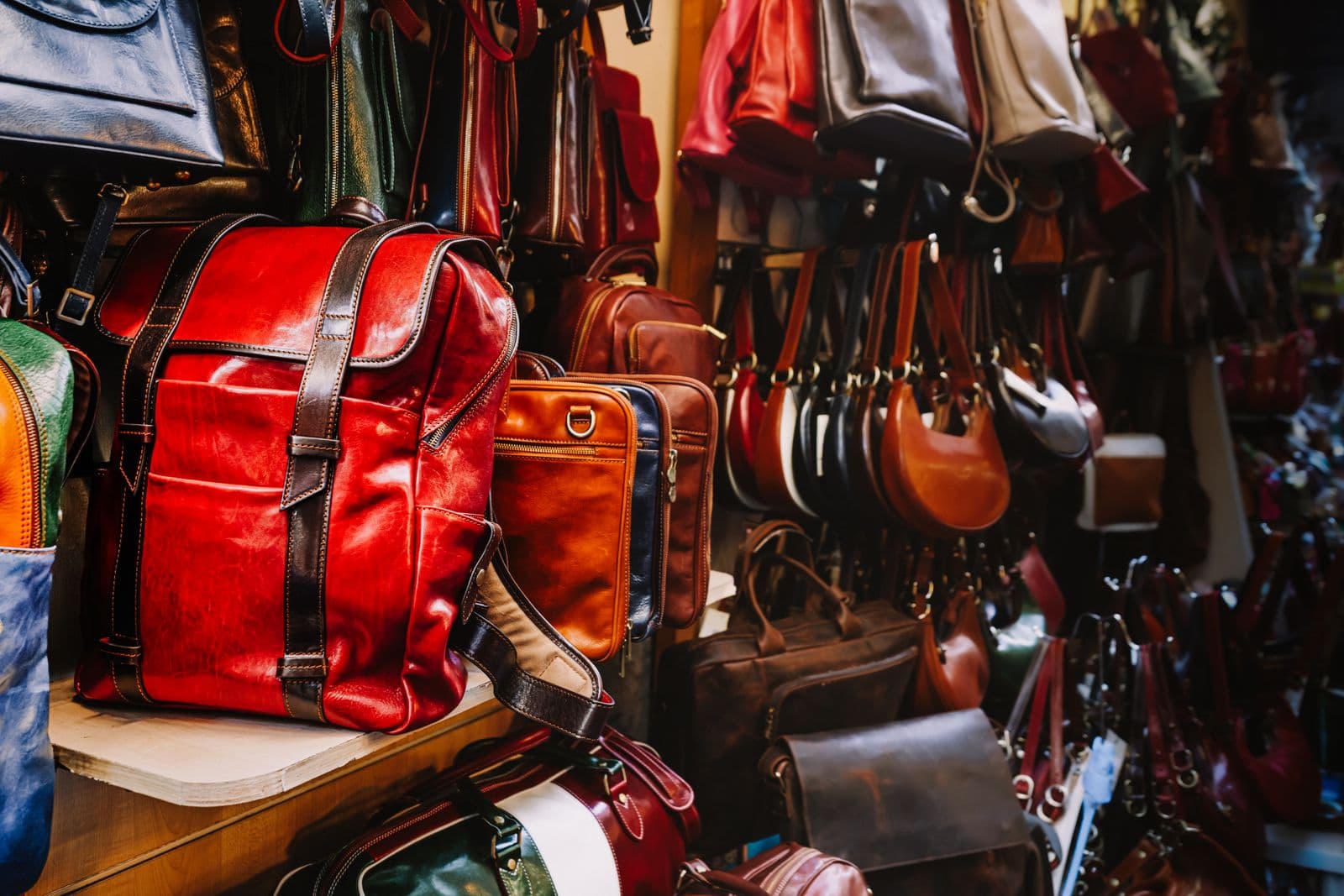
- Leather: look at the stitching. The saddle stitch is made by hand with two needles passing through the same hole: the stitches come out slanted and symmetrical on both faces and, if one gives way, the rest holds. A machine lockstitch is aligned to the millimetre.
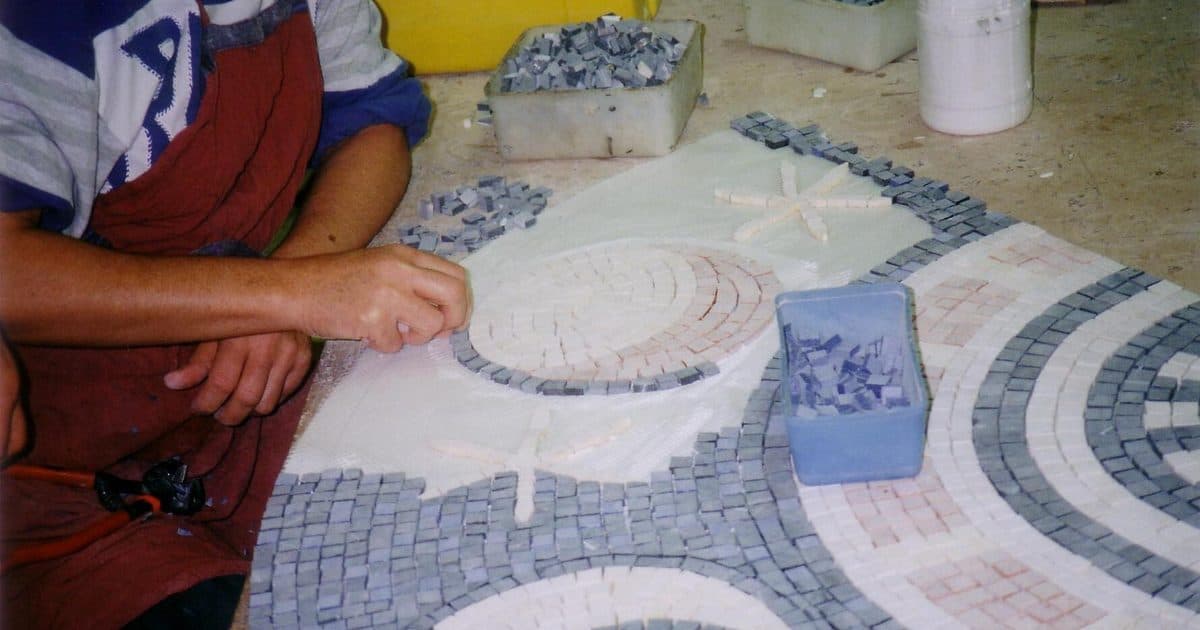
- Mosaic and stone: look for irregularity. Hand-cut tesserae are never all identical and the joints vary in thickness. Identical, aligned little squares mean industrial tesserae mounted on mesh.
- Fabric: go into the finishing. Linings, buttonholes and hems are where handwork shows: thread that isn't perfectly even, hems closed by hand, traces of removed basting.
Three questions to ask the seller
- Who made it, and where is the workshop? A good answer contains a name and a place. "Italian artisans" or "local production" are not answers.
- How many pieces like this exist? Someone who makes things by hand can tell you whether it's one of a kind, a run of ten, or a model they've remade for years. Someone who only resells usually can't.
- If it breaks, can it be repaired? Whoever made the object almost always repairs it, and says so immediately. That question separates a workshop from an importer.
There is also a check that doesn't depend on the answers: "artisan" on a shop sign is not a free adjective. Law 443 of 1985 sets up the provincial register of craft enterprises and states that no business may use a company name, sign or trademark referring to craftsmanship unless it is entered in that register.
And one last check worth more than any label: ask to see where the work happens. Many Roman workshops have the bench behind the shop or receive visitors by appointment, and five minutes are enough to tell whether the tools are used or are decoration. Someone with no place to show you usually has no piece to tell you about either.
Receipt, warranty, tax free: the boring part that saves you
A handmade object bought in a shop carries the same protections as any other purchase, starting with the two-year legal warranty of conformity from delivery, which the seller may neither exclude nor limit. It needs proof of purchase, so ask for the receipt even when the piece is cheap.
Watch out, though, for something almost everyone takes for granted: in a physical shop there is no legal right to change your mind. The 14-day right of withdrawal covers distance selling and contracts concluded away from business premises; if a shop accepts an exchange, it does so as its own policy. And if you live outside the European Union you can claim the VAT back above a minimum spend: ask the shop for the tax free invoice at the time of purchase, and have them confirm the threshold in force before you pay.
The gift you don't buy: taking home the gesture
Where gifts are concerned there is one last option, and it works better than almost anything else: instead of buying the object, give the afternoon in which the object gets made. A ceramics, mosaic or goldsmithing workshop lasts a few hours and ends with an unrepeatable piece to take home.
On Handsome craft workshops are booked online, the price you see is the final one and the Maker receives 100% of the workshop price. In fairness: there are no Rome workshops on the platform yet — today the active venues are mostly in Marche, Romagna and Emilia — so the Rome page works as a bookmark, worth checking as new Makers join. If you need an idea for the city in the meantime, we've also written about what to do in Rome in August.
The Rome listing fills up as new Makers join.
Keep an eye on the Rome page on HandsomeFrequently asked questions
- What is the most typically Roman souvenir you can buy?
- Historically the micromosaic: the invention of spun enamels is credited to Giacomo Raffaelli, who presented it in Rome in the holy year of 1775 and refined it with Cesare Aguatti. Today it is rare and expensive. The realistic alternatives are ceramics, a piece of jewellery from a goldsmith's bench, or a hand-stitched leather object.
- How can I tell whether a shop is genuinely a craft workshop?
- Under Law 443 of 1985 no business may use references to craftsmanship in its company name, sign or trademark unless it is entered in the provincial register of craft enterprises. That is a starting point, not a guarantee about the single object: the real check is still asking who made the piece, where the workshop is and whether they repair it.
- Are ceramics bought in Rome Roman ceramics?
- There is no protected designation called "Roman ceramics". In Lazio the towns in the national network of Ceramic Cities are in the province of Viterbo: Viterbo, Acquapendente and Tarquinia. A piece made in a Rome studio can be excellent, but the value lies in the technique and in who made it.
- Can I return a souvenir if the person I give it to doesn't like it?
- If you bought it in a shop, legally no: the 14-day right of withdrawal applies to online purchases and to contracts concluded away from business premises. Many shops accept exchanges, but that is their own choice. The two-year legal warranty still applies if the object is faulty.
In the end there is only one criterion: a real souvenir is an object whose origin you can recount. If you know who made it and where, you have bought a piece of Rome. Otherwise you have bought something you could have found identical in any other city.
Final price shown before you book, and 100% of the takings to the person teaching.
Explore craft workshops on Handsome