
It happens on every fondamenta in Murano. A window full of colour, a piece you like, and then the question that spoils it: is this real, or did it arrive in a cardboard box from a distant port? The fear of the fake is the first thing visitors bring to the island, and it is not paranoia. A name worth a great deal can be printed on any tag. This guide lays out the clues to check, explains what the official mark guarantees, and reaches a simple conclusion: the only piece you will never doubt is the one you watched come out of the furnace, or the one you made yourself.
What Murano glass actually means
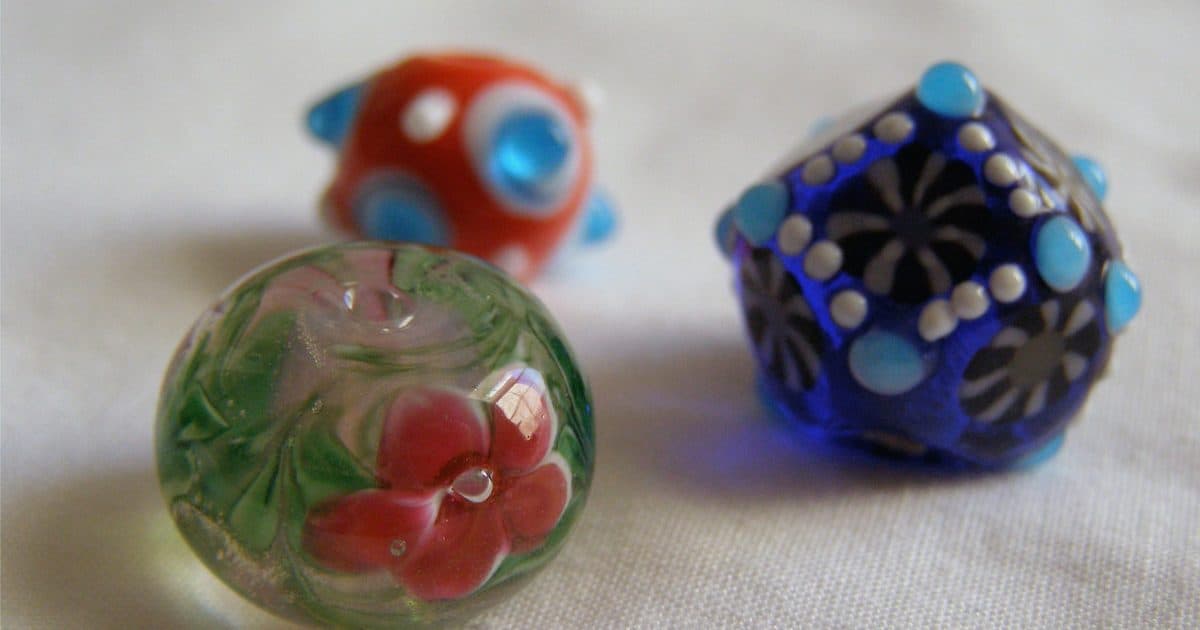
Murano glass is not a material. It is a place and a way of working. Sand and whatever makes it melt exist everywhere. What does not exist everywhere is a furnace burning on this particular island, a master at the blowpipe, an assistant handing over the glass at the right moment, and techniques passed down inside the workshop: murrine and millefiori, filigrana, sommerso, aventurine, beads worked at the lamp. A piece is Murano glass if it was born there, with those hands and those movements. Everything else, however pretty, is glass imitating a style.
The trouble is that a style copies well. A factory on the other side of the world can mass-produce a vase that, from a metre away, looks like one blown in the lagoon, and the Murano tag costs less than the vase. On the shelf, nothing declares where a piece was born. You work it out yourself, or trust whoever is selling it.
The clues you can check with your hands
None of these signs is conclusive on its own, but together they say a lot. Pick it up, turn it over, hold it against the light.
- The base. A piece blown on the pipe carries a pontil mark, the spot where the rod that held it was snapped off: rough, ground smooth or fire-polished. A piece poured into a mould has a flat, uniform base.
- Mould seams. A faint vertical seam running up the body is the trace of the two halves of an industrial mould. Free-blown glass does not have one.
- The right imperfections. A tiny bubble, a wall thicker on one side, a rim that is not a perfect circle: the signatures of handwork. Two identical pieces on the same shelf are the opposite signal.
- Murrine. In a genuine murrina the pattern runs through the full thickness of the glass, because it comes from a cane sliced and fused into the mass. Check the rim and base: if the motif continues there, it is inside the glass; if it sits on top, it was painted or printed on.
- Colour and gold. The colour is in the mass, not on top of it; gold or silver leaf is sealed between transparent layers, not applied to the outside. Run a fingernail over it: nothing should have any thickness.
- Weight and sound. A blown piece weighs what it looks like it should and, flicked with a nail, gives a full ring. The paper-thin glass of some imitations sounds hollow.
The mark, the label and the words that mean nothing
The clues above say handmade, not made in Murano: a well-made imitation can carry a pontil mark too. For provenance, the official tool is the collective trademark Vetro Artistico Murano, established by the Veneto Region and managed by the Promovetro consortium: a label with a code identifying the licensed furnace, certifying that the piece was made on the island. One limit: membership is voluntary, and some furnaces choose not to use it. Absence does not prove a fake; presence proves the piece is genuine.
Then there are the words, and here sellers are creative. Murano style, Venetian style, Murano design, Murano technique, inspired by Murano: each is an elegant way of saying the piece is not from Murano. A certificate printed by the shop itself is worth as much as the shop: without a furnace name and a person to ask, it is paper. Which furnace made this? Who is the master? Can I go and see it? People selling real glass answer without hesitation, often with pride. People who stall have already answered.
What no label can give you: watching it being born
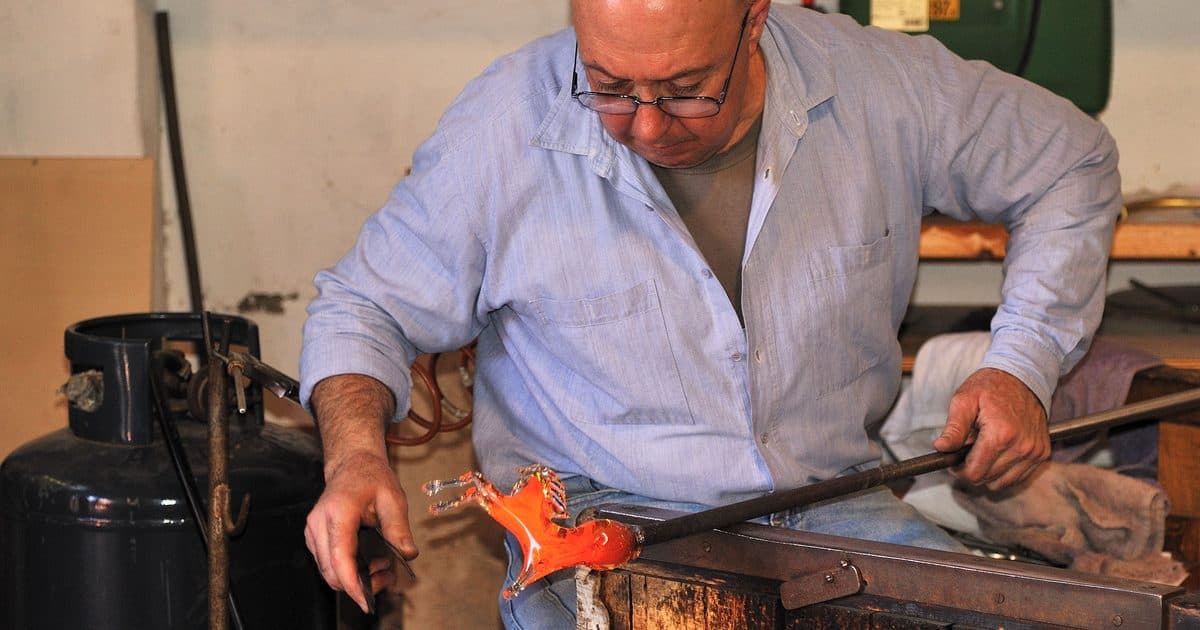
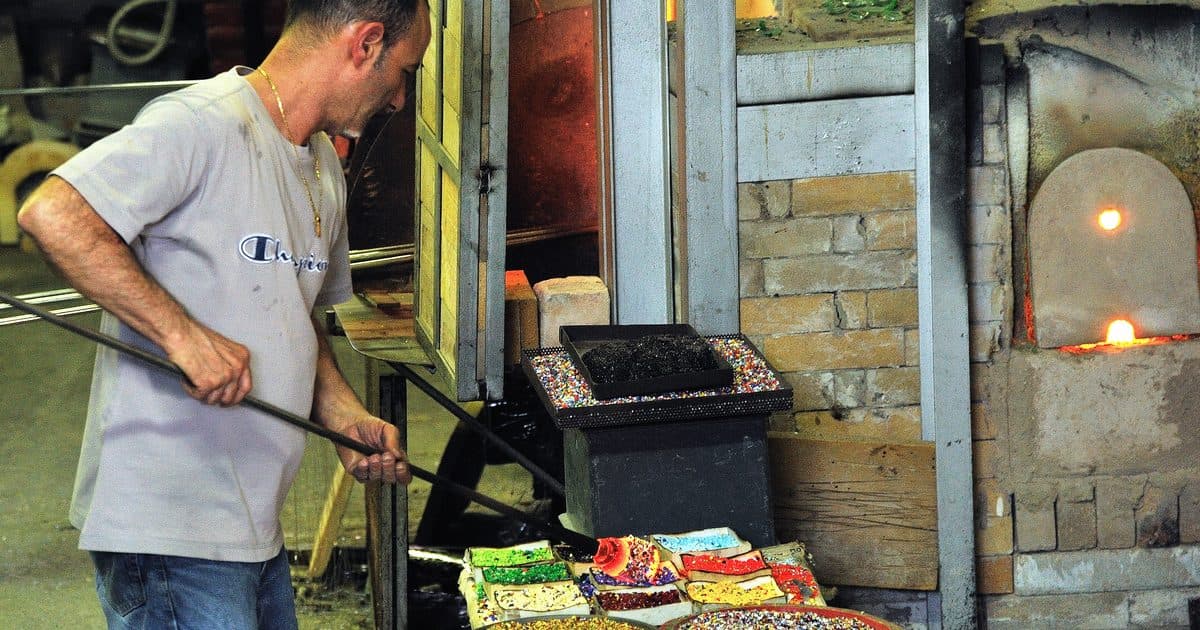
After all of this, a margin of doubt remains: you are judging a finished, cold object and reconstructing a story you did not witness. There is one way to close it, and it means turning the problem around: instead of buying finished glass, be there when it is made. A demonstration from behind a barrier is something, but you remain a spectator and the piece you buy at the exit goes back to being a piece you have to judge. A workshop lets you in as a participant: the master works with you, you see the crucible, the pipe gathering molten glass, the jacks, and the piece going into the annealing oven before it becomes yours.
At that point the authenticity question disappears, because the answer is in your own eyes. And if you shaped the piece yourself, with the master's hands guiding yours, the question of value disappears as well. That slightly crooked tumbler, that lampwork bead, that paperweight holding the colours you picked: they carry a story you can tell in full. No label competes with that. It holds for the other crafts of the lagoon: the real souvenir of Venice is the one you made, not the one you paid for.
To choose well, read the listing with a seller's questions. Where it takes place, and whether the furnace has a name. Whether you touch the glass or only watch. How many people the master follows at once, which in front of a furnace is also a safety matter. Whether you collect the piece the same day or after slow cooling, and how it reaches you. On Handsome, glass workshops are booked and paid online and the listing states all of this before you pay; the criteria are in the guide on how to choose the right workshop. If it is meant as a present, a gift card moves the gift from the object to the experience.
A label tells you where an object comes from. Watching it being made removes the need to ask.
Frequently asked questions
- How can I tell whether a Murano glass piece is authentic or an imported imitation?
- Look at the object, the label and the seller. On the object: a pontil mark on the base, no mould seams, small irregularities, murrine running through the full thickness, colour and gold leaf inside the glass. On the label: the collective Vetro Artistico Murano mark with the furnace code. On the seller: they should know which furnace and which master made it.
- Is the Vetro Artistico Murano mark compulsory? Is a piece without it fake?
- It is not compulsory. It is a collective trademark set up by the Veneto Region and run by the Promovetro consortium, and each furnace decides whether to join. A piece carrying the mark was made in Murano by a licensed company. A piece without it may come from a furnace that has not joined, or be an imitation.
- Can a complete beginner really make a glass piece in Murano?
- Yes, in a workshop designed for people who have never seen a furnace. You will not learn a trade in a few hours, but you will finish a small object with the master beside you: a tumbler, a small bowl, a paperweight, or a lampwork bead, which is made sitting at a torch.
- Do I take the piece home the same day?
- It depends on the technique. Blown glass has to cool slowly in a dedicated oven or it cracks, so it is often collected the next day or shipped, and the listing says which before you book. Lampwork beads and small pieces almost always go home with you.
Furnaces and studios that let you in as a participant: book and pay online, and take home a piece you watched being made.
See glass workshops in Murano and Venice