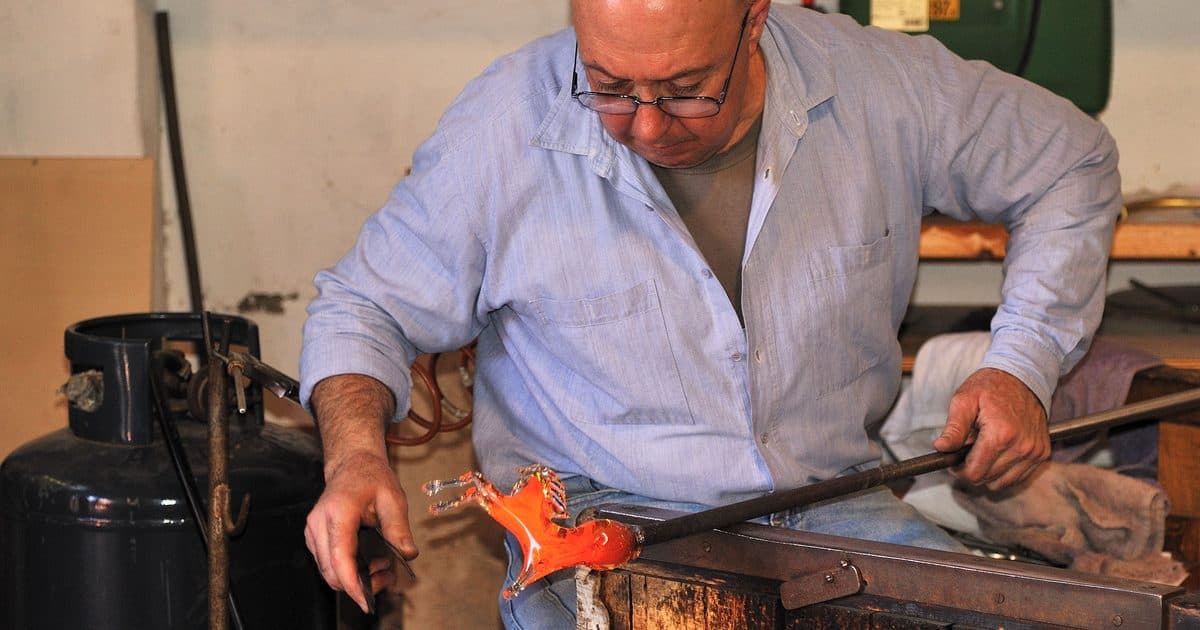
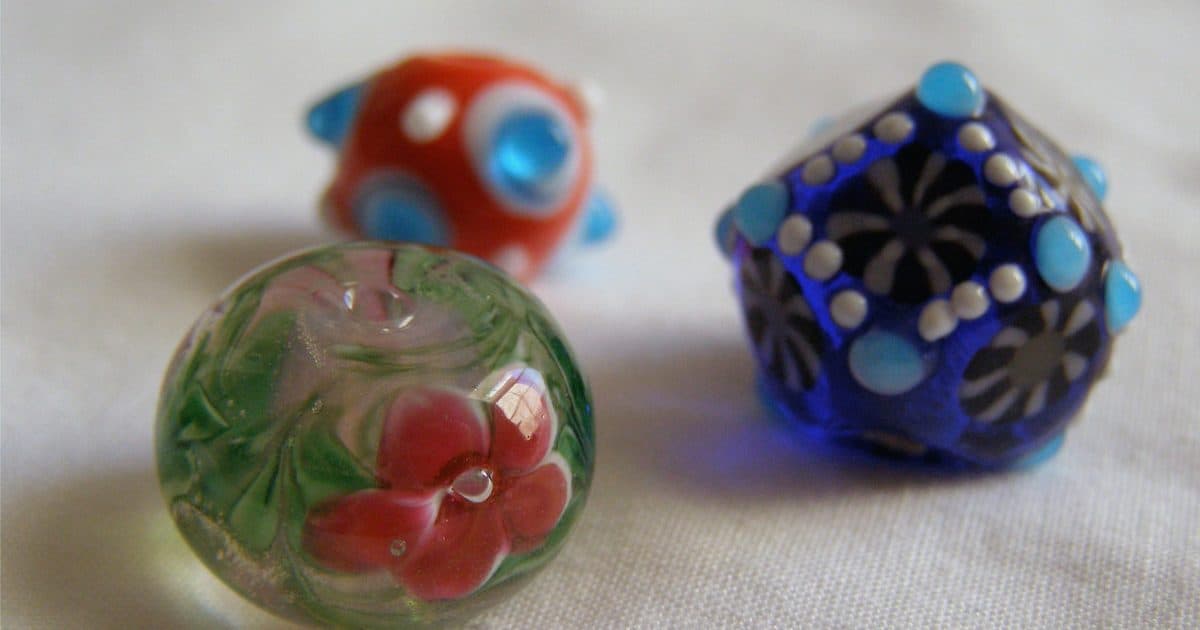
On a workbench there is a flame no wider than a finger and, beside it, a row of coloured glass rods. The teacher picks one up, holds its tip in the flame until it slumps into a glowing red drop, then winds it around a slowly turning steel wire. A moment later the glass is a bead. It is the simplest picture of Venetian glass, and the only one that someone who has never touched glass can reproduce with their own hands, start to finish, in the space of an afternoon.
Glass in Venice has a reputation that keeps people at arm’s length. The Murano furnace is a show you watch: the master, the long blowpipe, the assistant darting back and forth, the mouth of the furnace throwing heat at anyone who steps closer. As a visitor you may get one puff down the pipe and a photo to take home. Lampworking is the opposite road: small, quiet, the size of a bench and a chair. And it is the one that sends you home with an object you made yourself.
What lampwork actually is
The Italian name, lavorazione a lume, comes from the oil lamp once used to heat the glass; today the flame comes from a gas and oxygen torch, but the gesture is unchanged. You soften a rod of glass in the flame and wind it around a mandrel, a steel wire coated in a release paste so the bead slides off once cool. Thinner rods add dots, trails and spirals; gold and silver leaf and aventurine give the effects you see in shop windows. The Lampworking entry on Wikipedia is a good primer on tools and technique, and UNESCO has inscribed The art of glass beads on its list of intangible cultural heritage, separating a lume beads, made one at a time at the flame, from da canna beads, cut from a hollow cane and then threaded by the women Venice calls impiraresse. A workshop teaches the first kind.
Why lampwork is the right way in comes down to scale. Glassblowing needs a furnace that runs around the clock, a long pipe and an assistant who opens, closes, turns and holds: a beginner joins as a guest of a team. Kiln fusing is calmer, but it hands your piece to the kiln and gives it back when the firing is done, often after you have left town. A lampwork bead is small, made with one hand turning and the other feeding glass, at your own flame and your own bench.
What you really do in an afternoon
It starts with the rules, few and non-negotiable: where the hot end of the rod is, how to set it down, what you never touch. You are handed glasses with lenses that filter the yellow sodium glare, without which you would see nothing inside the flame. Then the teacher makes a bead in front of you, slowly, and it is your turn. The first one comes out lopsided, almost always: the glass sags to one side because you stopped turning, or it snaps with a small crack because you brought it into the flame too fast. From the second bead on, your hand finds the rhythm, and the rhythm is everything.
- The plain bead: wind, keep turning, and let heat and gravity pull it round.
- The shape: a graphite paddle presses it flat or stretches it into a cylinder or a lens.
- The decoration: dots of colour, trails wound into spirals, a pinch of silver leaf.
- The cooling: beads go into a small annealing kiln or a blanket of fibre and vermiculite, because glass that cools too quickly cracks.
- The finish: beads come off the mandrel, holes are cleaned, and where it is included they are strung on a cord or fitted to earring findings.
Cooling is the only step the glass does without you, and it is why some studios hand the beads over at the end of the afternoon while others have them ready the next day or post them. If you are in Venice for a few days, it is the first line to look for in the listing. If it is not there, ask before you book.
How to choose a class in Venice
The single most important difference is how many people share one flame. A torch each means you make every bead yourself; a shared torch means you take turns and spend part of the time watching. The listing has to say which it is, and the price should reflect it. The second thing to check is group size: at the flame the teacher needs to be behind every pair of hands, and a full table shrinks the share of attention that reaches you.
The price of a lampwork class moves for reasons you can read and compare: the length of the session, the number of people per torch, whether the glass is the soft Venetian type or a generic one, whether gold and silver leaf are included, whether the beads are kiln-annealed and set into jewellery, whether teaching happens in English, and whether it is private or group. Two listings with the same title can be very different experiences, and the rule from how to choose the right workshop applies: compare like with like, not the figure at the bottom.
Murano or the back streets: where it happens
The idea that glass lives only on Murano is true of the furnace and false of the flame. A torch does not need an industrial furnace, which is why bead makers keep their benches inside Venice itself, in studios opening onto a courtyard or a canal-side fondamenta in Cannaregio, Castello or Dorsoduro. A class in the city saves you the vaporetto and puts you in a quieter sestiere; Murano lets you pair the lesson with the Glass Museum. If you are after other Venetian crafts beyond glass, our guide to the hidden crafts of the lagoon lines up masks, gilding and textiles.
Glass will not be forced. It asks you to keep turning, always at the same speed, and to wait. That is the one lesson that holds for every bead, from the first to the last.
Frequently asked questions
- Do I need any experience to make lampwork glass beads?
- No. A lampwork class is built for people who have never worked glass: the teacher demonstrates the gesture, checks your hand position and stays close to the flame. The first beads come out uneven, and that is expected. All that is asked is that you sit still, pay attention and keep the mandrel turning steadily.
- What is the difference between a lampwork class and a furnace visit on Murano?
- At the furnace you watch a master and his team blow glass and, at most, try one puff down the pipe. At the torch you make the bead yourself, from rod to finished object, at your own bench with your own flame. The furnace is a spectacle; lampwork is a hands-on experience you complete on your own.
- Do I take the beads home the same day?
- It depends on how the studio handles cooling. Beads placed in a fibre blanket are usually collected at the end of the session; beads that go through an annealing kiln may be ready the next day or be posted to you. The listing says what you take away and when.
- Is it suitable for children?
- The flame and hot glass call for attention and steady hands, so most studios welcome adults and accompanied teenagers rather than young children. Each listing states the minimum age set by the teacher.
- Can I give the class as a gift to someone travelling to Venice?
- Yes. A Handsome gift card covers the whole experience and leaves the date to the person receiving it, which is the hardest thing to guess on someone else’s behalf. Refund terms for when plans change are set out on the cancellations page.
Look for Venice among the cities: every listing says how many people per flame, what is included and when you collect your beads. Book and pay online.
See glass workshops in Venice