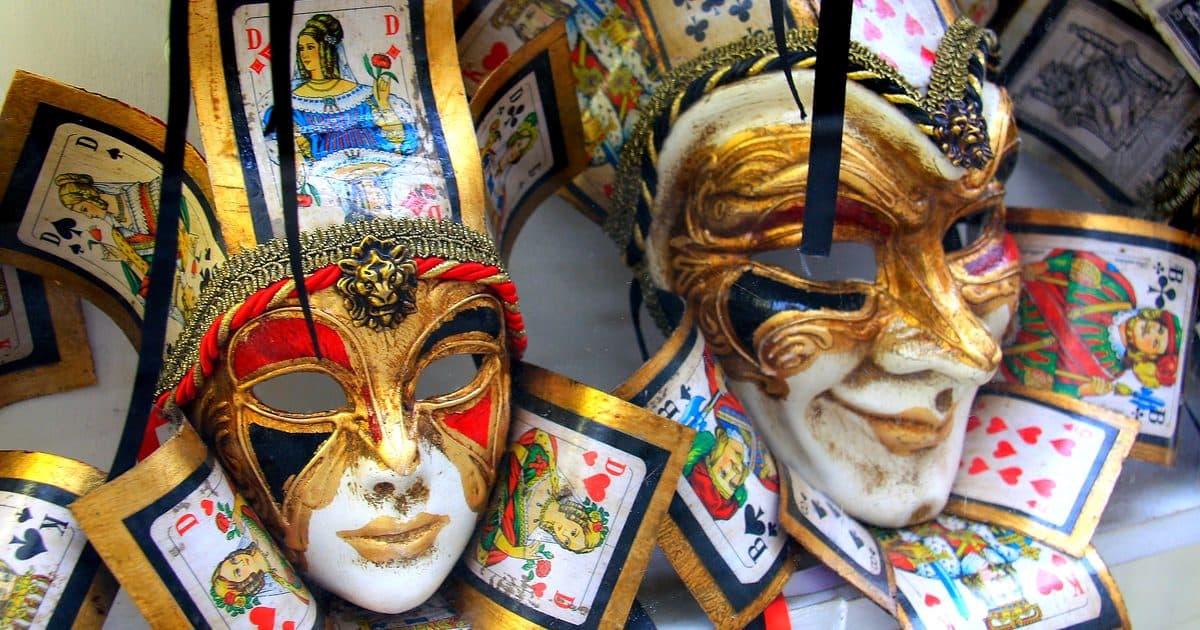
Between Rialto and St Mark's the mask is everywhere: glossy, gilded, feathered, lined up in rows of identical twins on every stall. It is cheap, it fits in a suitcase, and more often than not it was never made in Venice: it came out of an industrial mould, in plastic or resin, and was decorated on a production line far from the lagoon. A real Venetian mask is a different object: hand-torn paper, glue, gesso, a brush, and the slight asymmetry no machine can copy. And you can make one yourself.
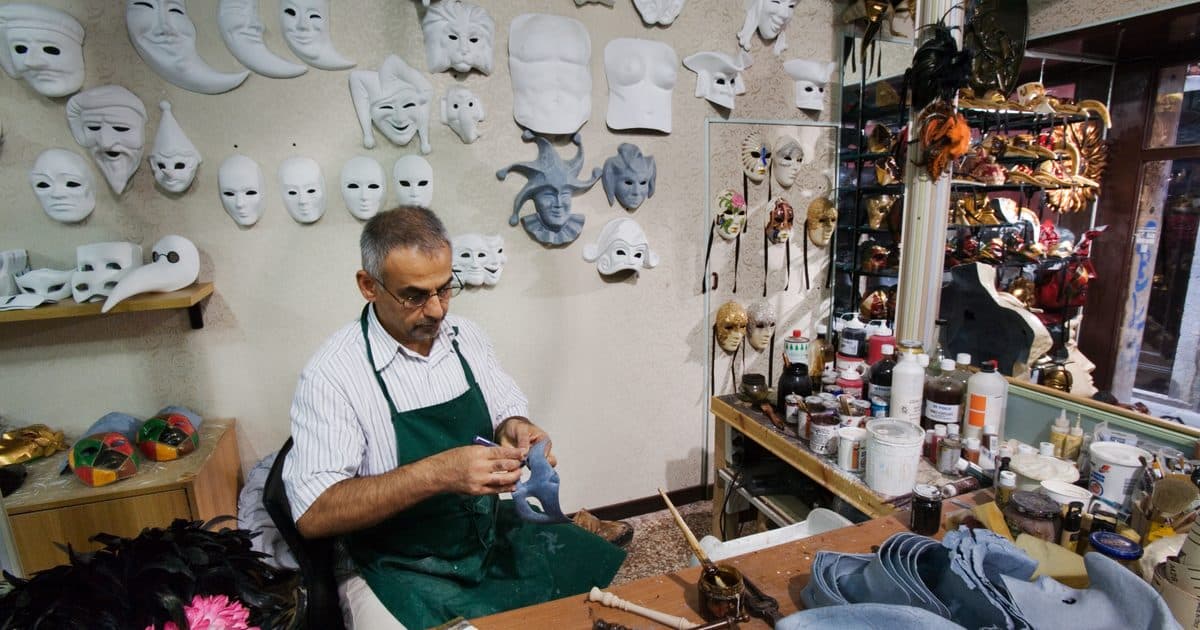
Where? In a Venetian mask-maker's workshop that, alongside its own production, opens the bench to visitors for a few hours. You work on a real mould, with the studio's materials, guided by someone who makes masks all year round, and you leave with the one you made. On Handsome the Makers publish their dates, you book and pay online, and your seat is confirmed before you travel: browse the available experiences.
How to tell a moulded mask from papier-mâché
It is worth learning the difference, because it changes how you look at every shop window afterwards. Papier-mâché is paper laid in layers and glued over a form: once dry it is rigid and light, but still paper. Turn the mask over. The back of a papier-mâché mask shows the fibre, the creases where the paper followed the curve of the nose, sometimes the maker's signature. The back of a moulded mask is as smooth as the inside of a plastic cup.
- The edge: trimmed by hand, slightly different from one side to the other; on a moulded mask it is clean, symmetrical, often with the seam of the mould still showing.
- Weight and sound: papier-mâché is light and gives a dull note when tapped with a fingernail; plastic feels colder and rings.
- The twins: if the stall has many that match down to the last brushstroke, they were sprayed or stencilled. Hand-painted masks are never identical.
- The smell: fresh papier-mâché smells of glue and paper; resin smells of varnish.
What happens in the workshop, step by step
The part that surprises most people is that a mask begins as a sculpture. The mask-maker models a face in clay, casts it in plaster, and that plaster becomes the form on which every later mask is built. A studio's moulds are its inheritance, and none of them ever leave the building. In a workshop you see them lined up on the shelves and pick one.
- The paper. Torn by hand, never cut: a frayed edge blends into the next layer far better than a straight one. Each piece is soaked in glue and pressed onto the mould, following the curves with your fingertips.
- The layers. They go on crosswise, alternating the direction of the paper, until the mask has a body. It is the slowest stage, and the one where you understand why no papier-mâché mask matches another.
- Drying. The mask has to dry on the mould before it can be lifted off. This is the time that cannot be compressed.
- Trimming. Off the form, the edges are cut, the eyes opened, the surface sanded: this is where it takes on its final profile.
- The ground. A few coats of gesso or white primer prepare the surface; without them the colour would soak in unevenly.
- Decoration. Acrylics, gold or silver leaf, fabric, crystals, feathers, lace, and a final wax polish. This is where the mask becomes yours.
The shapes on offer mostly descend from Carnival and the commedia dell'arte, and the main Venetian mask types are easy to recognise once you know them. The bauta covers the whole face, with a jutting chin that lets you eat and drink without taking it off. The moretta is oval, black and mouthless. The volto is smooth and neutral, ideal if you want to paint; the Colombina covers only eyes and cheekbones and is the most comfortable to wear; then come the characters, from Pantalone's long nose to the plague doctor's beak. Decide beforehand what the mask is for: one made for a wall can be as baroque as you like, one made to wear has to let you breathe.
How long it takes and what you take home
Wet papier-mâché works fast and so does decorating; what stretches the timetable is the drying between stages. That is why there are different formats. In the shorter one, a morning or an afternoon, the white base is already dry, prepared by the mask-maker on their own mould in the days before: you finish it, decorate it and carry it out at the end, because acrylics dry quickly. In the longer one, or one split across more than one visit, you build it yourself from the first layer of paper and come back to decorate it once dry. Both are honest formats; what matters is that the listing says which one you are booking. For the journey home ask for a rigid box; on the wall it lives happily away from radiators and direct sun, which fades the gold and yellows the white.
Choosing the workshop, and what moves the price
The first test is who teaches: someone who makes and sells masks for a living, not an entertainer with a kit. You can tell from the plaster moulds on the shelves, the half-finished masks on the benches, and listings that talk about paper and glue rather than "fun". The second is group size: decorating copes with a busy table, the wet-paper stage needs the teacher's hands close to yours. The third is language: if you do not speak Italian, the listing says which languages the session runs in. The full reasoning is in our guide on how to choose the right workshop.
On price, it is more useful to know what drives it than to compare figures blind. The shape matters (a full bauta takes more paper and more work than a Colombina), so do the materials (real gold leaf does not cost the same as gold acrylic), the length of the session, how many people the mask-maker follows at once, and whether the base is prepared for you. Timing works differently: in the weeks around Carnival the studios are buried in orders and places become scarce; in the quiet months the workshop is more available and the city easier to live in. If Venice tempts you beyond masks, our overview of the lagoon's other crafts helps build the rest of the trip. It also works as a gift, precisely because the object is made by the person receiving it: a Handsome gift card covers the whole experience and leaves the date open.
A mask you bought resembles you by accident. A mask you made resembles you by necessity: your fingerprints are under the paint.
Frequently asked questions
- Where can I make and decorate a Venetian papier-mâché mask with my own hands?
- In the workshops of Venetian mask-makers who open their bench to the public for a session. You work on a real mould, with the studio's materials and the guidance of someone who makes masks for a living. On Handsome the Makers publish their dates, you book and pay online, and your seat is confirmed before you travel.
- Do I need to be able to draw or paint?
- No. Laying a ground, filling a colour, applying leaf: you learn it on the spot, and the teacher corrects your hand as you go. The result depends more on your choices than on any talent.
- How long does a Venetian mask workshop last?
- It depends on the format. If you decorate a dry base prepared by the mask-maker, a morning or an afternoon is enough. If you want to build it yourself from the first layer of paper you need more time or a second visit, because papier-mâché has to dry on the mould before it can be trimmed.
- Do I take the mask home the same day?
- In the short format, yes: acrylics dry fast and the final polish is done on site. With gold leaf or glued fabric it may want a few more hours. The listing says whether you leave with the mask or collect it later, and the cancellation terms are on the cancellations page.
- Is it suitable for children and families?
- The decorating stage is, and it is often the part children enjoy most. The wet-paper-and-glue stage needs patience and careful hands: check the minimum age the Maker has set in the listing.
Dates published by the Makers are booked and paid online: your seat is confirmed before you travel.
Find a mask workshop in Venice