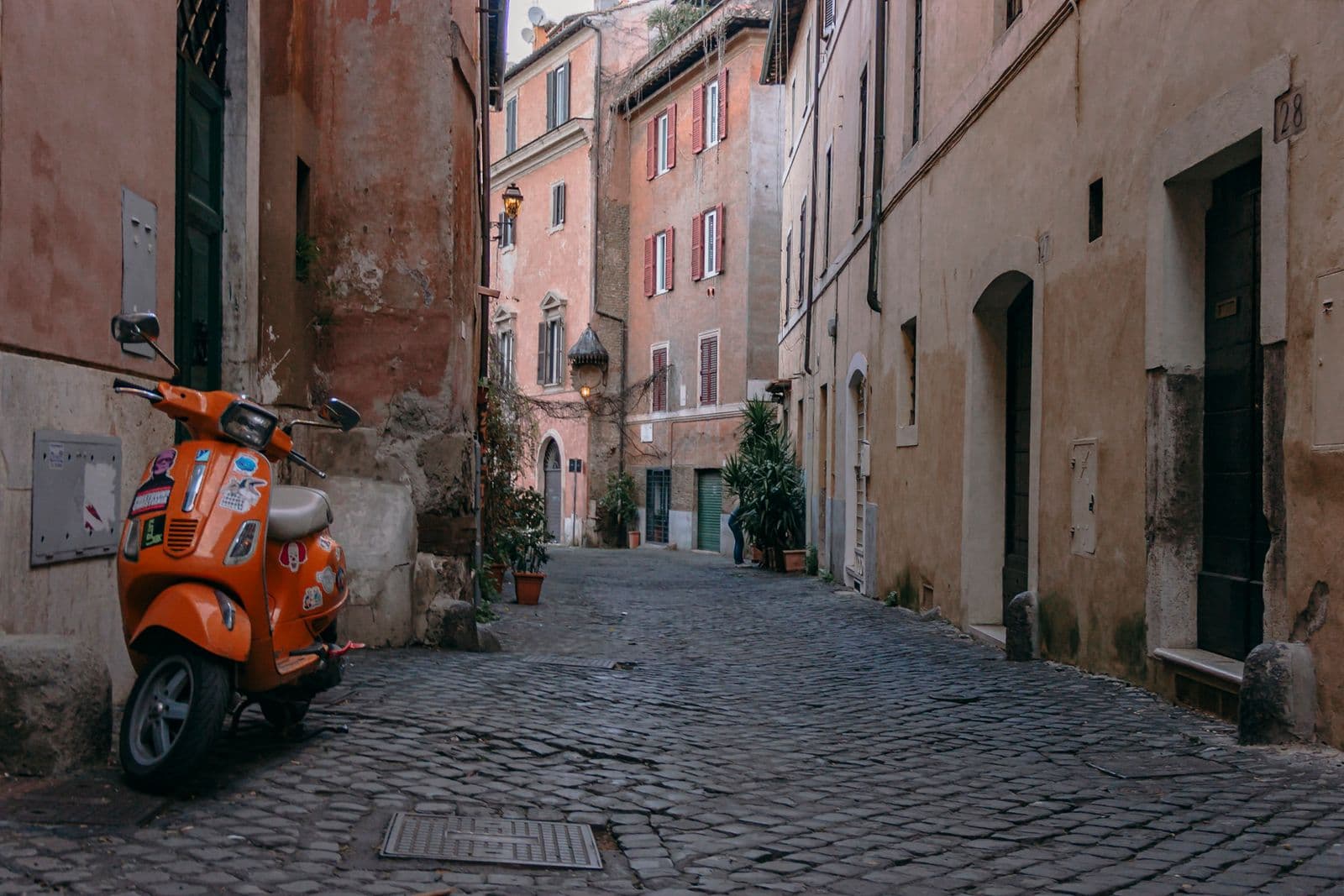
Trastevere, Monti and Pigneto get described as Rome's three craft districts. It is a convenient line and by now an expired one: none of the three works the way it did thirty years ago, and the change is not a hunch picked up in a bar — it is documented by laws, demolitions and figures. This is not a list of workshops to visit: it is the story of what happened, district by district, and of what is genuinely left to see.
The backdrop sits in two figures moving in opposite directions. According to an analysis by the CGIA di Mestre research office based on INPS data, active craft businesses in Lazio went from 113,943 in 2015 to 86,262 in 2024: 27,681 fewer, down 24.3%. The city of Rome alone, in a twelve-month reading, dropped from 61,374 to 58,034 craft shops, 3,340 fewer (-5.4%). While craft was retreating, tourism did the opposite: 2025 was Rome's record year, with 22.9 million arrivals and 52.92 million overnight stays, up 3.42% and 2.87% on the year before, according to figures from the Ente Bilaterale del Turismo del Lazio.
Trastevere: from a district that made things to one that hosts them
Before it was a place where you had dinner, Trastevere was a place where you unloaded cargo: the river port of Ripa Grande sustained for centuries an economy of boatmen, millers, fishermen and market gardeners. The proof is not an anecdote but a building: the church of Santa Maria dell'Orto, completed in 1567, was built and decorated with money from the "università", the district's guilds of arts and trades, thirteen of them according to the reconstructions. The confraternity born out of those guilds still exists and looks after the church.
The first break came when Rome became the capital: the Tiber embankments, built in the late nineteenth century, erased the river landscape and the trades attached to it. To see what it looked like there is one precise address. The Museo di Roma in Trastevere, in piazza Sant'Egidio, holds the 120 watercolours — roughly 53 by 75 centimetres, in three series of forty, painted between 1878 and 1896 — with which Ettore Roesler Franz documented the "Roma sparita", the Rome that vanished. They are fragile and shown in rotation: the district you see today is already its own second version.
The second break is measured in residents. The Trastevere statistical zone counted 16,111 inhabitants in December 2001 and 13,648 in December 2019, down 15.3%, with an average age of 47; a report published by the City of Rome in September 2020, using different boundaries, records a 35.8% fall in the historic centre and a 43.1% fall in Trastevere between 2014 and 2019. What matters is the direction: when a ground-floor unit yields more as short-stay accommodation than as a workshop, the joinery does not close because the joiner is tired, but because the square metre changed trade.
And yet the hardest craft in Rome is still taught here, without a shopfront. The Istituto Centrale per il Restauro, established by law no. 1240 of 22 July 1939 at the prompting of Giulio Carlo Argan and Cesare Brandi and inaugurated in 1941, is housed in the complex of San Michele a Ripa Grande; its Scuola di Alta Formazione e Studio awards a single-cycle master's degree qualifying graduates to practise as conservator-restorers of cultural heritage. Craft here is not finished: it moved from the street to the classroom.
Monti: the district cut through twice
Monti is rione I in Rome's numbering of its districts and covers about 1.65 square kilometres. Its ancient core is the Suburra, the working-class area between the Viminal, the Esquiline and the slopes of the Quirinal: in antiquity extremely dense, made of insulae with shops below and homes above. Via in Selci follows the line of the clivus Suburanus: anyone looking for the Suburra as a physical place finds that gradient, not a plaque.
Then the district was cut. First by the post-unification arteries: via Nazionale, established on 30 November 1871, and via Cavour, opened in the late nineteenth century to link the Esquiline to piazza Venezia across the valley of the Suburra. Then between 1924 and 1936, when a large portion of the lower district was demolished to open via dell'Impero — today via dei Fori Imperiali — and excavate the Fora. The result is visible on foot: a medieval street grid in the middle of the centre, isolated on three sides by through roads.
One misunderstanding needs clearing up. Monti gets presented as "the district of the trades" because Rome has streets named after trades, but those streets are not in Monti: via dei Cappellari, via dei Giubbonari, via dei Baullari and via dei Chiavari are around Campo de' Fiori, across the rioni Parione, Regola and Sant'Eustachio. Here the trace of craft is in the size of the units: narrow entrances, low ceilings, spaces a few metres deep, built to work in rather than to display in.
Today those same units hold vintage clothing, independent fashion, small design objects and resold ceramics; at weekends there is Mercato Monti, an urban market started in 2009 in via Leonina (worth checking venue and opening times before you go). It is a lively scene and worth the walk, but the verb changes: here craft is mostly bought, not watched being made.
Pigneto: the only one of the three born after the factory
Pigneto has no medieval past to defend. It takes its name from a row of pines on an aristocratic estate and until around 1870 it was countryside; urbanisation arrived with industrial plants and workshops, and the building boom concentrated between 1920 and 1935. Between 1921 and 1924 the railway workers' cooperatives built around 250 dwellings near piazza Copernico and piazza Tolomeo, two-storey semi-detached houses with small gardens on the garden-city model. Many were destroyed by wartime bombing, others demolished afterwards for public housing blocks.
Out of that combination — low houses, working people, no monuments — came the Pigneto of cinema. Pina's run, that is Anna Magnani, in Roberto Rossellini's Rome, Open City (1945) was filmed in via Raimondo Montecuccoli, on the edge of the district. Sixteen years later Pasolini shot Accattone (1961) around via Fanfulla da Lodi, using bar Necci — opened in 1924 by Enrico Necci as a dairy shop, and only later an ice-cream parlour — as a base. The district became the set of neorealism because it was poor and photogenic: two things that no longer go together.
The recent transformation has a precise date: 29 June 2015, when the Pigneto station on metro line C opened along with the stretch from Parco di Centocelle to Lodi, six new stations at once. From then on Pigneto stopped being "far away". The pedestrian stretch of via del Pigneto, with its morning market from Monday to Saturday, is still the part that feels like a small town; around it, bars have multiplied far faster than workshops.
In craft terms Pigneto has the opposite problem to Trastevere: no continuity to lose. Three generations ago the district's manual skill sat in the railway yards and the machine shops, not in a shop window. What opens today is newly founded craft: units less prohibitive than in the centre and a local clientele, but no inherited network of suppliers and no handover of a family workshop.
Where the work went
Across the three cases you see the same mechanism at different stages. The street-level unit has become too expensive for an activity that produces little and slowly. The shop window, once the sales channel, has been replaced by markets, fairs, commissioned work and online sales: the workshop can sit on a second floor, in a shed outside the ring road, or in a room at home. Protection laws reward those who survived; they do not manufacture new artisans.
The practical consequence, for anyone walking, is that hunting for shop signs is no longer enough. Better to learn to recognise the little that is there.
- Look at the back, not the window. In a real workshop the working space is bigger than the display space.
- Look for the right kind of dust: shavings, dried clay, leather offcuts, colour stains on the floor.
- Read the sign. If it names the trade — bookbinding, goldsmith, upholstery, restoration — more than the brand, that is a clue.
- Check the hours. People who produce open early and close in the afternoon; those selling to tourists open late.
- Compare two identical pieces. If they match to the millimetre, they were not made by hand in there.
- Ask "do you make it here?". Whoever produces will show you the bench, whoever resells changes the subject.
A sensible day across the three districts
The three districts do not work well on the same day. They work well if you ask each one for a single thing, at the hour when that thing exists.
- Morning in Monti: via in Selci and the streets above via Cavour, for the scale of the units and the gradient of the Suburra. Metro B, Cavour stop.
- Early afternoon in Trastevere: piazza Sant'Egidio for the watercolours, via Anicia for Santa Maria dell'Orto, then San Michele a Ripa Grande. On a Sunday, Porta Portese first of all.
- Evening in Pigneto: via Raimondo Montecuccoli, via Fanfulla da Lodi and the pedestrian stretch. Metro C, Pigneto stop; for the market, though, come back in the morning.
And the craft workshops? The honest answer
Handsome is a marketplace of craft workshops, so the question comes up: where do you book a class in these three districts? The honest answer is that we do not yet have a single Maker signed up in Rome. The city page exists and fills itself in as soon as somebody publishes a date: for now it is nearly empty, and we would rather say so than pad it with promises. When a Roman Maker opens bookings, the price you see is the final one, everything included.
The Roman listing is just starting: only genuinely open dates are shown.
See the Rome page on HandsomeIn the meantime, the most effective way to look at the Rome that still makes things is the one described above: go in, ask, buy something small. The workshops that are left do not need better storytelling: they need customers on a Tuesday morning.
Frequently asked questions
- Is Trastevere still a craft district?
- Partly, and not in the way it is sold. Residents of the statistical zone fell from 16,111 in 2001 to 13,648 in 2019, and the pressure on ground-floor units has pushed most production out. What remains are the documented roots, such as Santa Maria dell'Orto, and the institutions: the Istituto Centrale per il Restauro is based at San Michele a Ripa Grande.
- Why does Monti have more vintage shops than workshops?
- Because the units in Monti are small, central and much in demand: perfect for selling, uneconomic for producing. The district, cut through by via Nazionale and via Cavour and amputated in its lower part between 1924 and 1936, was left with a dense street grid in the middle of the centre.
- How do I know whether a shop is genuinely historic?
- The Lazio Region recognises historic businesses under regional law no. 1 of 10 February 2022, based on registers compiled by the municipalities: at least seventy documented years for historic premises, fifty for art workshops. Asking whether the business is on the register is the quickest route.
- Can I book a craft workshop in Rome on Handsome?
- Not yet: there is currently no Roman Maker signed up to the platform. The Rome page stays online because it populates as soon as somebody publishes a date. If you are looking for an experience soon, look at the cities where the listing is already active.
Filter by city and by date.
Browse the available workshops