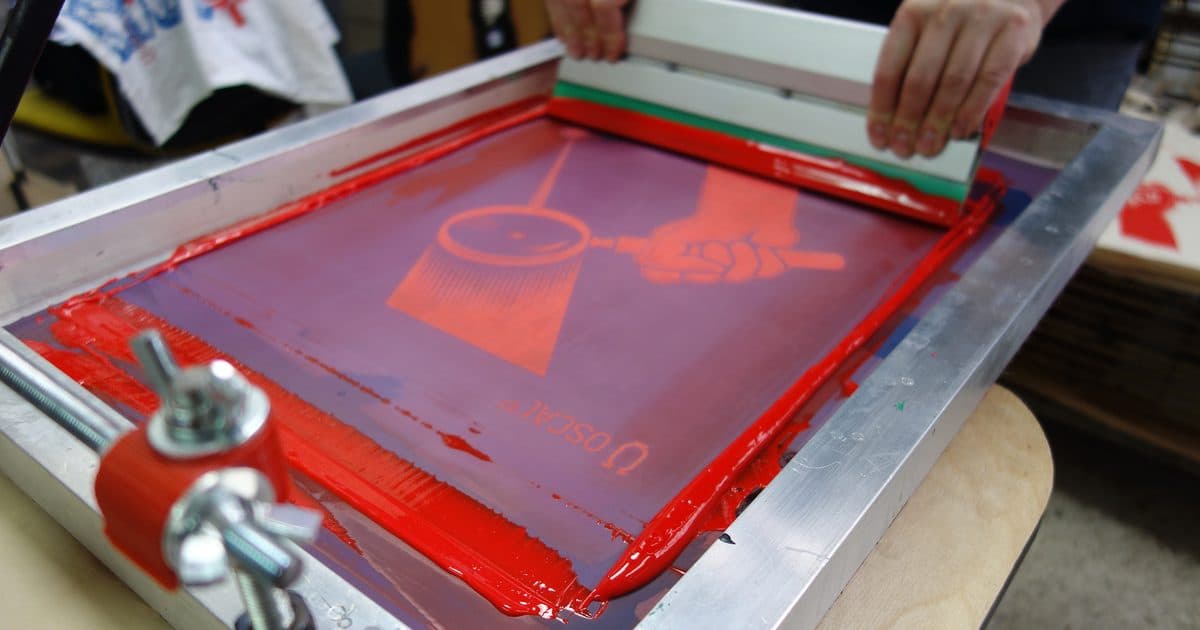
The gig poster with flat, saturated colour and crisp edges, the t-shirt from a small independent label, the tote bag from last summer’s festival: that is almost always screen printing, and almost always somebody made it by hand, on a table, with a tool that looks like a window squeegee. Turin has a long-standing relationship with print and graphic design, and plenty of studios let complete beginners have a go. The trouble is that course descriptions throw around words like screen, emulsion and squeegee as if everyone knew them. This article explains them before you book.
Screen printing is a stencil technique. Ink is pushed through a very fine mesh stretched over a frame, and only gets through where the mesh has been left open; everywhere else is sealed. The image comes out identical every time you repeat the stroke, which is why it works for a single t-shirt and for a run of posters. You will meet a handful of objects — the screen, the emulsion, the squeegee — and each one answers a different question: where the ink passes, how you decide where it passes, and how you push it through.
The screen: a frame with a very tight mesh
The screen is a wooden or aluminium frame with a synthetic fabric stretched drum-tight across it. The weave is so fine that to the naked eye it looks solid; in fact it is a grid of tiny holes, and printing works by blocking some of them and leaving the rest open. If you have ever sprayed lettering through a cardboard stencil you already have the idea. The difference is that here the stencil needs no bridges to hold the middle of an O in place, because the mesh itself supports every part of the design. In a class the screen is supplied by the studio, already stretched and cleaned; making one from scratch is a separate job.
Emulsion: letting light do the work
So how do you decide which holes stay open? With emulsion, a light-sensitive coating spread over the mesh in dim light and left to dry. Meanwhile your design is printed in solid black on a transparent film, or drawn straight onto it with an opaque marker. Film and screen go under a lamp: wherever light lands, the emulsion hardens and seals the mesh; wherever the black of your design blocks it, the emulsion stays soft and rinses away under a jet of water. Once the screen is dry, your drawing has become an open passage through the mesh and everything around it is closed.
An afternoon squeezes this stage. Emulsion needs hours to dry, so the person running the class turns up with screens already coated, leaving you the interesting part: drawing, exposing and washing out. A good class explains the whole thing anyway: that is where you understand why the black on the film has to be truly black and why a hairline vanishes.
The squeegee: the stroke that prints
The squeegee is a rubber blade on a handle. Ink is poured along the top edge of the screen, which sits on the t-shirt or the sheet of paper. With the squeegee you first sweep the ink across the design lightly, filling the open mesh without pushing through, then pull a firm stroke, angled and with steady pressure, that forces the ink through the mesh onto whatever is underneath. Lift the screen and there is your print. The motion comes in minutes; what takes practice is keeping angle, pressure and speed constant, because that is what makes every copy match the one before. Everyone’s first print comes out a little pale or a little smudged. The ones after it improve fast.
T-shirts and posters ask for different care. On fabric you use water-based inks made for cotton, which have to be heat-set after printing, with an iron or a heat press, or washing takes them away; in a studio this is done before you leave. On paper the ink air-dries on a rack and the poster goes home as soon as it is ready. If the class includes a second colour you meet registration: lining the second pass up with the first, which explains on its own why a multi-colour print costs more.
What you actually take home
- The t-shirts, tote bags or posters you printed yourself. One screen yields many copies, and in a class it is normal to leave with more than one.
- The film with your design, if you made it: the reusable part, with which a studio can reprint your artwork later.
- The ability to read a print: from that afternoon on you will recognise screen printing by the weight of the ink and the edge of the image.
- Not the screen. It stays in the studio, where the emulsion will be stripped to take the next design: it is the teacher’s working tool, not a consumable.
Choosing a screen printing class in Turin
Classes with the same title are not the same experience. Look for these things in the description, or ask before paying: whether you bring your own design or print artwork prepared by the studio; whether you print a single colour or several; whether the garment is included or you bring one; how many people work at once, because exposing and washing out take a fixed time and a big group queues; and whether heat-setting is done on the spot. Those are also the things that move the price, along with duration and how many pieces you take away. On Handsome, workshops are published by people who print for a living, with the terms written down before you pay, and the guide on how to choose the right workshop applies here too. If the afternoon is a present for someone who draws, a gift card lets them pick the date. Turin itself is easy by tram and by bike: an afternoon in a print studio slots between a market and an evening out.
Printing by hand means accepting that each copy is almost the same as the one before. That almost is the difference between a poster and a print.
Frequently asked questions
- How does a beginner screen printing class work?
- You start from a design, transferred in solid black onto a transparent film and laid on a screen already coated with light-sensitive emulsion. Under the lamp the emulsion hardens everywhere except where the black shields it: there it washes out with water and your design stays open. Then you pull ink through with a squeegee onto a t-shirt or a sheet of paper, lift the screen, and the print is done. The only step the teacher prepares in advance is coating the screen, which needs hours to dry.
- What do you take home from a screen printing class?
- The t-shirts, tote bags or posters you printed, usually more than one. If you prepared the film with your design, that too. The screen stays in the studio, where it is cleaned and reused.
- Do I need to be able to draw?
- No. Many studios provide ready-made artwork, and anyone who wants to bring their own can work with simple shapes, lettering or a logo. Screen printing likes hard contrast and solid forms.
- Can I bring my own t-shirts, and will the print survive washing?
- It depends on the class, and the description will say. Where it is allowed, light-coloured cotton works best: the water-based inks used with beginners are translucent and barely show on dark fabric. The print lasts if the ink was heat-set before the first wash; after that, wash the garment inside out and at a low temperature.
- How long does it take and what should I wear?
- An afternoon: explanation, screen preparation and printing. Wear something that can get stained: the ink comes off your hands with water, off fabric much less so. Cancellation rules are the same for every workshop and are on the cancellations page.
Dates published by people who actually print, with materials and terms spelled out before you pay. Book and pay online.
Find screen printing workshops in Turin