Turin's relationship with chocolate lives in gestures more than in shop windows: the steaming cup in a café under the arcades, the spatula slicing a still-warm paste, the gold foil folded with two fingers. The gianduiotto, the city's hazelnut chocolate, is all of that in a single bite, and you don't need to be a pastry chef to make one. Workshops around the city teach you, in an afternoon, to temper chocolate, work hazelnut paste and hand-cut the upturned-boat shape you would recognise with your eyes closed. This guide answers two questions that travel together: where in Turin you can do a chocolate workshop, and what you actually learn. First, though, why this particular chocolate was born here, because that is also what the workshop is about.
Why the gianduiotto was born in Turin
The story the city tells begins with a shortage. In the Napoleonic era the Continental System cut the European mainland off from British trade, and goods arriving from the colonies became scarce and ruinously expensive. Cocoa was one of them. Turin was already a city that worked chocolate, and demand didn't stop by decree. So its chocolate makers did what craftspeople do when the raw material runs out: they looked nearby. On the hills of the Langhe and Roero grew a round, sweet hazelnut so rich in oil that, roasted and ground for long enough, it turns into a cream on its own. Blended with what little cocoa was available, it stretched the chocolate without cheapening it, and a new paste was born, softer and more fragrant: gianduja. Historians argue over the details, and the encyclopaedia entry on the gianduiotto reports them with caution, but the core holds: a chocolate that exists because a city replaced what it lacked with what it had.
The name comes from Gianduja, the Piedmontese carnival mask, and the shape comes from hands. Gianduja paste holds so much hazelnut that, freshly made, it's too soft to be poured into moulds like an ordinary chocolate. For a long time gianduiotti were made by taking a knob of paste and slicing it with a spatula, one stroke after another. That cut leaves the trapezoid section and the two sloping sides everyone knows. It's the trace of the gesture, not decoration. And it's precisely the gesture a workshop puts in your hands.
What you actually learn in a gianduiotto workshop
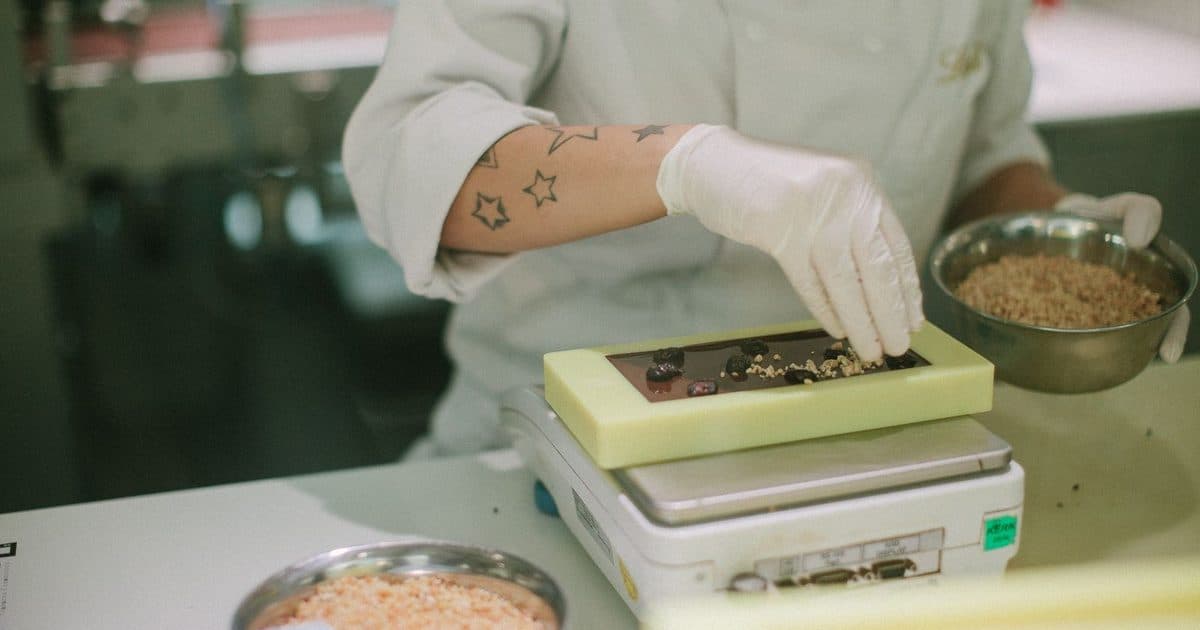
A well-built workshop follows the order of the material, not the order of the show. The steps vary slightly from one lab to another, but the sequence is this:
- The hazelnut. You start with the roasted nut, learn to judge it by its smell, and understand why the Piedmont hazelnut, which carries its own protected geographical indication, takes roasting better and releases more oil.
- Gianduja paste. Hazelnuts ground down to a cream, blended with cocoa, cocoa butter and sugar. This is where your fingers learn how much the ratio changes the result: more hazelnut, more softness; more cocoa, more firmness.
- Tempering. The technical heart of it, the thing that separates a glossy chocolate that snaps cleanly from a dull, streaky one. You bring the mass to a precise temperature, cool it by working it on marble, then raise it again slightly. Your teacher will have you feel the change on the back of your hand.
- Cutting or shaping. By hand with the spatula, the old way, or with a piping bag or a mould. The hand cut is the hardest step and the most satisfying.
- Wrapping. Folding metallic foil around a chocolate that mustn't warm up between your fingers. It looks like a detail; it's where you discover how much hand it takes.
Tempering deserves an extra word, because it's what you take home besides the box. Cocoa butter can set into several different structures, and only one gives the chocolate we want: glossy, firm, free of the whitish bloom that shows up after a few days. Tempering is how you persuade it to choose that structure.
How to choose the right workshop
In Turin the range runs from chocolatier courses spread over several sessions to a few-hour experience. For the gianduiotto the second is the natural format, and the things to check on the listing are few but decisive: how many people the teacher follows, because tempering needs their eye; how long the session lasts and whether a tasting is included; what you take home, and whether the chocolates leave already wrapped; and who is running it, a chocolatier or pastry chef who does this every day or a host reading from a script.
On price, it's more useful to know what moves it than to compare figures blindly. The quality of the hazelnut and the cocoa, the length of the session, the size of the group, how many pieces you carry away and any guided tasting all weigh in. Two workshops with the same title can be very different experiences, and they're only worth comparing like for like: it's the reasoning behind our guide on choosing the right workshop.
On Handsome, whoever teaches is a Maker or an Apprentice who practises the craft for real: they publish their own dates, and the listing tells you before you pay what's included, how long it lasts and how many places there are. Look for Turin among the available workshops, book and pay online, and your place is confirmed. If you'd rather give the afternoon away, the gift card covers the experience and leaves the choice of date to the person receiving it.
A Turin afternoon built around chocolate
The workshop pays off more inside a coherent day, and Turin makes that easy. The historic cafés of the centre still serve the bicerin, a layered cup of coffee, chocolate and cream you drink without stirring, and under the arcades the chocolate shops display gianduiotti like jewellery. A walk that starts there and ends with your hands in gianduja paste closes the circle: first you taste the result of generations of craft, then you find out what it costs in gestures. Itineraries and opening hours are on Turismo Torino, the city's official tourism site. An afternoon in a workshop is the most concrete way to carry Turin home: not a box you bought, but one you cut yourself, with slightly crooked sides that say it was your first time.
The gianduiotto is proof that a limit, taken seriously, becomes a recipe.
Frequently asked questions
- Where can I do a chocolate workshop in Turin?
- In the labs of chocolatiers and pastry chefs who open their counter to the public for short sessions. On Handsome you find them by looking for Turin among the workshops: the listing gives the location, the length and what's included, and you book and pay online.
- What do you learn in a gianduiotto workshop?
- To judge the hazelnut, prepare gianduja paste, temper chocolate and shape it by hand or in a mould, right through to wrapping. You leave with your own chocolates and with one technique, tempering, that applies to any chocolate you work with at home.
- How long does it take, and do I need experience?
- The usual format is a session of a few hours, designed for people who have never worked chocolate. No experience is needed: the teacher guides every step, and tools and ingredients stay in the lab.
- Is it suitable for children?
- Often yes, but it depends on the lab: warm chocolate and marble slabs call for care, and the listing states whether the workshop is suitable for children and from what age.
- I have a tree-nut allergy. Can I take part?
- The gianduiotto is hazelnut by definition, so a dedicated workshop isn't for you; there are, however, chocolate sessions without tree nuts. Flag it when you book anyway, so the person running it can tell you whether and how it's possible.
- Can I give the workshop as a gift?
- Yes. The Handsome gift card covers the whole experience and leaves the date to the recipient. Cancellation and refund rules apply to every booking and are collected on the cancellations page.
Book and pay online; the listing tells you up front what the session includes and what you take home.
Find chocolate workshops in Turin