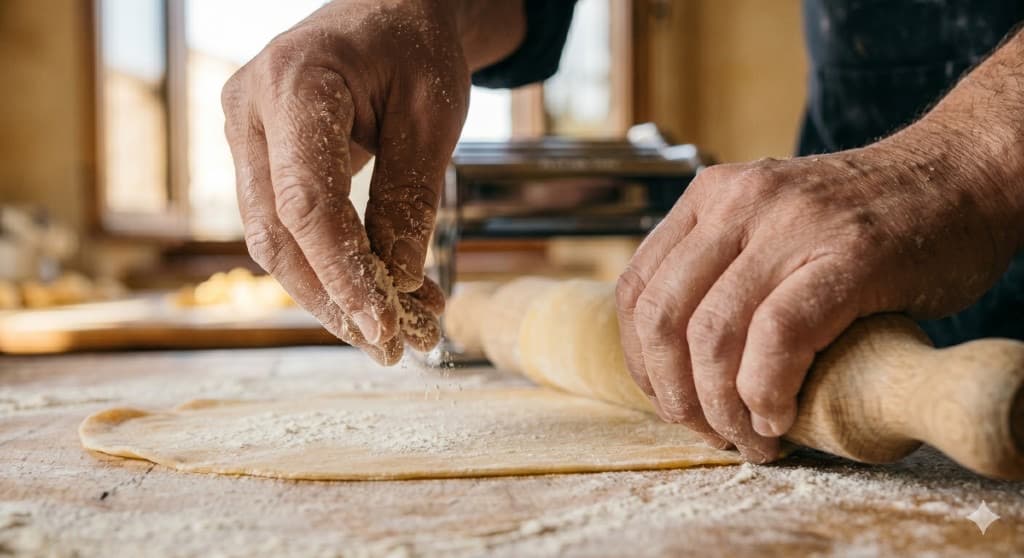
The plin is not a type of pasta: it is a gesture. It is the pinch you give the dough sheet between one mound of filling and the next, and that is where agnolotti del plin get their name, a shape typical of Piedmontese cooking. In a fresh pasta class in Turin it is also the point where almost everyone slows down: kneading and rolling out the sheet is learned quickly, closing identical agnolotti one after the other, sealed and with no air trapped inside, much less so.
Before the technique there is something more mundane to settle: the word workshop is used to sell two different experiences. In one you have your hands in the flour for most of the time; in the other you watch someone work and then taste. Neither is wrong, but you choose them for opposite reasons, and almost every disappointment comes from mixing them up. It is the first thing to clear up, before the date and before the price.
The plin is a pinch, and that is where everything shows
In Piedmontese, plin means pinch. The method is this: you roll out a thin strip of dough, place mounds of filling at regular intervals along one edge, fold the sheet over to cover them and then, with thumb and index finger, pinch the empty space between one mound and the next. The pinch does two things at once: it pushes out the air and welds the two layers of dough together. Only afterwards do you cut with a fluted wheel, exactly where you pinched. The result is a small agnolotto, with a narrowing at the centre and two little wings at the sides.
The difficulty is not in the movement, it is in the rhythm and in the condition of the dough. If the sheet dries out while you work, the pinch does not seal and the agnolotto opens in the water; if it is too damp it sticks to your fingers and tears. If there is too much filling, or it is unevenly spread, air stays inside and the pasta swells in the pot. That is why you work on short strips, keeping the rest of the dough covered: it is not fussiness, it is the only way for the sheet to be in the same condition at the start and at the end of the strip.
Hand-rolled or machine: what actually changes
By hand you roll with a rolling pin, from the centre outwards, turning the dough and widening it into a disc. It takes time, space and a bit of arm, and the result has a thickness that is never perfectly even and a slightly rougher surface, which holds the sauce. With a crank pasta machine you pass the dough through decreasing settings: it is repeatable, fast and gives you a regular strip, which is handy for the plin because the fold doubles the thickness and a mistake is felt straight away between your teeth. Neither way is cheating. It can happen that both are used: the rolling pin to understand the gesture and the direction of the dough, the machine to reach a workable thickness in time. Asking which tool is used also tells you how much of the lesson will be effort and how much will be closing.
The filling starts as a leftover, and that is not a flaw
Agnolotti del plin are cooking built on reuse. The classic filling is usually meat that has already been cooked, a roast or a braise from the day before, finely chopped together with the vegetables that accompanied it, generally bound with egg and cheese and seasoned with its own cooking juices; traditional versions change from one household to the next. It is not a mixture you improvise: the meat has to be cooked slowly beforehand, and the filling often arrives ready made. Ask whether that is the case and whether it is explained to you anyway: which meats, in what proportions, why the cooking juices matter more than salt, how you can tell the mixture is dry enough not to soak the dough. If the filling is dealt with in a rush, you are only learning to close.
A filling prepared the day before is not a shortcut in the class: it is exactly how these agnolotti came about.
Beginners' class or demonstration: how to tell in advance
The word workshop covers both. In a beginners' class you knead, you make the mistakes and whoever is teaching comes round to correct them; in a demonstration someone works in front of you, explains, and at the end everyone eats. The second is not worse, but if you go thinking you will come home able to roll out a sheet of pasta you will be disappointed. Usually the wording of the page and the number of places make it clear, but the shortest route is to write and ask. For a general method to use before booking anything, see how to choose the right workshop.
- How many people are expected and how many work stations there are: a board each or one shared table changes everything.
- Whether you make the dough yourself from flour and eggs or it arrives already made and rested.
- Whether you need to bring anything, an apron included, or everything is provided on site.
- How much time is set aside for closing the plin, which is the slow part.
- Whether there is a stretch where you only watch, and how long it lasts.
- Whether the teacher corrects person by person or talks to the group from the back of the room.
How much you really knead, and what you take away
Three questions help more than any description does. First: how much dough each person gets, that is, whether everyone works their own piece or you share a single batch already made by the Maker. Second: does the pasta you close stay there or do you take it home, because it can be a mix, part of it is cooked on the spot and the rest is packed up. If you are comparing options at different prices, the comparison is made on these things and not on the figure: we go into it in how to read the price of a workshop. The third question is the most concrete: is there a meal at the end, and if so what, because there is a difference between tasting your own agnolotti with butter and sitting down to a full table with starters and wine.
How booking on Handsome works
On Handsome you book online by paying a deposit, and you pay the balance in the studio on the day of the class. The deposit goes straight to the Maker's Stripe account: the Maker's profile is free and Handsome takes no commission on the price of the workshop. Cancellation terms are written on each workshop's page, so read them there before confirming. If it is a gift there is the gift card, which covers the whole workshop and is valid for twelve months, and whoever receives it books the date they prefer. If instead you are already a group, a family or a circle of friends, with private events you agree on the date with the Maker and the group stays closed: for fresh pasta that is convenient, because the number of work stations is the real limit. If the occasion is a work one, there are events for companies.
Frequently asked questions
- Do I need to know how to make pasta already for a class on agnolotti del plin?
- No, if the class is described as being for beginners: dough, resting and rolling out are taught from the start. What is worth checking is that there is enough time for the closing, because the plin is only learned by repeating it many times in a row.
- What is the difference between agnolotti del plin and ordinary agnolotti?
- The size and the way they are closed. The classic agnolotto is larger and is closed by hand or with a mould; the plin is small and comes from pinching the sheet between one mound of filling and the next, with the cut coming after the pinch. The way you eat them changes too: being small, the sauce counts for more than the quantity.
- Can I take home the pasta I made during the class?
- It depends on the studio, so ask before booking: it can happen that part of it is cooked on the spot and the rest is packed up.
- Is there a meat-free version of the filling?
- It depends on the studio: it is not a given, because the traditional filling is meat cooked slowly. If you need it without meat, ask when you book and not on the day. The same goes for egg and gluten: in fresh pasta they are not a variation, they are a different dough.
Dates and cancellation terms are on each workshop's page: you book with a deposit and pay the balance in the studio.
See fresh pasta classes in Turin