In Turin, the label ceramics course covers two very different experiences. On one side the potter's wheel: you sit in front of a spinning disc, wet your hands and try to hold still a ball of clay that keeps pushing to escape. On the other, hand building, where you construct the clay piece by piece, with no machine at all. The wheel is what you see in videos, and it is the first thing that comes to mind. For a single session it is not necessarily the right choice.
The difference is not the level of difficulty. It is what you are left holding at the end of the session. On the wheel a beginner mainly learns one thing, centring, and the first pieces collapse: that is part of the lesson. With coil or slab building you almost always get to a finished object, even if the walls are uneven: finished as far as shaping goes, though, not yet ready to take away. And there is a detail that surprises everyone: you do not get the piece that day. It leaves your hands soft and full of water, and before it becomes ceramic it has to dry and go through the kiln twice.
Wheel or hand building: what really changes
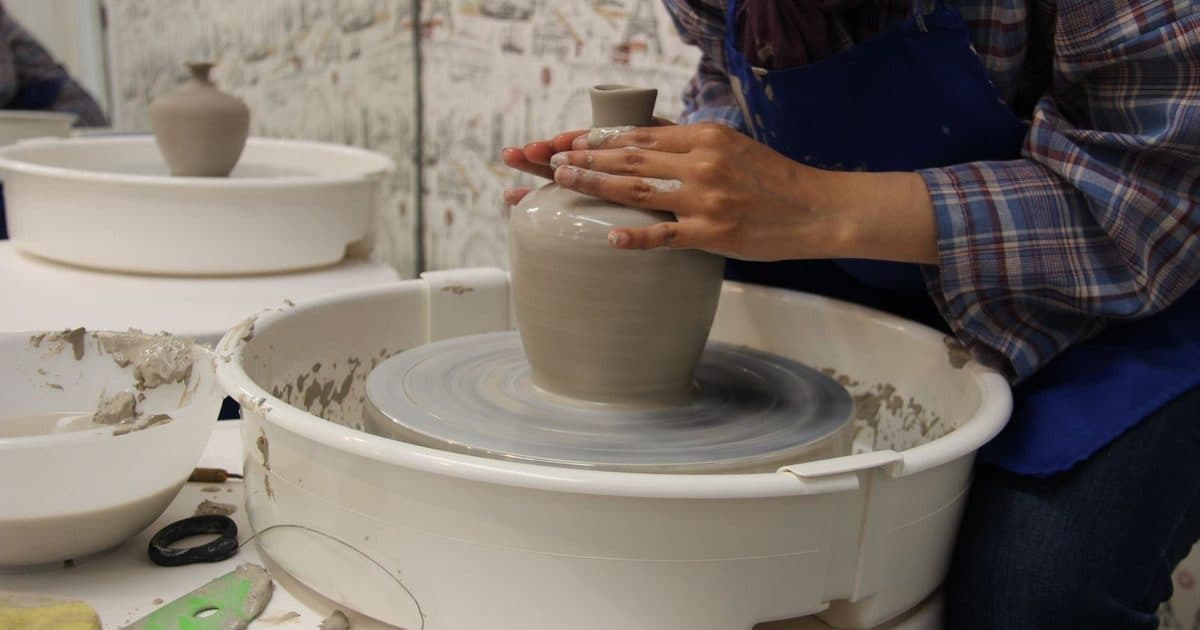
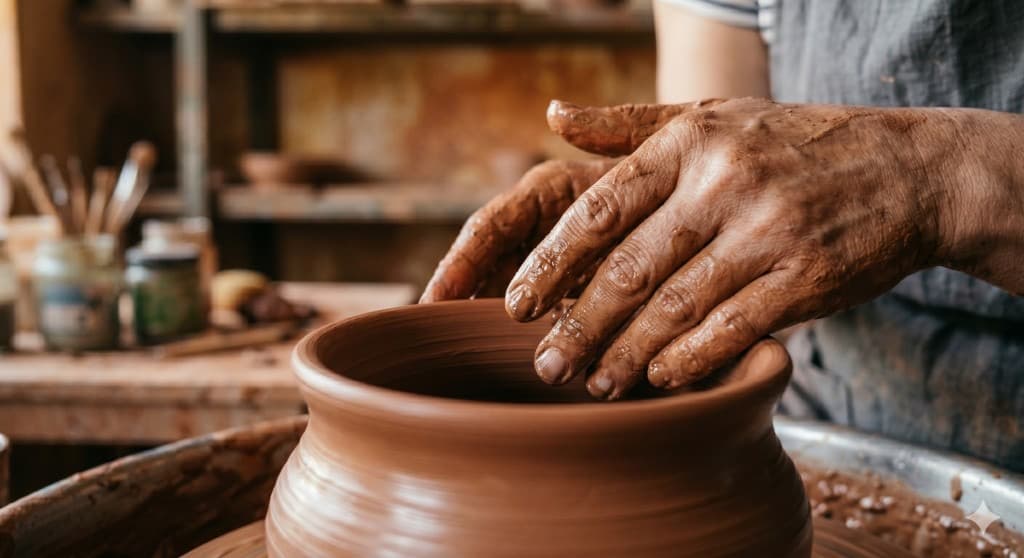
On the wheel the real work is centring. The ball has to spin without wobbling, and to get there you press it with your palms while your elbows stay locked against your legs: the force does not come from your hands, it comes from a body that stays still. Until it is centred, anything you build on top of it will deform. Then you open the base with your thumbs and pull the walls upwards, with steady pressure between the hand inside and the hand outside. One moment of distraction and the wall thins out in a single spot: from there the piece folds in on itself in a second. The right pressure is hard to explain in words, so ask beforehand whether the Maker's support is one-to-one or only a demonstration.
Hand building is not the easy version of the wheel: it is a different technique, with three main routes. Pinching starts from a ball, you sink your thumb into the centre and thin the walls as you rotate it, and it is the quickest way to a small cup or bowl. Coiling starts from rolls of clay stacked round after round and joined together with your fingers or a rib, and it allows tall or asymmetrical shapes that the wheel would never give you. Slabs are rolled out with a rolling pin, cut and assembled like cardboard: plates, trays, boxes. These are the techniques people used to make ceramics for thousands of years, before the wheel existed.
In an introductory session on the wheel not everything you start makes it to the end, and that is normal: ask how much clay is included and how many pieces you get to keep. Even the piece you save is only half done: the base is thick and has to be trimmed when the clay reaches leather hard, which is not the same day. That step is called trimming and the Maker often does it, without you seeing it. It is worth asking about, because that is where the piece gets its foot and its final weight.
- On the wheel, first time: a low, open shape, a bowl or a wide tumbler. Narrow, tall shapes demand far more control.
- With coils or slabs: a finished object, even an elaborate one, as long as the walls stay an even thickness.
- Decoration: carving, texture from stamps or fabric, small applied details. All of it happens while the clay is still soft, not afterwards.
- What you cannot do in a single session: glaze the piece you have just made. Glaze goes onto ceramic that has already been fired once.
Why the piece shrinks and changes colour
Clay is earth mixed with water. As it dries it loses that water and tightens; in the kiln it also loses the chemically bound water and the particles fuse together, so it tightens again. The object you collect is smaller than the one you shaped, visibly so: how much depends on the clay body, and the Maker knows it. If you are making a mug for a specific coffee capsule or a vase for a narrow shelf, say so beforehand and make it bigger. Colour plays the same trick: raw clay is dark because it is wet and already lightens as it dries, and glazes go on in a colour that is not the final one, pinks and greys and beiges that come out of the kiln red, blue, green. Ask whether there are fired test tiles you can look at before you choose: it is the only way to know what you are actually choosing.
The piece you touch at the end of the class is its bigger, more fragile, wrong-coloured version.
How long before you get it back
After the class the piece dries slowly, away from draughts: if it dries too fast it cracks. Then comes the first firing, the one that turns it into bisque. Then glazing. Then the second firing, which makes the glaze glassy and the object usable. Each firing means a long rise in temperature and an equally long cooling with the kiln shut, because nobody opens a hot kiln. On top of that, kilns are fired full, not for a single object: yours waits until there are enough of them. Add it all up and weeks can pass between the class and the collection: ask the Maker for an approximate date before you book. That is not a delay, it is the process. The only sessions you leave holding your object are decoration-only ones on already fired ceramics, which are a different activity: there you shape nothing.
What to ask before you book
The right questions fit in two lines of a message, and they are also what explains why two ceramics courses in Turin cost differently. On what pushes the figure up or down we wrote what determines the price of a craft workshop. On Handsome you book by paying a deposit online and pay the balance in the studio on the day of the workshop; the cancellation terms are written on each workshop page, so read them before you confirm, especially if you are booking for two.
- Who fires the work and where: a kiln in the studio or someone else's kiln. In the second case the piece makes one more trip before it comes back to you.
- How many firings are included. If only the first is, you get back a porous piece that is not waterproof and not fit for the table.
- Whether glaze is included or paid per piece, which colours are available and whether they are food safe.
- How many pieces you get to keep: all the ones you manage to make, or just one.
- How many seats at the wheel. If there are more participants than wheels you take turns, and your hands-in-the-clay time shrinks.
- How and when you collect the piece, whether there is a final deadline and whether shipping is an option.
Why ceramics studios are where they are
A ceramics kiln takes up space, is heavy and needs a dedicated electrical line. It is not something you slot in behind a shopfront under the arcades: it takes a real workspace, an inner courtyard or a former workshop, and in Turin spaces like that exist in districts such as Aurora, Barriera di Milano, Borgo Vecchio Campidoglio or Vanchiglia. Neighbourhood houses and shared spaces host courses in rooms that are not studios: for ceramics, ask whether the kiln is on site, because if it is not the pieces have to be taken elsewhere to be fired. We covered it in workshops in neighbourhood houses. Choose partly on how easy it is for you to go back: you will see the studio twice, the second time to collect your piece.
Frequently asked questions
- What should I wear to a ceramics course?
- Something that can get dirty. Wet clay splashes and the dust settles on everything; it comes out in the wash, but in the meantime it stays on you. Short sleeves, or sleeves you can roll up, because at the wheel you get wet up to your forearms. Rings and long nails really do get in the way at the wheel: spinning clay meets every edge and the wall gets marked. Take rings off before you start, not with dirty hands.
- Can two of us come together?
- Yes, but at the wheel it is one person per station: two pairs of hands on the same piece get in each other's way and the wall suffers for it. As a couple you work on two pieces side by side, each at your own wheel. With hand building, on the other hand, you stay at the same table and you can even build a single object together, because the pace is slower and you can stop whenever you need to.
- Is one session enough to learn the wheel?
- No, and nobody should promise you that. The first time round you understand how to sit, how much force it takes and whether you enjoy it: that is already a lot. The wheel is memory in the hands, it is built by repeating. If you want to carry on after the trial, ask the Maker whether they also run courses over several meetings, so you do not start from scratch every time.
- Can I give a ceramics course in Turin as a gift?
- Yes, with a [gift card](/gift-card) that covers the whole workshop and is valid for 12 months: the person receiving it picks the date, which is handy with ceramics, because you have to go back to the studio a second time to collect the piece. If the group is a closed one, a birthday for example, there are also private events.
Wheel or hand building: see the ceramics workshops available in Turin and choose the technique before the date.
See the workshops in Turin