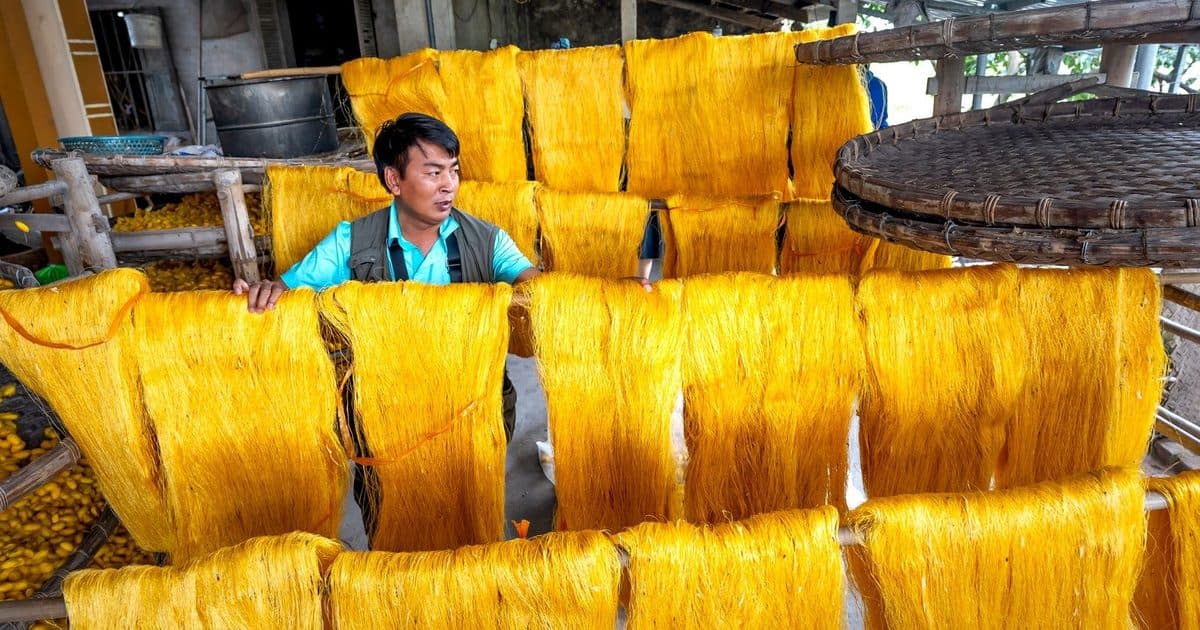
You recognise silk with your hands before your eyes. It is cold for a second, then it takes the temperature of your skin; it slides with a hint of resistance, and stretched on a frame it stays put and waits. That is also why it takes colour so well: on a fibre like this, dye does not sit on the surface, it goes in.
In Como none of this is brochure talk. Silk manufacturing is a historic activity of the city — the Museo didattico della Seta di Como tells that story — and the lake still has a working chain of dye houses, printers and studios producing to order. If you would rather spend half a day dyeing a scarf than looking at one in a shop window, this is one of the places in Italy where that instinct makes the most sense.
Why try silk here
The difference between a dyeing class anywhere and one taken here is not the material: silk is silk everywhere. It is the person handing it to you. Where fabric printing is a trade rather than a pastime, the teacher may well be someone who spent years making sample runs and fixing print registration. That changes the kind of detail you get told: why the yellow goes down last, why the squeegee is pulled and never pushed.
Then there is the shape of the day. A studio session takes a morning or an afternoon and leaves the other half to the lake: the ferry, the waterfront, the funicular up to Brunate. It is the sort of plan that survives unreliable weather, which around here is worth something.
Screen printing or dyeing: what actually changes
A screen-printing frame has nothing to do with a weaving loom: it is a frame with a fine mesh stretched across it. Part of that mesh is blocked — with a cut stencil, a film, or a light-sensitive emulsion — and the rest lets ink through. You lay the frame on the silk, pour a line of ink along the edge, drag it across with a rubber squeegee and lift: the design is there, with clean edges. The awkward part is the second colour, because one screen carries one colour only. Every extra colour is another pass, and each time the frame has to go back exactly where it was. Printers call that registration, and it is why an introductory session usually stays at one or two colours.
Dyeing works the other way round. You are not placing a design on the cloth; you are deciding where colour must not reach, and letting the bath handle the rest. You bind, fold, wrap around a pole, clamp between two blocks, stitch and pull the thread tight: these are the families of shibori, each with its own geometry. Then you dip, wait and open it up. That moment when the binding comes off and the pattern appears is why people come back.
- Screen printing gives a precise, repeatable mark: the same motif, identical, across several pieces.
- Resist dyeing gives a result that negotiates with you: fold and pressure decide alongside your hands, and no two pieces come out the same.
- Painted-resist techniques sit in between: you draw an outline by hand that stops the colour, then flood the shapes, keeping drawn precision with the softness of dye.
With only half a day, the choice makes itself. Resist dyeing usually reaches a finished piece within the session, because the waiting happens inside the bath. Multi-colour printing needs drying time between passes, so you either stay on one well-made colour or accept finishing in two stages. Neither is the easy option; they ask for different kinds of attention.
What you take home
The object first. Silk workshops nearly always start from a piece already cut and hemmed — a square scarf, a long narrow one, sometimes a pouch — so the time goes into colour rather than sewing. The type of silk changes the outcome more than you would expect: weight is measured in momme, and it decides whether your scarf drapes softly or holds itself like paper. If the studio fixes by steam you may leave the piece behind and get it later, so ask before booking if you travel on the same day.
Then there is the part that does not fit in a suitcase. After a few hours spreading colour on a fibre that reacts to everything — water, salt, acid, pressure — you look differently at a market stall full of scarves: you start to see what makes a hand-printed one cost what it costs, and where the mark is real. The same happens to people who try fashion and couture workshops in Milan: the eye stops being naive.
Finding a date and booking it
On Handsome you filter workshops by city and by craft: silk sits inside Textiles and Fibre, together with natural dyeing, fabric printing and weaving. Dates are published by the people teaching, so the calendar moves: if nothing is running on the lake that week, widen the search to Milan and Brianza, the same textile district half an hour away by train. Before confirming, read the listing to the end — length, places, what is included — and check the cancellation policy. If you have not settled on a craft yet, this guide starts from the right question. It works well for two and it works as a present: when the right date is not there yet, a gift card leaves the choice to them.
Frequently asked questions
- Where can you try working with silk in Como?
- In textile studios in the city and around the lake, which alongside their production work open short dyeing and printing sessions to anyone. On Handsome you find them by filtering workshops by city and by craft, under Textiles and Fibre. Availability depends on the dates Makers publish: if there is nothing in Como during your stay, widen the search to Milan and Brianza, part of the same textile district.
- Do I need experience for a silk dyeing or printing workshop?
- No. Both resist dyeing and screen printing are taught from scratch: in one you learn to bind and fold the cloth, in the other to pull the squeegee with the right pressure. What helps is accepting that the first piece will not be perfect, because that is where you learn how the fibre behaves.
- What is the difference between screen printing and dyeing on silk?
- In printing, colour passes through a partly blocked mesh and leaves a design with clean edges that repeats identically across pieces; every extra colour means another screen and another pass. Dyeing works in reverse: you block the colour by binding, folding or clamping the cloth, then immerse the whole thing, and the result cannot be repeated.
- Can I take the scarf home the same day?
- It depends on how the colour is fixed. With dyes set by heat or in an acid bath the piece is ready at the end of the session, once dry. If the studio fixes by steam, that step happens later and the scarf is collected another day or posted to you, which is worth asking about if you are in town briefly.
- How long is a session and what is usually included?
- Half a day, morning or afternoon, is the common format. In most cases the silk blank, the dyes and the equipment are part of what you pay, but this is not a rule: the workshop listing on Handsome states duration, places and materials included.
- How do you wash a hand-dyed or hand-printed silk scarf?
- By hand, in cold water with a neutral soap, without long soaking and without wringing: press it in a towel and dry it in the shade. Iron on a low setting, on the reverse, while the silk is still slightly damp. Wash it on its own the first time, since a little surplus colour can still come out.
Filter by city and craft, check what each listing includes and book online.
Find a textile workshop near the lake