You can spot a hand-sewn notebook before you even open it. The spine is not a glued fold: it is a row of gatherings held together by thread, and when you lay the notebook on the table it stays open by itself, without you flattening it with your palm. A bookbinding course teaches you to build that object, not to decorate a cover.
Print shops, publishing, departments where a book was folded, sewn and dressed before it reached the bookshop: in Turin the printed-paper trade left skills and tools behind, and today part of that knowledge passes through the workshops that teach. Here we talk about the sewn side: what actually happens in a day, how to recognise a serious course, and why the first thing they teach you is not the stitch but the grain of the paper.
What you actually do in a day
It starts with folding. Flat sheets are folded in half and nested inside one another in small groups: each group is a gathering, and a notebook is made of several gatherings in a row. The fold is closed with a bone folder, a flat tool that crushes the fibre without burnishing the paper the way a fingernail would. Then comes punching: you make a card template marked with the sewing stations, slip it inside the gathering and pierce it with an awl, always from the inside out. Only at that point do you sew, with a blunt needle and waxed linen thread, moving from one gathering to the next according to the chosen pattern. At the end you fit the cover, paste the endpapers and put everything under weight. How many notebooks come out of a day changes from workshop to workshop: ask beforehand. What you take away in any case is the sequence, and the same sequence applies to a whole book.
Paper has a grain, and you can feel it
When industrial paper is made, the fibres nearly all line up in the same direction, and that direction is called the grain. Folding with the grain is easy: the fold comes out straight and soft. Folding against the grain means breaking the fibres crosswise, so the fold turns rough and tends to crack. The real trouble comes later, with glue and humidity: paper folded the wrong way warps, the spine bulges and the pages ripple. There are two quick tests to find the grain: bend the sheet without creasing it first one way and then the other, feeling which direction gives less resistance; or tear a corner in both directions, because with the grain the tear runs almost straight and against the grain it comes out ragged. There is only one rule to remember: the grain must run parallel to the spine. That goes for the pages, the endpapers, the cover paper and the board as well.
Coptic, long stitch, cords: the stitches and what they change
The stitch is not an aesthetic choice: it decides how the book opens and how long it lasts. Which stitch a day covers changes from course to course, and it is worth knowing before you book, because the object you end up holding is very different.
- Coptic: the gatherings are chain-linked to each other, with no glue on the spine, and the boards hook straight onto the sewing. It opens completely and lies flat, with the thread on show. There is no drying time, so it can be finished within the day.
- Long stitch: you sew straight through a soft cover, in card or leather, and the stitches stay visible on the spine. Few steps, good hold, little margin for error when punching.
- Sewing on tapes or cords: the gatherings are sewn around linen tapes that are then fixed to the boards, and the spine is glued and covered. This is the structure of the classic book: it needs glue, mull, a press and drying time.
- Three-hole pamphlet stitch: one gathering, few pages, a single thread. It is a booklet rather than a notebook, but it is the best exercise for understanding tension and knots.
- Japanese stab binding: you punch the margin of single sheets and sew along the side. It is simple and tidy, but the notebook will not open flat and writing close to the spine is uncomfortable.
Bookbinding course or decoupage in disguise
It happens that you pay for a day of bookbinding and find yourself gluing decorated paper onto gatherings someone else has already folded and punched. It is a legitimate workshop, but it is a different thing, and the title does not say so: the details in the description do. Signs of a real course: paper grain is discussed, there is a template and an awl at every seat, the thread is waxed linen and not decorative twine, there is a pressing stage, and they explain why a measurement is what it is. Opposite signs: a pre-packed kit, the longest part of the day spent choosing the cover pattern, nobody ever mentioning the spine. If you are comparing several listings, the general criteria are in how to choose the right workshop.
Look at the spine: that is where you see whether you learned to sew a notebook or to decorate one.
What to ask before you pay
- How many people there are per Maker: sewing is learned by watching hands, and beyond a certain number the Maker only goes round tying knots.
- What comes out of the day: one notebook or two, what format, how many gatherings, soft or hard cover.
- Whether the notebook is really finished on the day or whether part of it has to be left under weight and picked up at home.
- Which materials are included and whether you can bring your own paper: if so, ask in advance whether it works for weight and grain.
- Whether tools are one per person or shared: when the awl gets passed around, punching turns into a queue.
- Where you work: floor, stairs, light. Punching and sewing for hours need a high table and good light.
There is no absolute right price: it changes with the length of the day, the number of participants, the materials included and the object you take home. What you can check is that everything is written down beforehand. If you book on Handsome you pay a deposit online and the balance is paid at the workshop on the day; the cancellation terms are written on each workshop page, so read them before you confirm. To understand what pushes the cost of a day up or down, we covered it in the fair price of a craft workshop.
Carrying on at home without buying a bindery
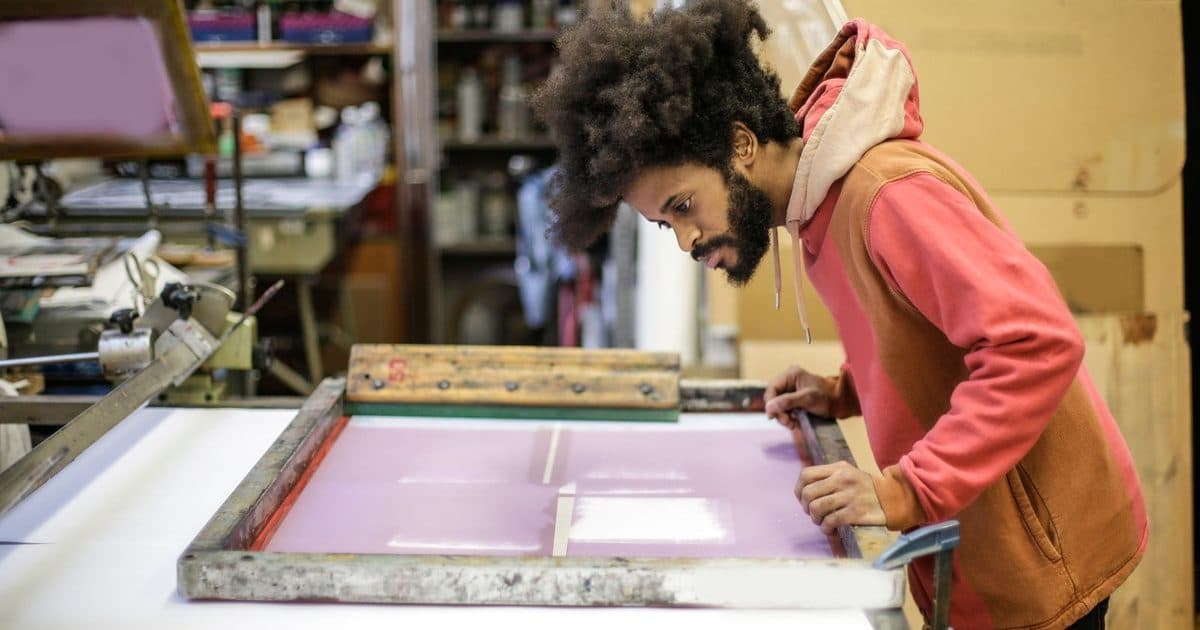
Repeating at home what you did in the workshop takes very little, and almost nothing specialist: a bone folder, an awl (a thick needle stuck into a cork works too), a few blunt needles, a spool of linen thread to wax with beeswax, a metal ruler, a craft knife with spare blades and a scrap of board as a cutting base. You make the template yourself from the card of a biscuit box. The press, at the start, is a stack of heavy books on two boards: all it takes is distributed weight and time. What makes no sense to buy straight away is a board shear, a sewing frame, leather and conservation board: those purchases come once you know which stitch you actually like. The one line worth spending on is paper: large sheets, cut by you in the right direction, change the result more than any tool. And if you move from thread to ink, the trade next door is hand printing: we wrote about it in the screen printing course in Turin.
Frequently asked questions
- What is the difference between bookbinding and rebinding?
- In everyday speech they are used as synonyms, but in a workshop they mean two different jobs. Bookbinding builds a new object from loose sheets: folding, sewing, cover. Rebinding, and even more so restoration, means working on a book that already exists and is usually damaged. An introductory course does the first thing, not the second.
- Do I need to know how to sew to sign up?
- No, and you do not even need to handle a needle the way you would for fabric: bookbinding stitches are taught from scratch, and there are few of them, repeated over and over. What really counts is precision in folding and punching, not dexterity with thread. If threading a needle is hard for you, say so at the start: needle threaders and large-eye needles exist.
- Can I bring a broken book and have it fixed?
- Not in a basic bookbinding course. Book restoration is a separate discipline, with reversible materials and choices that depend on the state of the object, and it cannot be improvised in the middle of a group. You can still bring it along and ask the Maker for an opinion on what kind of work it would need.
- Is it suitable for children?
- It depends on the workshop and the age. Awls, needles and craft knives are involved, so check whether the course states a minimum age. If the workshop page does not say, ask before booking, and ask the Maker as well whether there is a version for younger participants with the holes already set: that is a different activity and has to be agreed in advance.
The dates open in the city. The cancellation terms are written on each workshop page.
See workshops in Turin