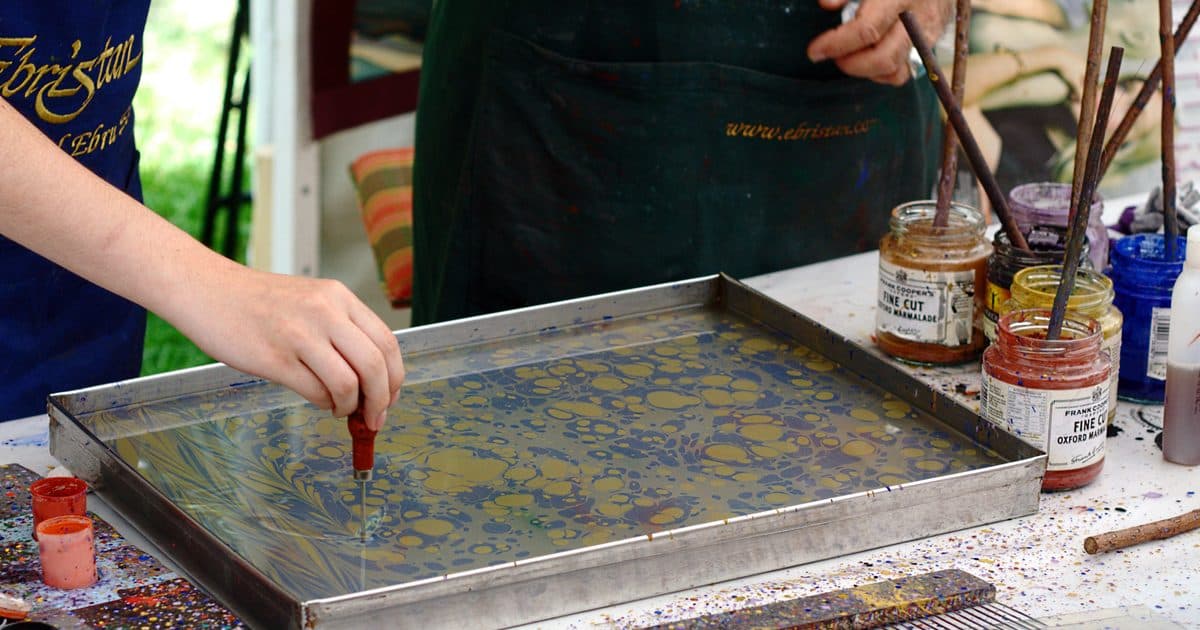
Almost everyone who visits Florence takes some of it home without really noticing: a sheet of marbled paper folded into a stationer's bag, the cover of a notebook, the lining of a box. It is a piece of the city that fits in an envelope, and it is also the thing visitors always buy ready-made. Yet the tray, the combs and the colours can be used with your own hands. Florence has bookbinding studios where, in a couple of hours, you marble your own sheet without ever having held a paintbrush. The short answer, for anyone wondering before they book a trip: yes, you can try it, and you do not need to know how to draw. The class takes place in a bindery or a paper studio, fills a morning or an afternoon, and you leave with your own sheets and often with a hand-bound notebook. You are not the one doing the drawing. The water is.
What marbled paper actually is
The technique is easy to explain and startling to watch. A shallow tray is filled with a thickened water bath on which colours float instead of sinking. Drops are let fall, they spread, and they are pulled with styluses and combs into veins, feathers and peacock eyes. Then a sheet, treated beforehand with a mordant that fixes the pigment, is laid on the surface, and in an instant the pattern jumps from the water to the paper. No sheet can be repeated: the same tray never gives you the same result twice.
Paper marbling has a long history that runs through East Asia and the Ottoman world, where the Turkish form known as ebru is recognised by UNESCO as intangible cultural heritage, before reaching European binderies. There it lined the endpapers of books for generations, the pages that join the cover to the text block. In Florence it became part of the binders' and stationers' trade, and then of the shop windows. One detail worth knowing before you buy: much of the decorated paper on sale is machine-printed from a repeating design. Hand-marbled paper is recognisable because it never repeats, and sometimes it keeps the trace of the comb or an air bubble that makes it feel alive.
What happens in a couple of hours at the tray
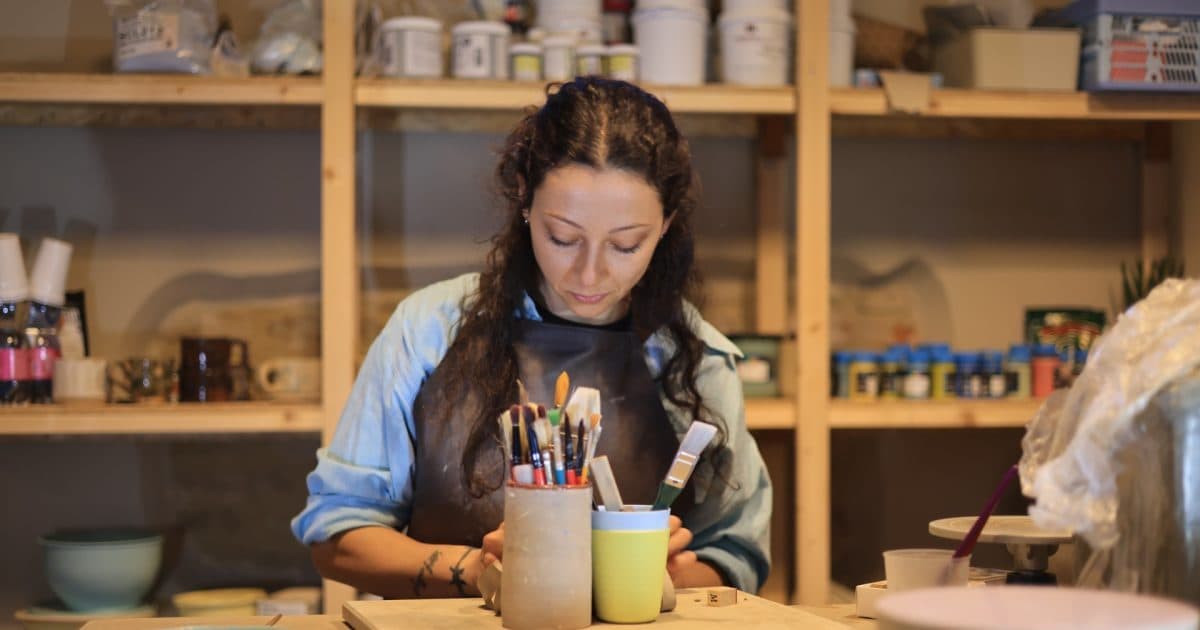
A beginners' class almost always follows the same arc, because the technique has its own timings and none of them can be skipped. The person leading it, a Maker who binds or decorates paper for a living, prepares the bath and the colours in advance: you arrive and find everything ready for you to get your hands dirty.
- The sheet is coated with the mordant and left to dry. This is the invisible step that makes the colour stay on the paper.
- You choose your colours and let them fall onto the surface of the bath, in drops or by flicking a brush over the water.
- With styluses and combs you move the colours: straight lines, waves, spirals, and the combed pattern that is the most recognisable of all.
- You lay the sheet on the water in one movement, without hesitating, and lift it straight away.
- You rinse off the excess bath and hang the sheet to dry. Meanwhile, you start again with the next one.
Here is the part that reassures anyone who thinks they have no talent: at no point do you need to draw. Your hands make broad gestures and the comb does the rest. Mistakes become part of the pattern, and the sheet a participant calls a failure is often the one the Maker finds most interesting. In the fuller experiences, the dried sheets end up on the cover of a hand-sewn notebook, so you go home with a whole book rather than a loose sheet.
From paper to book: why the two belong together in Florence
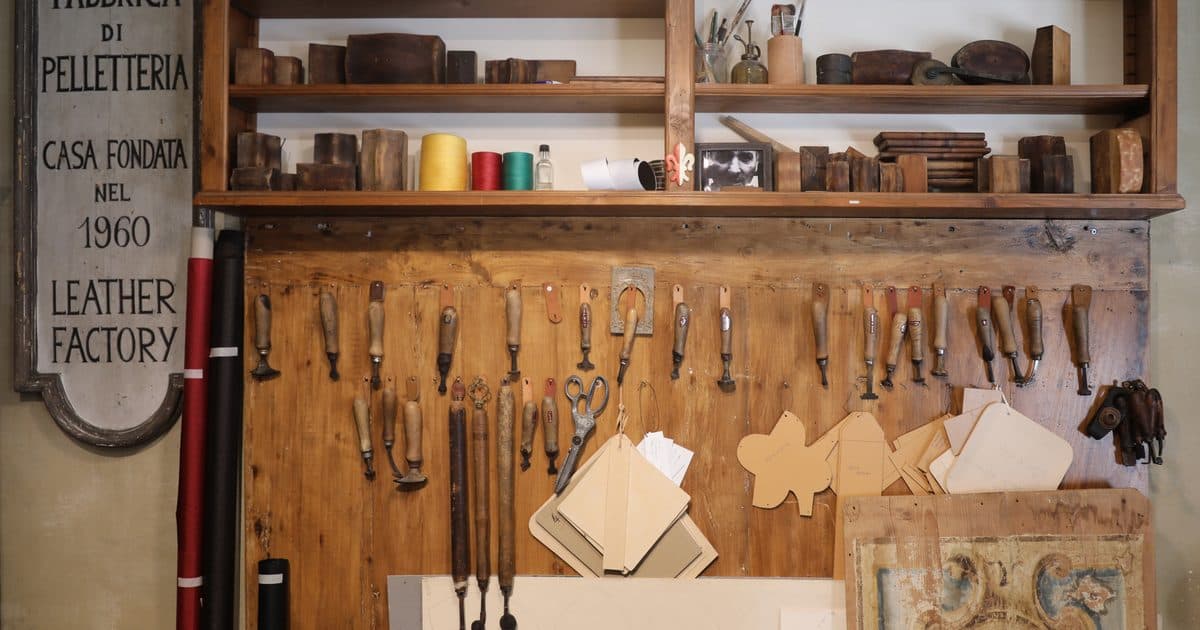
In Florence, marbled paper was first of all a working material for bookbinding: it covered boards, spines, boxes and endpapers. That is why many classes in the city combine the two crafts. You marble in the morning and sew in the afternoon, or you give each stage its own session. If the sewing side appeals to you more, waxed thread, spine and folded signatures, we have described the binding techniques that suit beginners in our guide to bookbinding and handmade notebooks. The notebook that comes out of a session like this is worth something different from the sheet you would buy in a shop window. It is not prettier. Sometimes it is a little crooked. But the cover is your tray, your comb, your hand laying the sheet down a second too early or a second too late. And that, unlike the stationer's envelope, is not for sale.
How to choose the right class in Florence
Paper classes in the city are not all alike, and the cover photo rarely shows the differences. Before you book, check these points.
- Who leads it: a Maker who binds or decorates paper as a trade, not someone who learned the technique last week. The profile tells you what they do when they are not teaching.
- Group size: the tray is used in turns, so in a large group you spend a lot of time waiting. A small group means more sheets each and more time with the Maker.
- What you take home: only the sheets, or a bound notebook too? And will the sheets dry in time, or do you need to collect them later?
- Language: many Florentine studios work with international visitors and teach in both Italian and English. Check the listing if that matters to you.
- What changes the price: the length of the session, how many sheets are included, whether the bookbinding part is in, and the size of the group. A private session for a couple works differently from an open-group date.
If you want to look beyond paper, our guide to artisan experiences in Florence gathers the crafts you can still try in person in the city, from leatherwork to mosaic. And if the class is a present for someone else, a Handsome gift card covers the chosen workshop and lets the recipient pick the date that suits them.
Marbling is the craft where the water does the drawing and the hand only decides when to stop it.
Frequently asked questions
- Where can I try paper marbling in Florence?
- In the bookbinding studios and paper workshops that open their doors for short classes. On Handsome you find them among the paper workshops by filtering for Florence: each listing says who leads it, how long it lasts, what is included and what you take home.
- How long does a marbled paper class last?
- Usually a morning or an afternoon: enough to prepare the sheets, make several attempts at the tray and let them dry. If binding a notebook is included, the session runs longer or is split across more than one meeting.
- Do I need to be able to draw?
- No. The pattern comes from the movement of colour on the water and from the pass of the comb, not from freehand drawing. The Maker guides your gestures and shows you how to get the classic patterns; the rest is experimenting.
- Can I take the sheets home straight away?
- It depends on the studio. Paper needs to dry and be pressed to stay flat: some classes hand it over at the end of the session, others ask you to come back or post it to you. Check the listing or ask the Maker before booking.
- Is it suitable for children and families?
- Often yes, because the gesture is simple and the result is immediate. Pigments and bath do stain, though, so check the minimum age on the workshop listing and come dressed for it.
Filter by Florence and book your date online
Find paper and bookbinding workshops