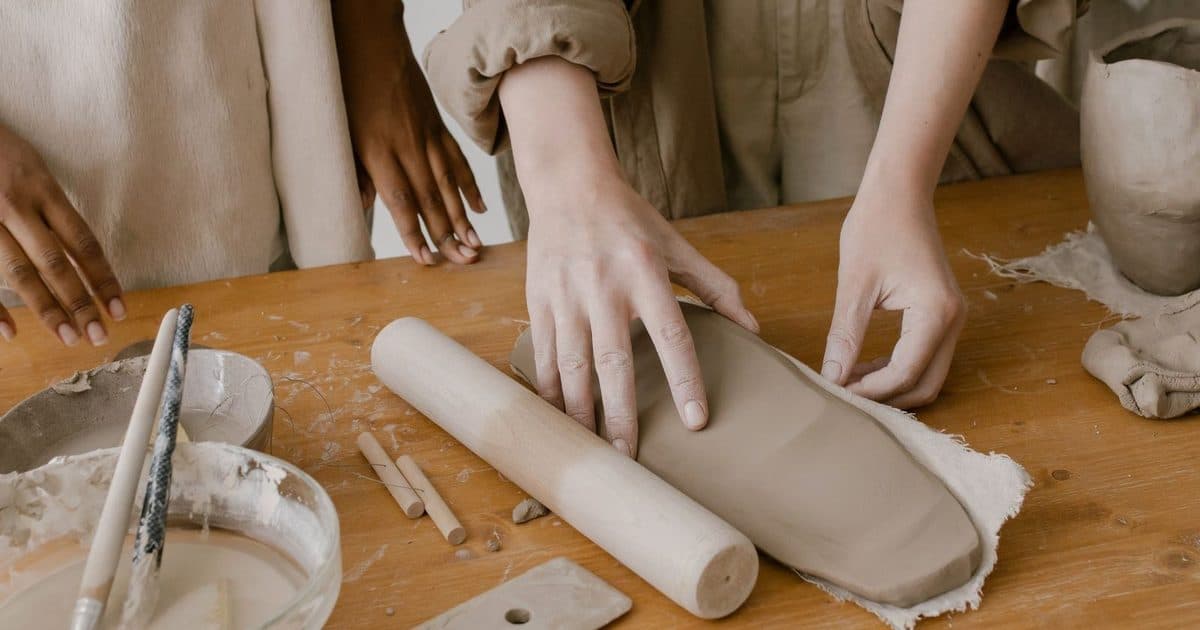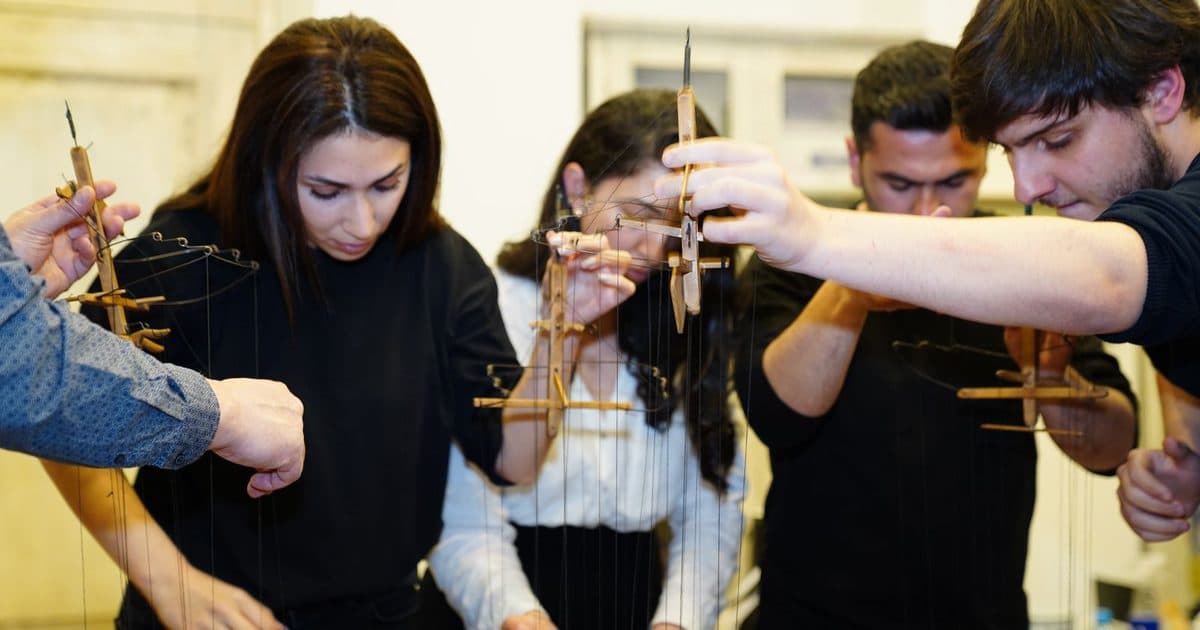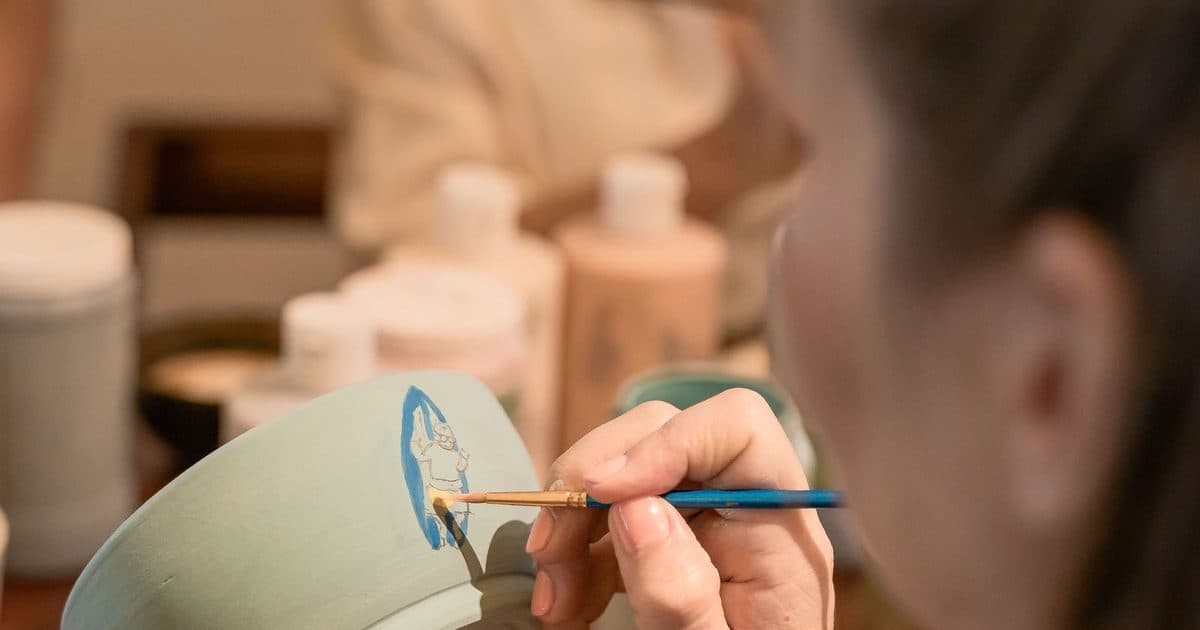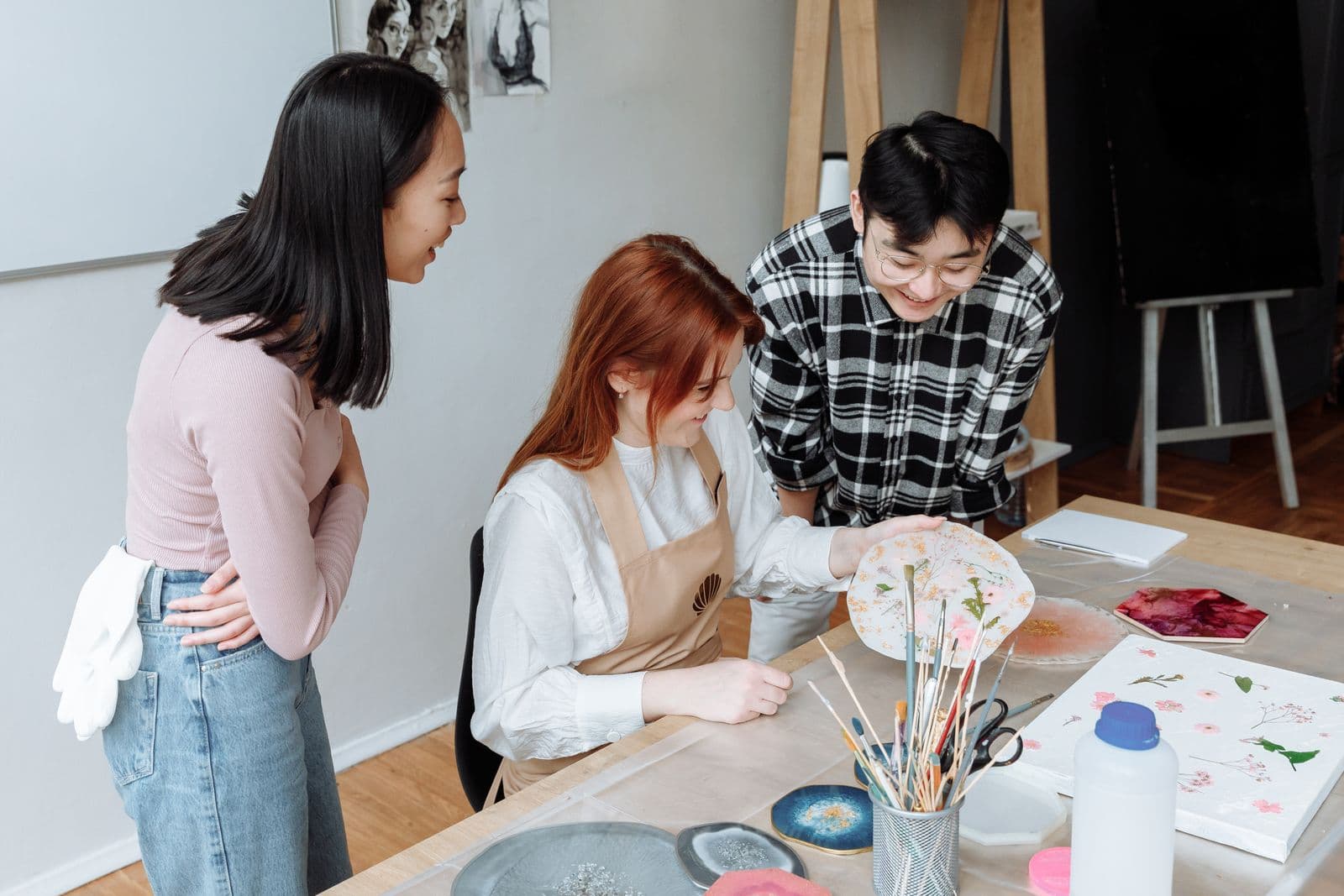
The email goes out in September or in January, and in Milan it reads like this: “we need to do something for the team before the quarter ends, we have a budget and half a day”. The options on the table are almost always the same three: an escape room in the centre, a long aperitivo with a private room, a sport somebody will call adrenaline-fuelled. By Monday they have left nothing on anybody's desk.
This guide takes the fourth option — two hours in a craft workshop, either at the Maker's studio or with the Maker coming to your office — and pulls it apart: what the research says, how a session runs hour by hour, how many people genuinely fit, and what is left when everyone goes back to work.
How well team building works, according to those who measured it
It is worth starting with an uncomfortable number. In 2009 Cameron Klein, Deborah DiazGranados, Eduardo Salas and colleagues published a meta-analysis on the effectiveness of team building in Small Group Research: across some sixty collected correlations, the average link between these interventions and team outcomes comes out at .31. A positive effect, but a moderate one, and unevenly spread: the strongest link is with affective and process outcomes — how people feel within the group and how they work together — far more than with performance.
Translated for whoever is organising: no afternoon will move the quarterly numbers, and anyone promising otherwise is selling something. It can, though, change how people speak to each other the next day. The right question is not “which activity is more fun”, but “which activity produces conversation between people who normally don't have any”.
Why the hands, specifically
The first part of the answer comes from a Drexel University study published in 2016 in Art Therapy by Girija Kaimal, Kendra Ray and Juan Muniz. Thirty-nine adults aged 18 to 59 spent 45 minutes making something with their hands — markers, clay, collage materials — with no instructions: salivary cortisol, measured before and after, was lower in roughly 75% of participants. The detail that matters to an organiser, though, is another one: there was no correlation with prior art experience.
The second part is about the group. In 2013 the British Journal of Occupational Therapy published an international survey by Jill Riley, Betsan Corkhill and Clare Morris of 3,545 people who knit: doing it in a group was significantly associated with higher perceived happiness and with improved social contact and communication. It is not the knitting as such — it is busy hands plus people around the same table.
The third part explains why the object matters. In 2012 Michael Norton, Daniel Mochon and Dan Ariely described in the Journal of Consumer Psychology what they called the IKEA effect: across four experiments, from assembling IKEA boxes to folding origami to building Lego, people valued their own amateur creations roughly as highly as work made by experts. With one boundary: the effect vanished when the task was not completed.
Escape room, aperitivo, workshop: the honest comparison
None of the three is wrong in the absolute: they answer different needs. But the criteria the decision actually turns on are different ones, and they never appear in the email.
- Who gets left out. In an escape room you win by thinking fast and out loud: whoever processes slowly, whoever doesn't have Italian as a first language, whoever is uneasy in enclosed spaces waits for it to be over. At a bench everyone has their own piece and their own pace.
- Noise. The aperitivo with a private room is the loudest of the three: anyone with a hearing difficulty, anyone who speaks quietly, anyone who doesn't drink drifts to the edge and nobody notices. In a workshop the volume stays low by necessity.
- Whoever arrives late, and in Milan somebody always does: in a timed room, walking in twenty minutes late is not an option; at a workbench you sit and start.
- What is left on Monday. From the escape room, a photo with the time board; from the aperitivo, an expense claim; from the workshop, an object on a desk that people will point at and ask about for weeks.
What a two-hour session actually looks like
Anyone who has never been in a workshop with a work group imagines a lesson. It is not: it is a fairly precise sequence, and knowing it helps you understand what to ask for.
- First fifteen minutes: you walk in, look around, and the Maker explains what they do and shows the tools. It looks like the optional part and it holds up the rest: the group understands it is in the space of someone who does this for a living.
- Minutes fifteen to thirty: the demonstration. The Maker performs the movement everyone will repeat, once, slowly. The questions come here, and anyone afraid of getting it wrong relaxes on seeing that the gesture is repeatable.
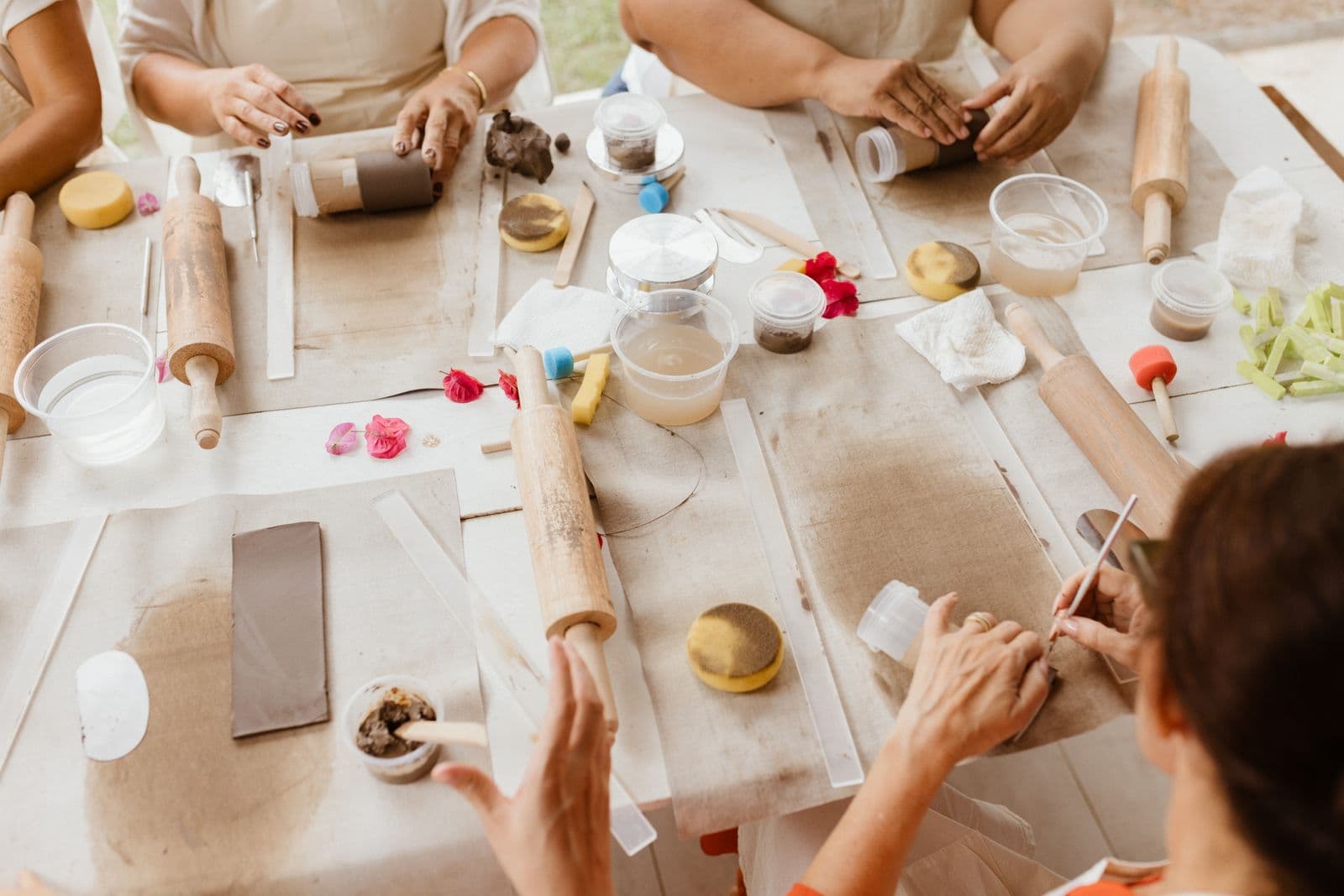
- Minutes thirty to ninety: work. This is the heart of it, and it must not be compressed. The noise drops, people help each other unprompted, and the manager asks advice from the colleague who joined three months ago and worked out how to hold the tool first.
- Minutes ninety to a hundred and five: finishing. Sanding, trimming, cleaning. This is where people become fussy about their own piece — which is when the object becomes theirs.
- Last fifteen minutes: every piece ends up on the same table. Twenty different versions of the same brief appear, people laugh, photos get taken. This moment is worth the debrief nobody wants to run.
Two hours is the minimum to reach a finished object; three give you room. Worth knowing before choosing the craft: wood, leather, textiles, paper, printing and cooking finish on the day, ceramics does not. A ceramic piece has to dry and be fired, so it reaches the office a few days later — known in advance, that becomes a second team moment.
How many people genuinely fit
A workshop's capacity is not measured in square metres but in stations: benches, clamps, looms, hobs, and the room to move safely with a tool in your hand. Then there is a second limit: how many people one Maker can follow without leaving somebody standing idle. That is the number that decides whether the session works.
- Rotating sub-groups: half the team in the workshop, half outside with a programme of their own, then you swap. You need a written timetable, or the swap slips.
- Two Makers in the same space: the group splits by craft and compares results at the end. This is the format that carries the larger numbers without losing contact with the person teaching.
- The Maker on the road: when the group outgrows any studio, you work wherever there are enough tables, and the Maker arrives with tools and materials for everyone.
Studio or office: how to decide in Milan
A real workshop has an advantage no meeting room can reproduce: it smells of the craft, the machines are running and half-finished work sits on the shelves. The cost is getting there. In Milan, moving across the city has changed since the M4 was completed: as of 12 October 2024 the blue line connects San Cristoforo FS to Linate Airport, twenty-one driverless stations, end to end in about half an hour. If the group travels by public transport, start from the metro map — which is what our guide to Milan craft workshops reachable by metro does.
The alternative is bringing the Maker to your offices, and for larger groups it is often the more sensible call: it removes the travel and the risk of twenty people arriving in waves. You do need real tables rather than desks with monitors, a water point, permission to make a mess and power sockets — all checked in advance rather than on the day. With a team spread across several sites there is a third route, leaving the city: our guide to half-day team building outside Milan lays out the real distances between Monza, Brianza and the lakes.
The hybrid team is the real reason you need a physical moment
There is also a structural reason. According to the Osservatorio Smart Working at POLIMI School of Management, whose research was presented in October 2025, around 3,575,000 people in Italy work remotely for at least part of their time, and smart-working schemes are in place at 95% of large companies.
The consequence is straightforward: the moments when the team is physically in the same place are few, and they need to be spent well. Spending them in a meeting room with slides, or in a venue where everyone re-forms into the usual sub-groups, is a waste. A workbench, by contrast, mixes people by force.
What people actually take home
Three things, in increasing order of how long they last. An object, which is the most visible part and the least important. A story to tell, because everyone goes home explaining how to do something they couldn't do the night before. And one new thing about a colleague: that they have steady hands, that they are patient, that they can explain.
The best debrief is the one you don't have to organise: it happens by itself when twenty people put twenty different objects on the same table.
For the organiser: where the time really goes
The hidden cost of team building is not the price per head: it is the time of whoever puts it together. Finding a workshop, working out whether it takes groups of that size, checking accessibility, collecting allergies and dietary requirements. Every piece has a different counterpart.
On Handsome that path is a single one. From the companies page you fill in a brief with how many people, which city, preferred and alternative dates, indicative budget, the kind of experience (there is a “surprise me” option) and the objective, from team building to onboarding. Handsome replies within 24 hours, selects the right Maker, sends a tailored proposal within 2 working days and coordinates space, timings and materials. One point of contact, from request to event.
One honest note about Milan: as things stand there is no Maker with a workshop inside the city on Handsome yet, so a proposal for Milan means either the Maker travelling to your offices or a space in the surrounding area.
People, city, date and indicative budget. We take care of the Maker and the organising.
Tell us about your event: reply within 24 hoursFrequently asked questions
- Why does a craft workshop work better than an escape room for team building?
- Because it includes rather than selects: in an escape room you win by thinking fast and out loud, while at a bench everyone has their own piece and their own pace. An object is also left behind, and research on the IKEA effect shows we value what we build ourselves more highly — but only when the work is actually completed.
- How many people can a workshop session hold?
- The limit is not square metres but the stations available and the number of people one Maker can follow without leaving anybody idle. For larger groups you work in rotating sub-groups, with two Makers, or you bring the Maker to a venue with enough tables.
- How long should a creative team-building session be?
- Two hours is the minimum to reach a finished object; three give you room. Wood, leather, textiles, paper, printing and cooking finish on the day; ceramics has to be fired and reaches the office a few days later.
- Is it better to take the team to a workshop or bring the Maker to the office?
- In a workshop the setting does half the work, but everyone has to get there at the same time. At your offices you remove the travel entirely, which is often right for large groups: you need real tables, a water point, permission to make a mess and, for some crafts, power sockets.
The Milan catalogue is only taking shape: it updates whenever a Maker publishes a new date.
See Handsome's Milan page