To organise creative team building in Bologna there are three decisions, in this order: the format (what people actually do with their hands), the space that can hold that number of participants, and who runs the session. Everything else follows. The part that gets underestimated is almost never the activity itself: it is the welcome, the wrap-up, and the people who do not show up at the last minute.
Start from the goal, not from the activity
"Let's do a ceramics workshop" is not a brief. The brief is who takes part, why you are putting them in the same room, and what you want to happen during those hours.
- New or reorganised team: an activity that forces people to talk, in pairs or at small tables, with a shared result.
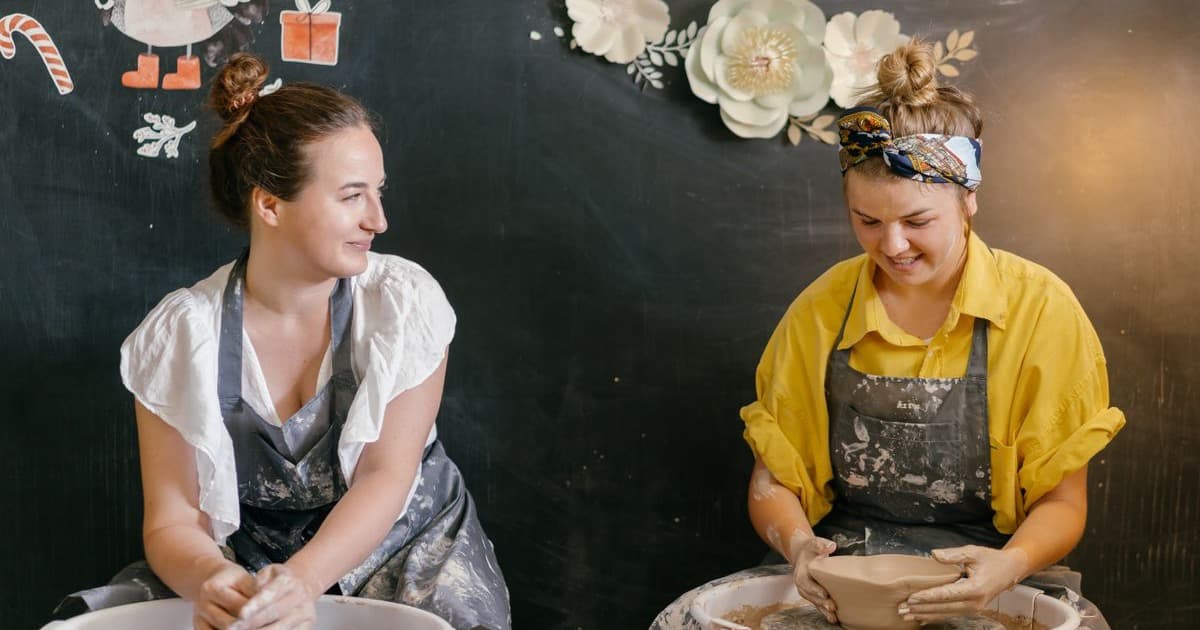
- Team that already knows each other and works under pressure: the opposite, something individual and quiet. The potter's wheel, printing and woodwork keep hands busy and lower the volume in the room.
- Project close-out or reward: what matters is the object people take home. Prefer a technique that finishes in the same session, or plan for a second delivery after firing.
- Clients or a stand at a trade fair: continuous flow, short slots, no compulsory sign-up.
- Welfare or a gift: you do not need a single date here, it works better to let each person choose with a gift card, valid for 12 months on any workshop on the platform. It works like a wallet: if the experience they pick costs less, the remaining balance stays on the card for next time.
How the format changes with group size
Numbers do not just change the quote: they change the physics of the day. The thresholds below are not an industry standard: they are the points at which, in practice, the way you run the session has to change.
- Up to a dozen people: one Maker is enough. Everyone sees the demonstration and gets individual feedback.
- More than a dozen people per Maker: you need a second pair of hands, and the demonstration has to run twice or on a screen.
- Between twenty-five and forty: you stop thinking in terms of one workshop and start thinking in terms of stations. Two or three techniques in parallel, groups rotating, one person in charge of each station and someone keeping time without running anything.
- Over forty: either two sessions, or a demonstration format with open stations. A guided workshop for a much larger group all at once, in practice, turns into a lecture.
Going from a dozen people to forty, materials scale proportionally; everything else moves in steps. A second Maker is added all at once, wheels and kilns do not multiply, and above a certain threshold you have to change venue altogether: that is the item that weighs most.
How long it really takes, welcome and clean-up included
When a supplier says "two hours", they almost always mean two hours of activity. The day is another matter. If you are writing the agenda for the team, these are the blocks to put in.
- Staggered arrival: people do not turn up together. You need margin and you need someone at the door.
- Welcome: aprons, bags, a few words from whoever is running the session. This is when the group loosens up.
- Demonstration: with large groups it has to be repeated or shown on a screen.
- Activity: the part everyone pictures, and often the shortest block of the day.
- Wrap-up and clean-up: pieces to label for collection, hands to wash. It is not dead time: it is when people walk around and look at each other's work.
Take the stated duration of the activity and add a solid margin. If the team has to be back at a specific time, say so before you sign, not on the day.
How much space you need
If the event takes place at your offices, the meeting room is hardly ever enough. This is the checklist to hand to whoever manages the space, before you confirm the date.
- Proper work surfaces, not low coffee tables: each person needs room in front of them for the object and the tools.
- A sink within reach: ceramics, paints and printing all need to rinse something.
- Surfaces you can cover, sockets near the tables, air exchange if glues and paints are involved.
- Loading and unloading: where the van parks and how far it is from the room.
- Set-up time and accessibility: the room free before the start time, steps and toilets checked.
How many people, when, where. We organise the format, the Maker, the space and the materials, with one point of contact.
Send us your briefLast-minute drop-outs
In a corporate group the number of no-shows is never zero: meetings that slip, travel, illness. The point is not to avoid them, it is to decide in advance who pays for what.
- Agree on a range of participants, not an exact number: inside that range nothing gets recalculated.
- Ask by when you have to confirm the final number: usually it is the day the Maker buys the materials.
- Separate materials from facilitation: the materials of people who do not show up are still yours, have them delivered or used by whoever is there.
- Plan for substitutions, and read the cancellation terms beforehand.
Questions to ask your supplier
- Who actually runs the session, and with how many people in the room?
- Does the stated duration include welcome and clean-up, or is it activity only?
- What does each participant take home, and when?
- If the technique needs firing, who returns the pieces and when?
- What do you bring and what do we need to have in the space?
- By when do I have to confirm the final number?
- What happens if the space falls through or the facilitator falls ill? And who remains our point of contact?
How the price is built
There is no single price list for team building, and anyone who hands you one before hearing your brief is selling a package. The price depends on specific items: facilitation, materials, space, logistics, and extras such as custom gadgets, food or set-up with your logo.
The price we give you is per person and all inclusive: materials, Maker and organisation. It is what you pay: for the same number of people, nothing is added afterwards.
Why Bologna works for this
Bologna has a real craft density, not just an evocative one: according to the Chamber of Commerce, in 2021 the metropolitan area had 26,543 registered craft business locations, 43 per cent of them in services; further local data sits in the chamber's economic information section. The tradition of workshops and shops in the historic centre is also documented by Bologna Welcome. For whoever is organising, this means something concrete: from ceramics to printing to woodwork, almost every technique is reachable within the day, without making the team travel.
How we work: one point of contact
The fastest way to derail a team building day is to assemble it in pieces: the workshop from one place, the room from another, the materials from a third, and three people to chase.
- You send us the brief: how many people, when, where, what kind of day you have in mind.
- We come back with a concrete proposal: what you will do, date and time, duration, a price per person, all inclusive, and what the team takes home.
- You confirm, and we handle materials, set-up and the return of the finished pieces.
- On the day there is one single point of contact. If anything changes, it changes with them.
If the group is small and you want something more informal, look at private events and the groups format. If you just want a sense of what exists, the workshop catalogue and the Bologna markets page are a good starting point.
Frequently asked questions
- How many people do you need for creative team building?
- There is no strict minimum. Up to a dozen people, almost every technique works with a single facilitator and the individual result is better. Beyond a dozen people per Maker you need a second facilitator, and from around twenty-five upwards it is better to think in terms of parallel stations rather than a single workshop.
- How long does creative team building last?
- Half a day is the most common corporate format, but pay attention to what the stated duration covers: the hands-on activity is often the shortest block, while welcome, demonstration and clean-up take a significant share. Ask for the real start and end time, not the length of the workshop.
- Can it be done at our offices or do we need an external workshop?
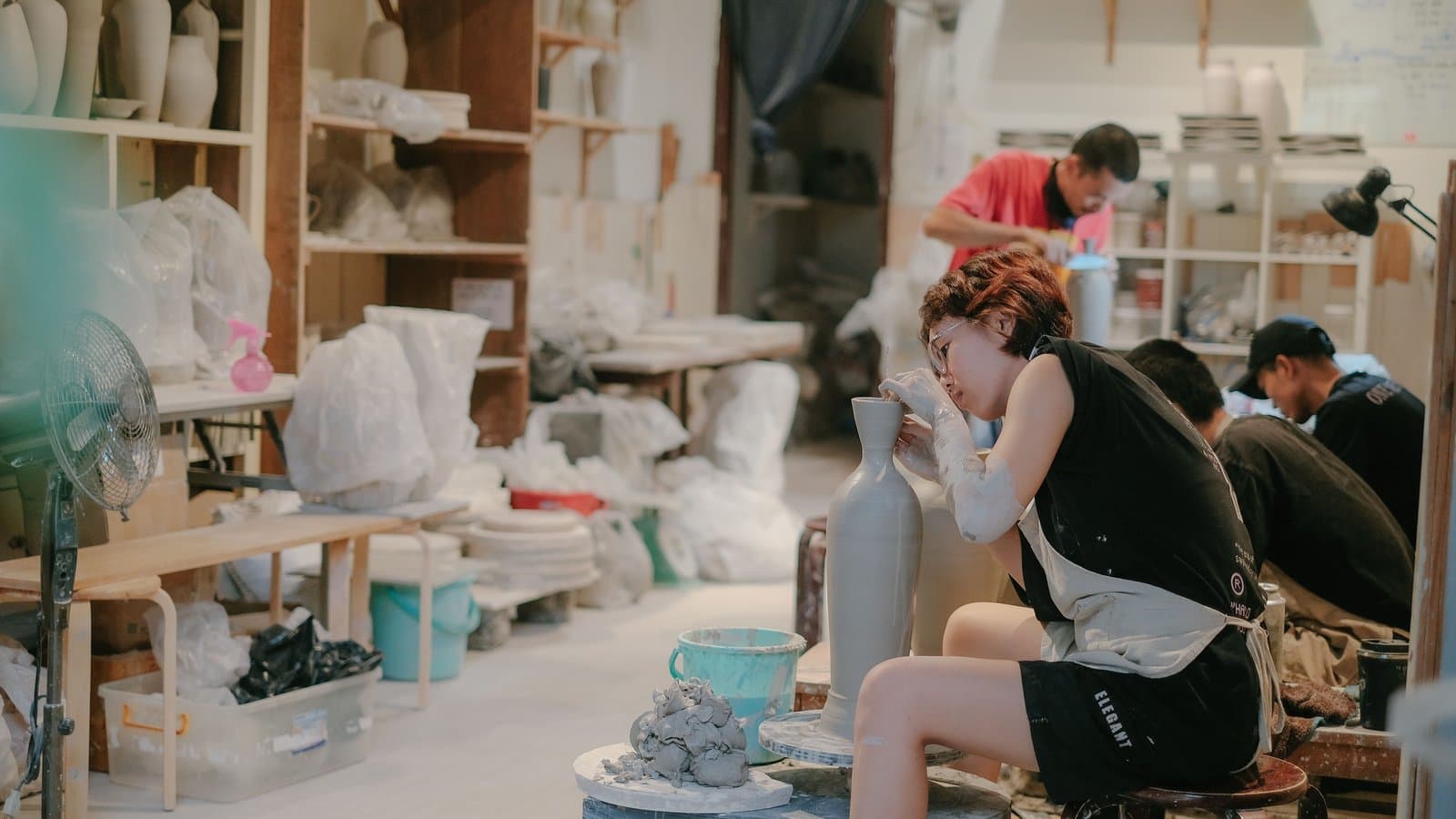
- Many techniques are portable and can be run on site, provided there are proper tables, a sink within reach, surfaces you can cover and air exchange. The potter's wheel, kilns and fixed machinery require the Maker's own workshop. It is the first thing to clarify, because it changes both the format and the price.
- What happens if someone cancels the day before?
- It depends on when the materials were bought. The sound rule is to agree in advance on a range of participants and a date by which you confirm the final number. The materials of people who do not show up still belong to the company: they can be delivered or reused.
- How much does creative team building in Bologna cost?
- There is no price list: it depends on the technique, the number of participants, who provides the space and what the team takes home. The price we quote is per person and all inclusive, covering materials, Maker and organisation: for the same number of people, nothing is added on top of it.
- Can the session be run in English?
- With some of the Makers, yes, but ask at brief stage. If the team is international, say so straight away: it changes the choice of facilitator, not the activity.
A team of ten or of forty, in the Maker's workshop or at your own offices: tell us numbers, date and goal, and we put together the Maker, the space and the materials. One point of contact, from request to event.
Let's talk about your event