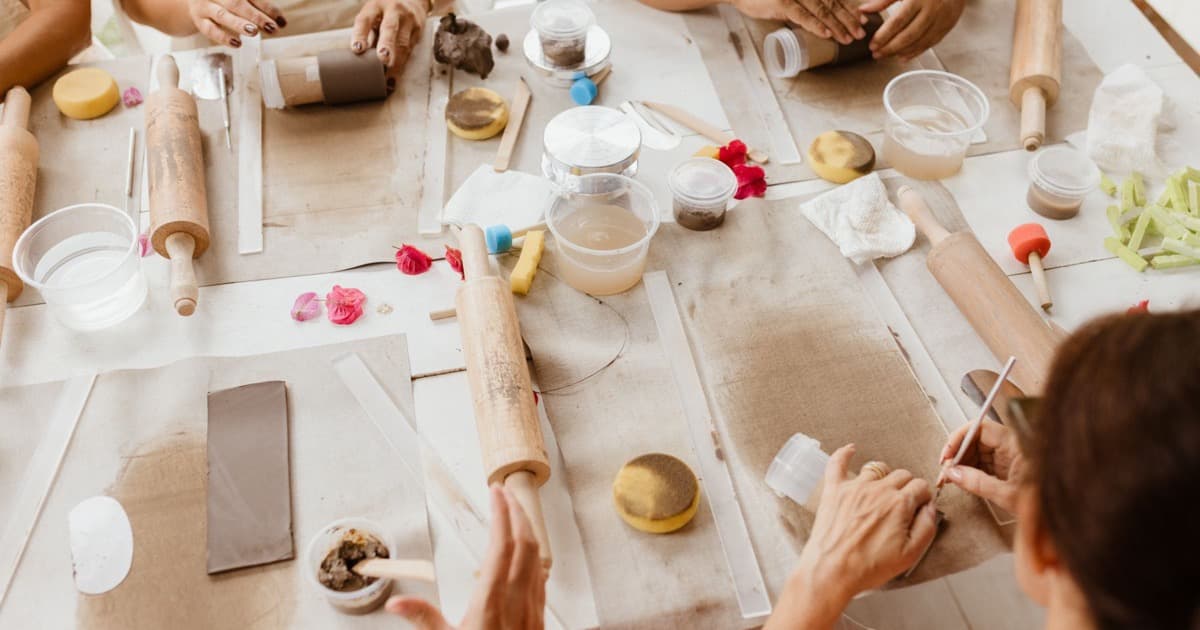
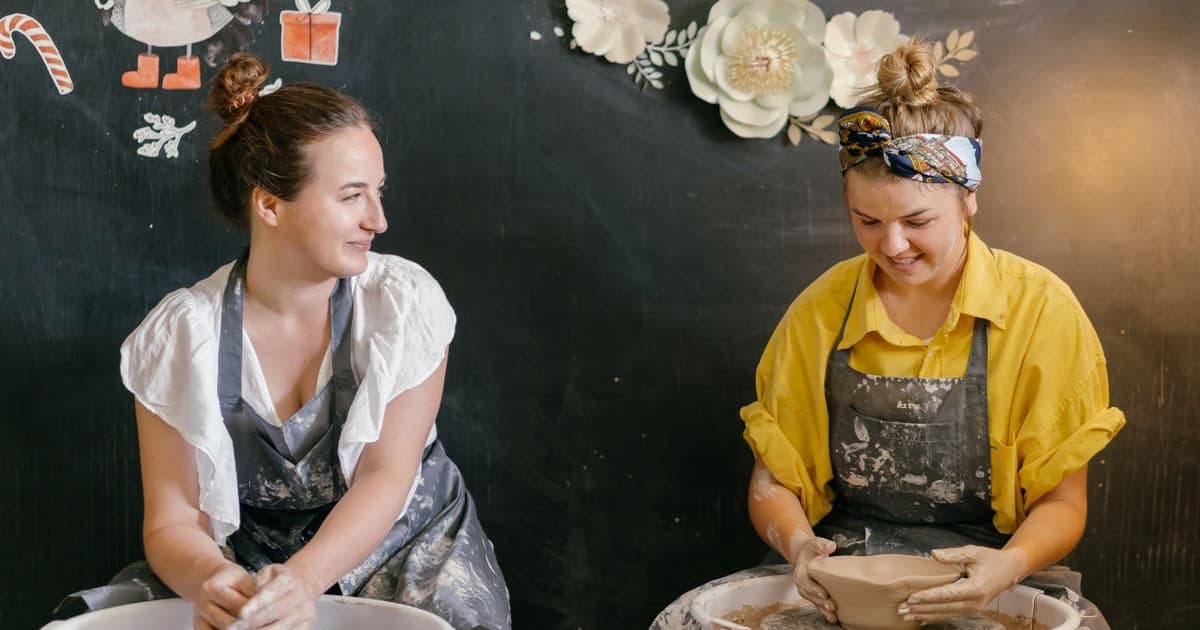
The welcome lunch has a structural flaw: the new person sits down, listens and talks to the two people next to them. By the end they know two colleagues and a menu. For onboarding new hires in Bologna there is an alternative that takes the same amount of time and leaves much more behind: a hands-on craft workshop, led by a Maker, ending with an object everyone takes away. Ceramics, printing, sewing or fresh pasta: the technique changes, the mechanism does not. You work side by side, you get it wrong together, you finish with something in your hands.
Why hands work better than a buffet
A workshop puts the group in a situation that the lunch, the round of introductions in the meeting room and the welcome kit cannot create.
- People stand side by side, not face to face. A workbench has no head of the table. You look at the dough or the slab of clay, not at the person you are talking to, and talking with busy hands is easier for everyone, especially for the shy and for those still learning the language.
- The task is the same for everyone. The head of department and the intern who started on Monday begin with the same lump of clay. At the bench, experience in the company counts for nothing: hierarchy is suspended for a couple of hours, and the group notices.
- There is a ready-made topic. No role play, no «tell us something we don't know about you». People talk about what is in front of them: the mug that leans, the colour that will not cover, the pasta sheet that tears. Introductions happen on their own.
- It ends with an object. The mug on the desk, the print pinned at the workstation, the sewn pouch. It stays in the office, recalls day one and is the excuse for the next chat with whoever shared the table.
- The Maker leads, not HR. Whoever organises takes part like everyone else. No hosting, no timekeeping: that is done by someone who does this job every day.
Which technique for which group
The techniques suited to a group that does not know each other share three traits: they can be learned in an hour, they need no prior skill and they give a visible result in the same session. In Bologna, the Makers who work with companies mostly cover these.
- Hand-built ceramics. Slab or coil building, or decorating pieces that are already fired. Building requires a second delivery after firing and glazing: for onboarding that is an advantage, because the object reaches the office a few weeks later and the group gathers again around the box. Decorating goes home the same day.
- Printing. Linocut, stamps, screen printing on paper or fabric. The most immediate: carve, ink, print, and within half an hour there is the first sheet. It works well with a shared design, for instance a motif chosen by the group, printed by each person on their own bag or postcard.
- Sewing and textiles. A small, finished object: a pouch, a pot holder, a flat bag. Slow pace, lots of conversation, no noise. For groups that above all need to talk.
- Fresh pasta (sfoglia). In Bologna it is the most natural choice. You knead, roll out, close the tortellini or cut the tagliatelle, and at the end you eat what you made: the welcome lunch, but prepared by the group.
Formats: half a day, at the Maker's or at your offices
The format that almost always works is half a day: welcome, workshop, and a closing moment with something to drink and eat. A full day tires people out, and for a new group a single hour is not enough to break the ice. Where to do it depends on how many people there are and where the office is.
- In the Maker's studio. The space is already equipped: wheel, kiln, press, sewing machines, washable benches. You leave the office, and for someone who has just moved to the city it is also a piece of Bologna they would not otherwise see. For small and medium groups; the Maker sets the capacity.
- At your offices. The Maker brings materials and tools. You need a room with tables that can be covered or washed, water nearby and, for pasta, a proper work surface. It makes sense with larger groups, with offices outside the centre (the Fiera district, the Interporto, Casalecchio, Bentivoglio, the San Lazzaro side) or when moving people costs more than the workshop itself.
On timing: not the first day, which is badges, laptops, forms and names to remember. The workshop pays off most between the end of the first week and the end of the first month, when people already have some context and a few questions to ask their colleagues.
Number of people, rough date, your offices or a studio: we reply with the Maker, the format and a single quote.
Ask Handsome for a proposalHow it works with Handsome
Organising it yourself means finding a Maker who works with groups, finding a space, handling materials and receiving several quotes to compare. With Handsome there is one path: one request, selected Makers, one quote, one point of contact. Contact with the Maker goes through Handsome, which picks who fits that group and that venue and follows every step: there is no need to reach out to them directly.
- Fill in the request at handsomemakers.com/aziende: how many people, indicative budget, city, preferred date and any special needs.
- Receive a proposal: what you will do, date and time, duration and a price per person, all inclusive, built around the group you described. We reply within 24 hours and the tailored proposal arrives within 2 working days.
- Confirm the quote, a single one, covering the Maker, the materials and, if needed, the space: you pay online to secure the date, with no registration needed.
- On the day, the Maker leads; whoever organised takes part. If there is a second delivery (ceramics after firing), Handsome coordinates it.
- You have one point of contact, Handsome, for everything: by email or WhatsApp, before and after the workshop.
What to prepare before asking for a proposal
The proposal is only as precise as the request. These are the details that make the difference.
- Number of people, and whether it may change. If other hires are about to close, say so: a small group and a large one are different formats, and a Maker with spare capacity saves you from redoing everything close to the date.
- Date and time slot. A window of two or three dates beats a single one: Makers' studios are working spaces, not event venues, and trade fair weeks in Bologna shift availability and prices for everything.
- Budget per person. You do not need an exact figure, you need an order of magnitude decided beforehand. Budget does not change the quality of the Maker: it changes technique, length, materials and whether there is a convivial moment at the end. Saying it upfront avoids a proposal that has to be redone.
- Allergies, intolerances and accessibility. Pasta means gluten and eggs; ceramics means dust and water; some printing uses solvents. Ask the new hires before asking us. On accessibility: ground-floor studios or lifts, seated stations, more time for those who need it. These are normal requests, not exceptions.
- Language. Around the Fiera and at the Interporto many offices welcome people who are still learning Italian. Ask for a Maker who also leads in English: there are some, but it has to be said in advance.
Three realistic cases in Bologna
Typical situations, built on the groups that are described to us most often. They are not real companies, but the way format, technique and venue fit together is the real one.
A multinational's office in the Fiera district
New hires who joined in the same quarter from different countries, many of them in the city for only a few weeks. A large meeting room, international hours. Format: printing at the office; the Maker brings plates, inks and a hand press and leads in English; each person prints the same motif on a canvas bag and on a postcard to leave at their workstation. No travel, everyone present, even the person with a call at four.
A city-centre firm with its summer interns
A professional firm under the porticoes that welcomes a group of interns every summer. Format: hand-built ceramics in the Maker's studio, walking distance from the office, half a day at the start of the internship. The pieces come back after firing, in the week when the interns present their final work: the delivery closes the programme.
A logistics company at the Interporto
New hires split between office and warehouse, different shifts, a site you can only reach by car. Format: fresh pasta in the company canteen, in a slot that covers the shift change; the Maker brings boards, rolling pins and ingredients. Knead, close the tortellini and eat them together: the welcome lunch made by the people eating it, with office and warehouse at the same table.
Tell us about the group and the venue. We select the Maker, put together space and materials and send you a single quote.
Ask Handsome for a proposalFrequently asked questions
Frequently asked questions
- How far in advance should an onboarding workshop be booked?
- The earlier the better, especially with large groups, spaces other than the Maker's studio or dates in a trade fair week. If the hires are already scheduled, you can send the request before you know the exact number: the format is locked in and the group is confirmed later.
- Can it be held at our offices instead of the Maker's studio?
- Yes, for almost every technique. You need a room with tables that can be washed or covered, a water point and, for pasta, a proper work surface. The proposal spells out what the Maker brings and what the company provides.
- Does an onboarding workshop count as corporate welfare?
- It depends on how the company frames it and on the plan already in place. We do not give tax advice: the article on corporate welfare in Bologna lists the official sources to start from, to be read with whoever handles your tax side.
- We only have two or three new hires: is it worth it?
- Yes, only the format changes. For very small groups you can book places in a public workshop among those on Handsome in Bologna, tutor included, or give a gift card to use when they prefer.
For a group that already exists, the piece on creative team building in Bologna goes into detail on formats, spaces and drop-outs; for a package of experiences for all employees, start from corporate welfare in Bologna. For onboarding, the short route is a request at handsomemakers.com/aziende.