In Milan, the December corporate gift has a calendar problem long before it has a taste problem. Between the end of November and the first days of December, Fieramilano Rho hosts L'Artigiano in Fiera; around 7 December, for Saint Ambrose, the Oh bej! Oh bej! fair fills the grounds of the Sforza Castle. But by the time Milan fills up with craft, corporate gifts have been bought weeks earlier: anyone turning up in those days with the idea of something handmade finds only what is left over.
This guide is not about logistics and ordering: we covered that side in our piece on closing the employee gift order across several offices. Here is the part almost nobody considers: how a handmade gift is actually produced, how long it takes, how many pieces a workshop can handle, and how you choose between object and experience. It is the part that decides whether the gift arrives at all.
The hamper isn't the problem: anonymity is
The Christmas hamper has one virtue nobody credits it with: it works. It takes half an hour to order, it arrives packaged, nobody takes offence. The problem is that it says nothing about who sent it and asks nothing of whoever receives it: two days later it disappears into a kitchen cupboard, and by March no one remembers where it came from. If that budget was meant to make you memorable, it did no work.
The handmade gift works for the opposite reason: it forces a choice. Someone decided the material, the shape, the colour, the engraving, and the person receiving it can tell. But it carries a hidden cost: time. A hamper is assembled; a handmade object is made, and making it takes days that cannot be compressed by paying more.
Personalised object or experience: two different decisions
The first choice is not "which object", it is "object or experience": two gifts that solve different problems and fail in different ways. A handmade object arrives where it is needed without asking anything of anyone: it sits on a desk, it is seen every day, it works for remote workers and for anyone who would never travel for a gift. In exchange, you have to guess right: get the taste wrong and you have got it wrong for everybody at once.
A gifted experience turns the relationship around: there is no wrong size, no parcel stuck at reception, and the recipient chooses the craft, the date and the studio. It counts as time rather than as an object — even though you take the object home anyway. The price is that it demands movement: someone has to go out and turn up. For a team that works side by side all year, an experience together is the gift that replaces the office dinner.
- Object: if people are scattered, working remotely or based in distant offices, and if the gift also goes to clients.
- Experience: if people are concentrated in a few reachable places and you would rather not guess tastes and sizes.
- Both together: one large office plus people scattered elsewhere is the most common case, and it does not complicate the order.
- Neither, until you have a firm deadline: without one, every choice becomes a December scramble.
Real handmade lead times: why November is late
The basic misunderstanding is treating craft production as a slow version of industrial production. It is not: it is production with physical waiting built into it. The Maker is not slow; the material has its own timing, which no urgent order shortens.
- Ceramics. A freshly shaped piece air-dries for days before it can go into the kiln. Firing lasts many hours and the temperature has to rise and fall gradually: opening the kiln and taking out the biscuit takes the best part of a day. Then glazing, decoration and a second firing.
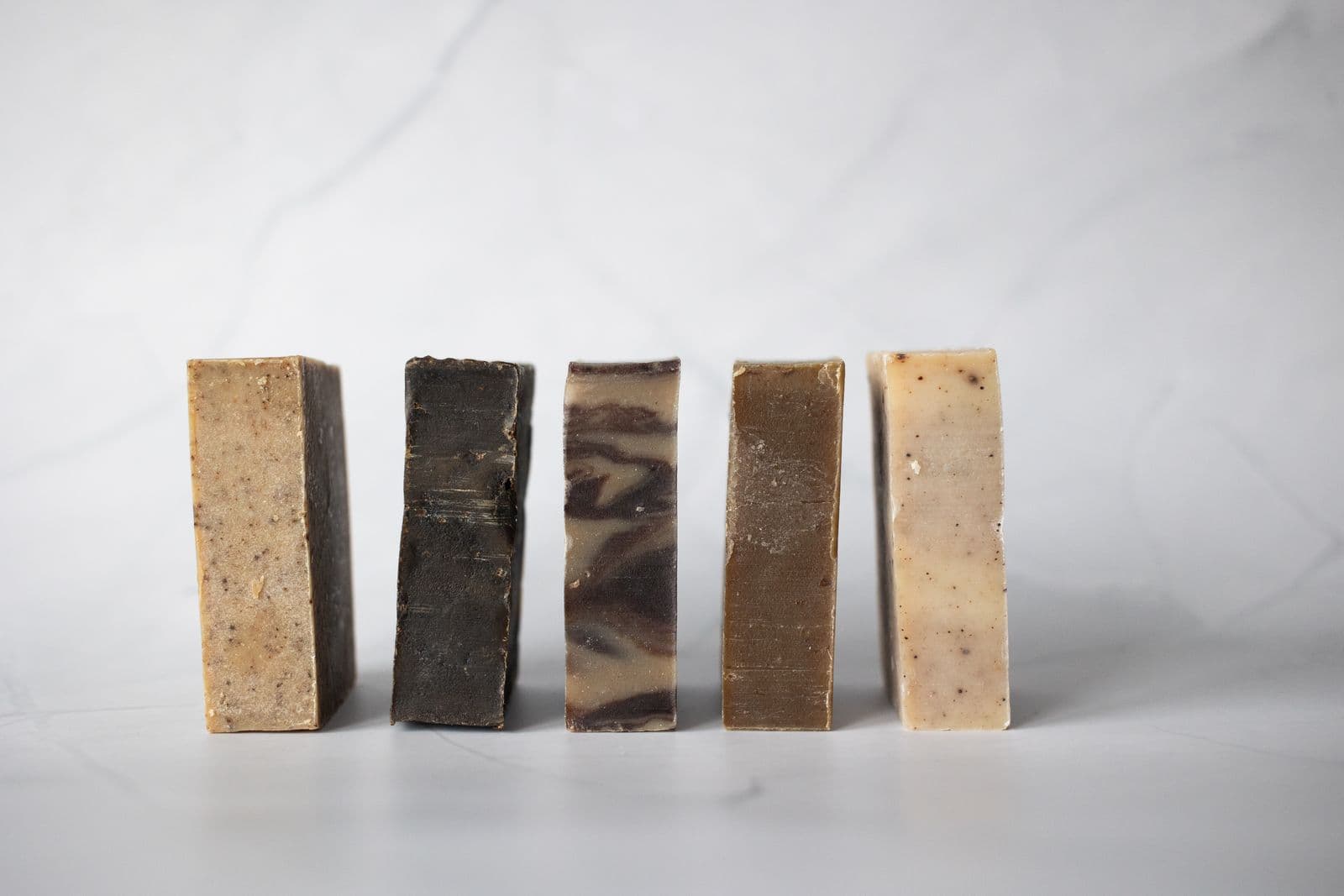
- Soap. A cold-process soap stays in the moulds for 24 to 48 hours and then cures for four to six weeks before it can be used. Ordered in November it is not ready for Christmas: that is a chemical constraint, not a scheduling one.
- Wood. An oil finish wants at least three coats, with 24 to 48 hours of drying between one and the next: the finishing alone on a production run takes more than a week of studio time.
- Personalisation. Engravings, initials, a logo: every piece becomes a different piece, so the time multiplies by the number of people, not the number of orders. A logo on a hundred and twenty mugs is a hundred and twenty operations.
And there is one step that always vanishes from plans made late: the sample. Before launching a run bearing the logo, someone has to see a finished piece, say that the green is not that green, and have it redone. That loop costs one or two weeks, and it is what separates a beautiful gift from a gift that will do.
How many pieces a workshop can really make
The second question almost nobody asks is the most obvious one: how many can you make? A craft workshop is not a miniature factory. In Milan and its hinterland, most studios are one-person or few-person operations, where whoever makes the work also answers the emails, packs the boxes and keeps the books. Capacity does not add up the way it does in a plant, and asking for twice as much does not double it.
The bottleneck is not the hands: it is the equipment. A ceramic kiln has a volume, and that volume decides how many pieces fit into one firing; a working day usually holds a single firing, because the kiln has to cool down in between. Real weekly capacity comes out of that multiplication, not out of a promise made on the phone. Four questions, before confirming a volume, all fit into one email.
- How many finished pieces do you deliver per week, personalisation included?
- What is the first free week in which you can start — not finish, start?
- Does the volume fit into a single run, or does it need splitting with staggered deliveries?
- If a piece breaks in the kiln, how long does it take to remake it?
An honest Maker will say no when the number is not sustainable, and that no is worth more than an enthusiastic yes in September that becomes a problem in December. If the volume exceeds a single workshop, you split the order between several Makers on coordinated variants — same material, different shapes — or move some of the group onto an experience.
A handmade gift is not bought: it is commissioned. And a commission has a start date, not just a delivery date.
The tax treatment changes for a client and for an employee
It is worth knowing before you set the per-person budget, because it changes the usable figure. In Italy, gifts to clients count as entertainment expenses: the cost of goods given away is fully deductible if the unit value does not exceed 50 euros (art. 108, paragraph 2, of the income tax code) and, under the same threshold, the VAT on the purchase is recoverable. The limit has stood at 50 euros since 13 December 2014, when the tax simplification decree (Legislative Decree 175/2014) raised it from the previous 25.82 euros. Above 50 euros the VAT is not recoverable and the cost falls within the percentage limits on revenue set by that same art. 108: 1.5% on the share of revenue up to 10 million, 0.6% on the share between 10 and 50 million, 0.4% on the share above 50 million. Those percentages have applied since 2016, after Legislative Decree 147/2015 replaced the lower figures originally set by the ministerial decree of 19 November 2008.
Gifts to employees follow a different route: they are not entertainment expenses but employment costs (art. 95, paragraph 1, of the income tax code), so the cost is deductible while the VAT on the purchase remains non-recoverable. For the recipient, the gift is a fringe benefit: the exemption threshold is 1,000 euros a year, or 2,000 for employees with dependent children, set for the 2025-2027 period by the 2025 Budget Law (Law 207/2024) — before locking the budget, check that the latest budget law has not changed it. Mind how the threshold works: if the year's total benefits exceed it even slightly, the entire amount becomes taxable, not just the excess.
The backwards calendar, month by month
With real dates instead of plan-ahead rhetoric, the plan becomes a few hours of work in total.
- September. Decide the shape of the gift (object, experience or a mix), the number of people and the budget range. You don't need a supplier, you need a signed-off internal decision.
- Late September, early October. Send the brief and gather proposals: a workshop that still has room in October has it by choice, not by bad luck.
- October. Sample: a genuinely finished piece, with the real personalisation, approved by whoever decides.
- End of October. Order confirmed and production under way. From here on, changes cost time rather than money.
- November. Production plus one mid-run check: a photo halfway through avoids almost every surprise.
- First week of December. Delivery, with margin against the date of the office party.
And if you are reading this in November? Change the shape of the gift. Experiences and gift codes need no production, they need free seats, and those open up right until the last minute. A complex object ordered in November is a risk; an experience to be enjoyed in January lasts longer, because it arrives once the holidays are over and there is nothing left to look forward to.
Who holds the pieces together
Coordinating three workshops handling different materials on different timelines is a job in itself, and it lands on someone who already has plenty to do. That is where we can help: with Handsome for companies you send one request — people, deadline, type of gift, budget — and we look for the Makers who can handle that volume in that timeframe, without promising capacity that isn't there. If the number does not fit the calendar, we say so while you can still change your mind.
Frequently asked questions
- When should you start organising handmade corporate gifts?
- September for the internal decision, late September to October for briefing the workshops. October is the cut-off month for approving a sample and starting production calmly. By November, what stays realistic is mainly experiences and gift codes, which require no production.
- Why is November late for a handmade object?
- Because craft work contains physical waiting periods that cannot be compressed: cold-process soap cures for four to six weeks, a ceramic piece dries for days before its first firing and needs two firings with slow cooling, an oil finish wants at least three coats 24 to 48 hours apart. Add the sample approval loop and November is already past the limit.
- How many pieces can a craft workshop produce?
- It depends on the equipment more than on the hands: the kiln or the dye vat decides how many pieces fit into one cycle and how many cycles fit into a day. Ask the Maker for real weekly capacity with personalisation included, and for the first free week in which they can start. If the volume exceeds it, the order is split between several workshops.
- How are gifts to clients and employees treated for tax in Italy?
- To clients they are entertainment expenses: fully deductible with recoverable VAT up to a unit value of 50 euros, beyond which the percentage limits on revenue apply and the VAT is not recoverable. To employees they are employment costs, deductible but with non-recoverable VAT, and for the recipient they are fringe benefits exempt up to 1,000 euros, or 2,000 with dependent children. Since 2025 the payment must be traceable.
Volumes, deadline and type of gift
Ask for a proposal for your company