A man climbs a 109-step staircase with a sack of corn flour on his shoulder. Halfway up he stops to catch his breath, rests the sack on the edge of the well, and the sack slips in. In any other town the story would end there, with a curse. In Corinaldo, it's where everything begins.
Legend has it that the man, rather than climbing back up, stayed down in the well eating his polenta. The women of the town, seeing he never returned, started spreading the word, and ever since the locals have carried the nickname polentari — the polenta eaters. Any ordinary village would have buried the story out of embarrassment. Corinaldo built its identity on it: the well is officially called the Pozzo della Polenta, every summer a costumed reenactment — the Contesa del Pozzo della Polenta — restages the falling of the sack, and the town has earned, with a certain pride, its reputation as the "village of the mad". Few places in Italy laugh at themselves this seriously.
The Piaggia staircase, with the well in the middle
The Piaggia staircase is the vertical heart of the village: 109 brick steps cutting through the historic centre, with the well planted exactly halfway up. Tradition says the well was built in the fifteenth century to supply water to the houses along the climb, which at the time was a paved road; it was buried in the early twentieth century, during works on the staircase, and rebuilt in 1980. Climbing the Piaggia slowly, stopping where the man with the sack stopped, is the right way to start your visit.
A few steps away is another story that explains the character of the place: the house of Scuretto. Gaetano, known as Scuretto, was a cobbler with a robust passion for wine. His son, who had emigrated to America, sent his savings home to build the family house; the money ended up, regularly, in the taverns. When the suspicious son demanded a photograph of the building works, Scuretto had only the facade built — complete with a street number — and had himself photographed leaning out of the window. The son understood and cut off the funds. The facade without a house is still there, and it is one of the most photographed spots in town.
The walls: 912 unbroken metres
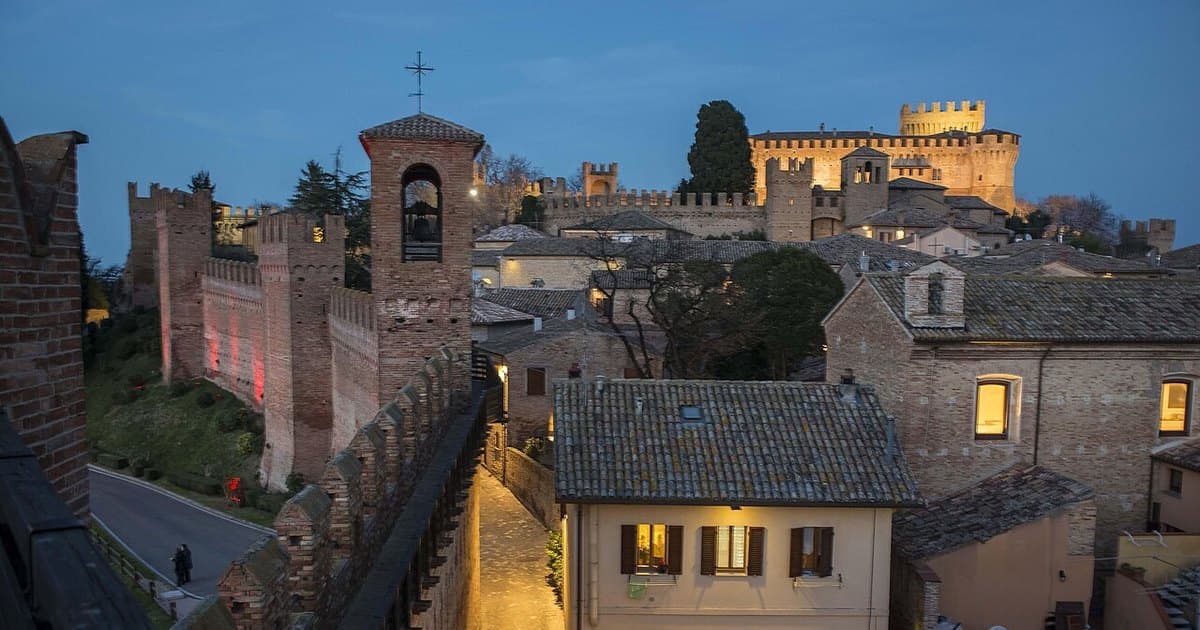
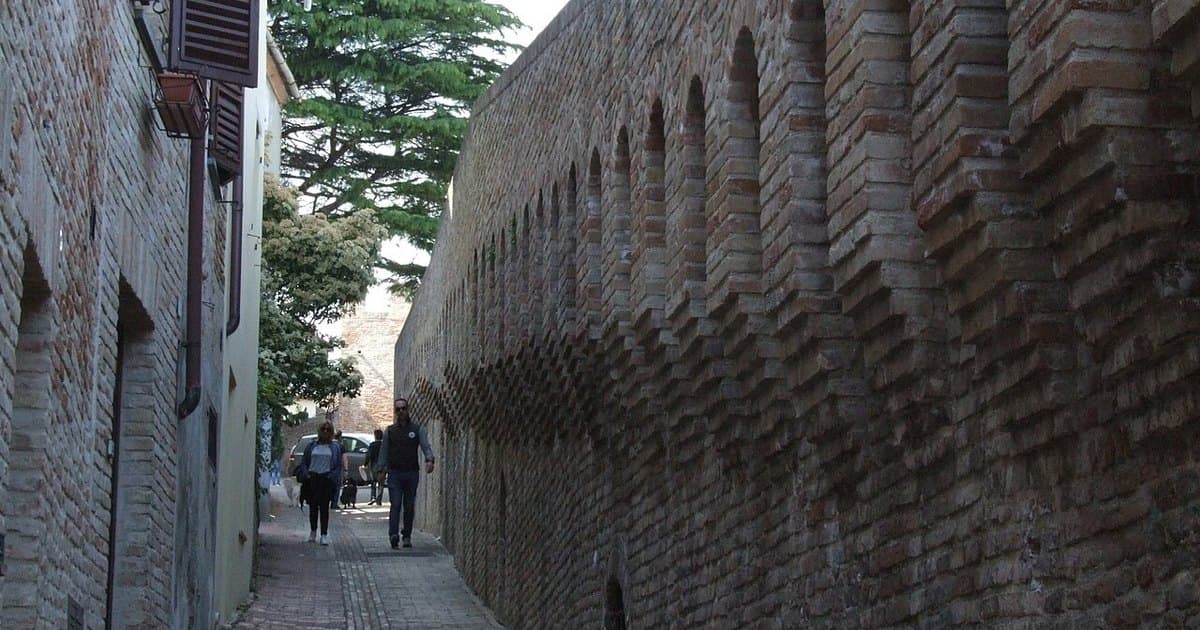
Then there are the walls, and this is where Corinaldo stops joking. After the town's destruction, Pope Urban V authorised its complete reconstruction in 1367. The result is an unbroken ring of 912 metres, reaching 18 metres in height, punctuated by circular and pentagonal towers, fortified gates and walkways: the most intact and longest walls in the Marche, among the best preserved in all of central Italy. The fortification elements are attributed to Francesco di Giorgio Martini, one of the great military architects of the Renaissance.
And they are not just scenery. In 1517 they withstood the siege of the army of Francesco Maria della Rovere, Duke of Urbino: twenty-three days of siege, and the town did not fall. For that resistance, Pope Leo X granted Corinaldo the title of city. Following the perimeter on foot today, passing under the gates and along the towers, is the best way to understand that this village of "madmen" was in fact built to surrender to no one.
Halloween: when the village dresses up
Since 1998, Corinaldo has added a new chapter to its legend: Halloween, the Festa delle Streghe — the Witches' Festival. It began as a small town celebration with a single tavern; in 2000 the Fear Tunnel arrived, and in 2003 the financial daily Il Sole 24 Ore crowned Corinaldo "Italy's Halloween capital". Today, in the last days of October, the alleys fill with pumpkins, masks, shows and taverns: the medieval village becomes the busiest — and most entertaining — place in the Marche in autumn. That a town founded on a self-mocking legend became the Italian home of the year's most theatrical festival is no accident: dressing up is an old tradition here.
The devotional side: Saint Maria Goretti
Corinaldo is also a place of pilgrimage. Here, on 16 October 1890, Maria Goretti was born — one of the most venerated saints of the twentieth century. Her birthplace, a brick farmhouse about one kilometre from the historic centre, can still be visited; in town you'll find the diocesan sanctuary dedicated to her and the small church of the Incancellata, where her family used to pray. It is an intimate itinerary that gives the village a completely different register from the witches and the polentari — and one that coexists with them without friction, like everything in Corinaldo.
Slow time is the right time to learn
Corinaldo is listed among the Borghi più belli d'Italia (Italy's most beautiful villages) and holds the Touring Club's Bandiera Arancione, but labels only count for so much: what stays with you is the pace. A place where a legend about a sack of flour has lasted for centuries is a place where time is measured differently. And that is exactly the time it takes to learn a craft: kneading, turning, sewing, weaving demand the same patience as climbing a 109-step staircase. In villages like this, Maker workshops are the natural continuation of the visit: you arrive as a tourist and leave with something made with your own hands.
Frequently asked questions
- How much time do you need to visit Corinaldo?
- Half a day is enough for the staircase, the walls and the alleys. If you add the Saint Maria Goretti sites or come during the Witches' Festival, plan a full day.
- When is Halloween held in Corinaldo?
- The Festa delle Streghe takes place in the last days of October, peaking on the 31st. It is the busiest event of the year: arrive early and check the programme in advance.
- Can you walk the walls?
- Yes: the best way to see them is to follow the perimeter on foot, passing through the gates and along the towers. It's 912 unbroken metres, and the one thing you must not skip.
- Where is Corinaldo?
- In the hinterland of Senigallia, in the province of Ancona, in the Marche region. It pairs well with a day on the coast or a tour of the valley's other villages.