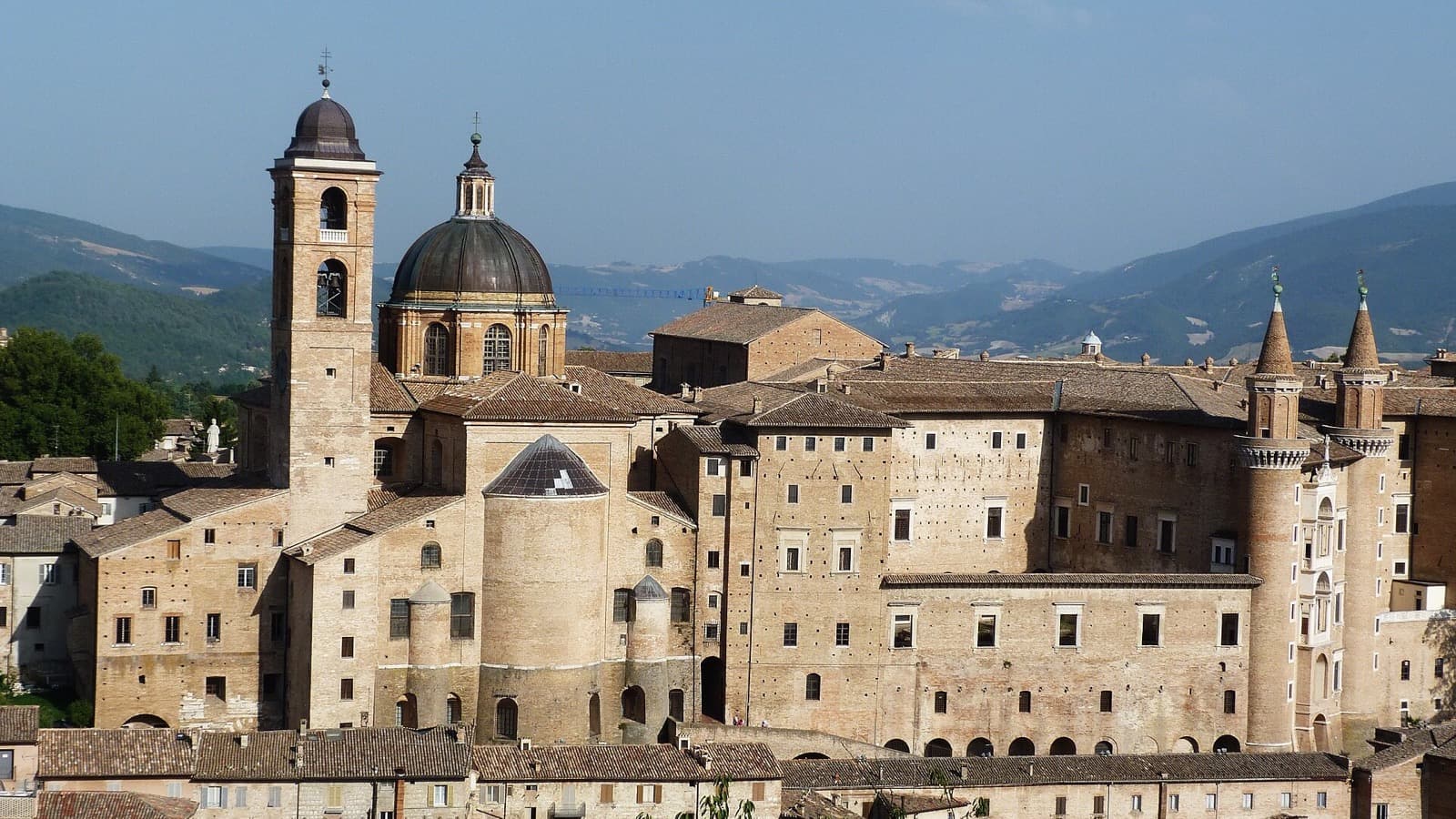
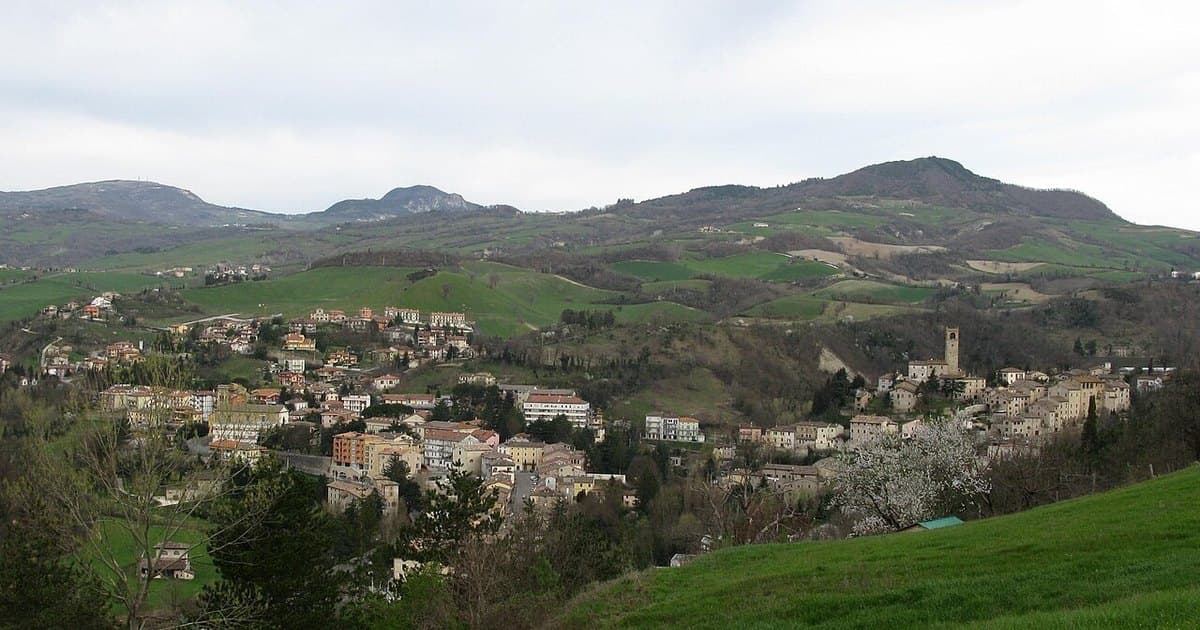
The same Montefeltro as the most photographed villages, but on the Marche side and off the mass-tourism circuit: same hills, same stone, far fewer people. Macerata Feltria is in the province of Pesaro and Urbino and borders Montecopiolo, which moved to Emilia-Romagna in 2021 under law 84, together with Sassofeltrio. The Romagna border, today, is right on its doorstep.
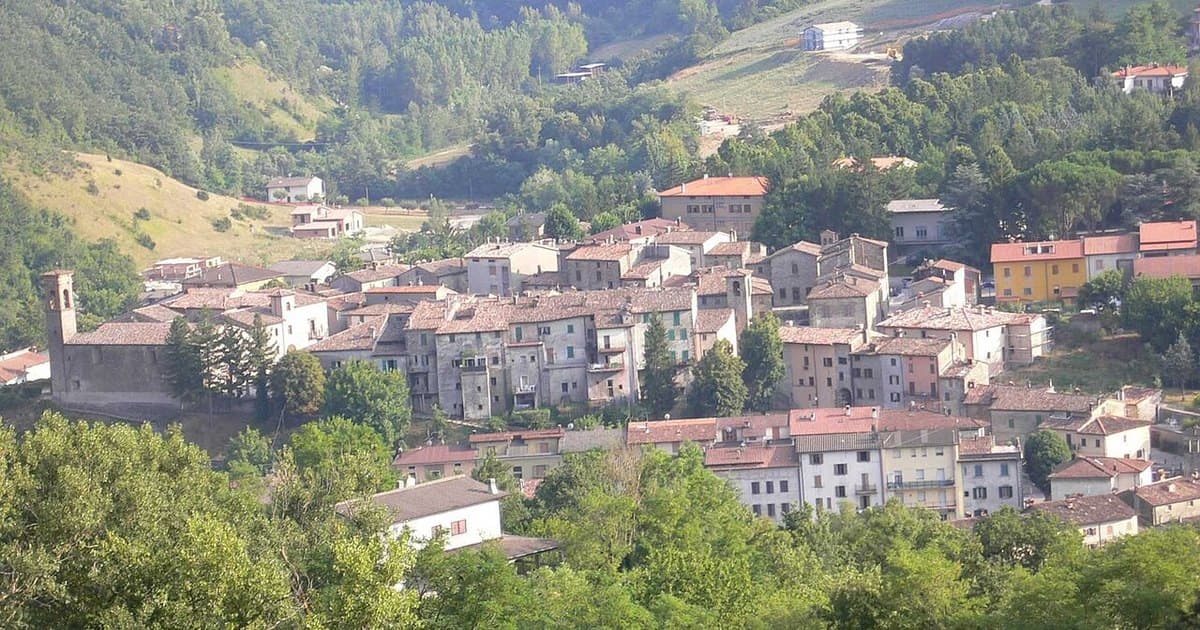
It is a town of just over two thousand residents, 321 metres above sea level, in a green basin where the Marche, Romagna and Tuscany almost meet. It appears on the official list of I Borghi più belli d'Italia. Within the same square kilometre three things overlap: a fortified core of Lombard origin, a Roman town buried under the fields and a sulphur spring. Enough for a full half day, and for a whole weekend if you plan ahead.
Two towns in one: the Castello and the Mercatale
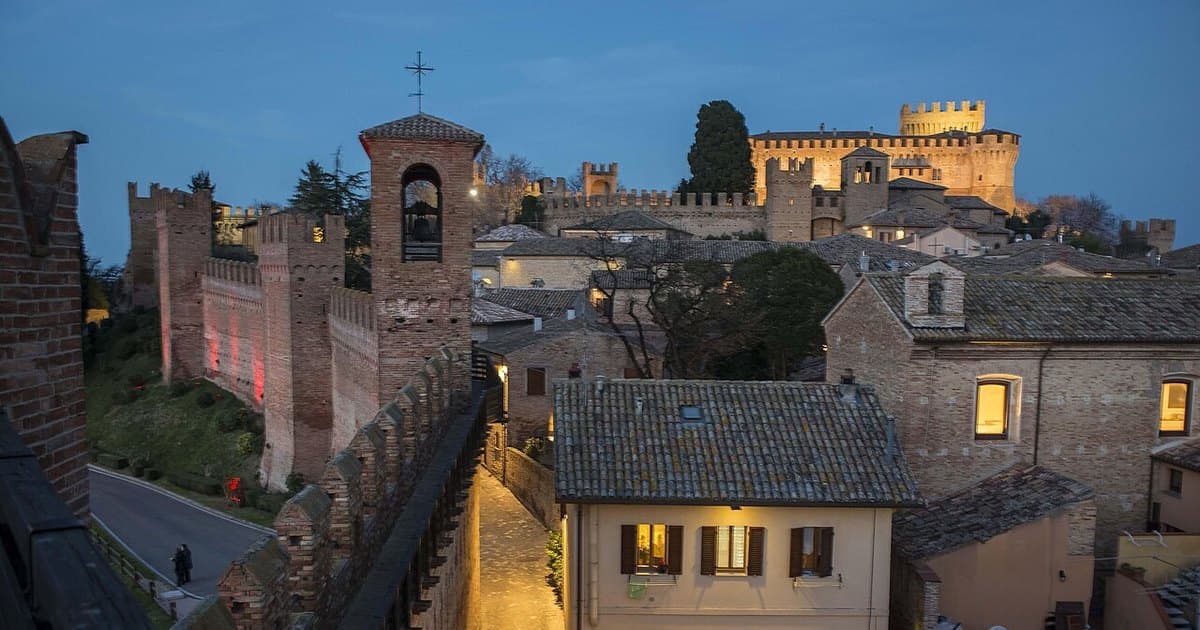
The old centre is split into two halves that face each other. Up top is the fortified core of Lombard origin, which everyone calls the Castello: narrow streets and the civic tower you can see from a distance. Below is the Renaissance section, the Borgo, also known as the Mercatale because the market was held there. You go up on foot. One entrance worth using is the Arco dei Pelasgi, the old southern gate of the Castello.
- Palazzo del Podestà, 13th century, today home to the civic museum.
- The civic tower, which dominates the hill and is visited on the same ticket as the museum: inside, spread over four floors, are fossils collected across Montefeltro and the Metauro valley.
- The church of San Giuseppe, which holds a painted leather altar frontal bearing the Montefeltro coat of arms.
- Palazzo Evangelisti, 16th century, decorated with frescoes.
- The church of San Michele Arcangelo, with a wooden crucifix dated 1396.
The museum inside the Palazzo del Podestà
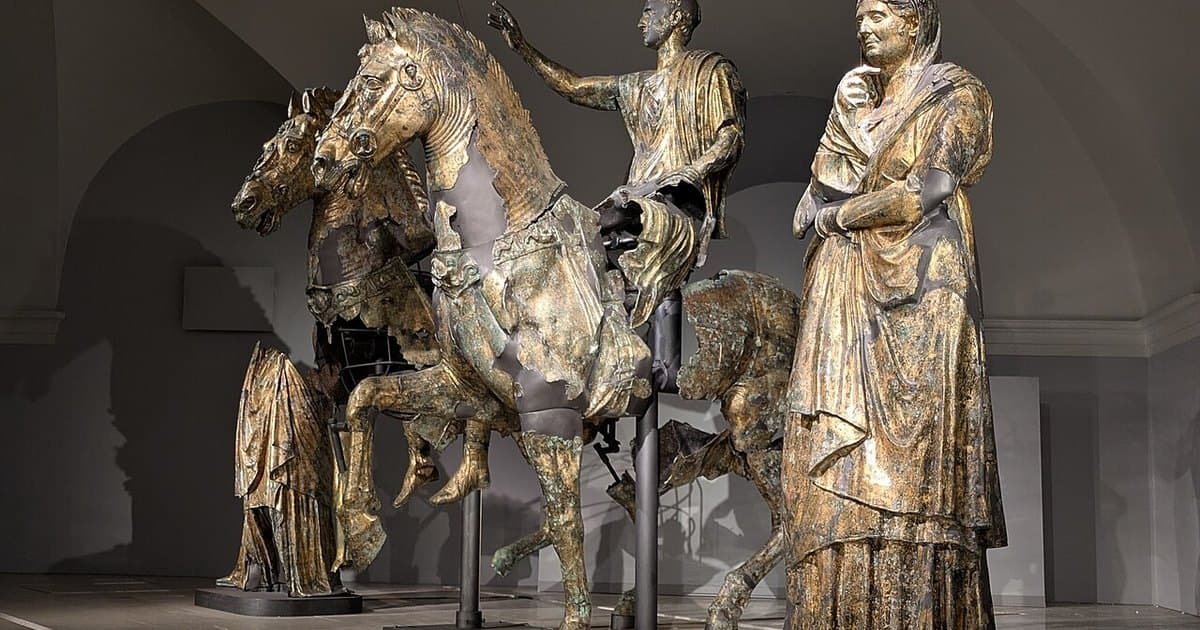
The Museo Civico Archeologico e Paleontologico occupies eight rooms of the Palazzo del Podestà and tells the story of the area from prehistory to the Roman age. The first rooms line up Bronze Age and Iron Age material. Two full rooms are given over to Pitinum Pisaurense: inscriptions, coins, bronzes, everyday objects, pottery, glass and architectural terracotta. The final section moves into the Middle Ages, with the reconstruction of tombs found above the decumanus maximus of Pitino, near the church of San Cassiano.
Pitinum Pisaurense is the Roman town that stood here before the present village, a little over a kilometre from today's centre. Inhabited from the end of the 3rd century BC, it went on living without interruption until the 6th century AD. The medieval village came later, built on its ruins, and that is where the name comes from: Macerata, from the rubble of the Roman town.
The Certalto spring, and why the baths are not an option
Two natural springs run beneath the town, Certalto and Apsa, and sulphur water comes out of both. The thermal establishment opened in 1993 and fed by the Certalto was given the Roman name of the town, Pitinum. Today, though, it is not a service you can use: it has been closed for years, health-booking portals list it as permanently closed with no treatment available to book, and the official website no longer exists. In March 2021 the mayor spoke of a forced closure that had lasted years and warned that reopening would take a long time. No source since then records a reopening.
The only recent news concerns the water, not the baths: in February 2021 the Marche Region authorised the concession to bottle the sulphur water of the Certalto, taken over by a private buyer after the thermal company went bankrupt. It is drunk and used for inhalation, but there is nowhere in Macerata Feltria to bathe.
The other two museums are booked, not found open
Macerata Feltria has two more museums, small and very different from each other. The Museum of Industrial Archaeology is installed in the cellars beneath the church of Santa Chiara and gathers working machinery from mechanical workshops of the 19th and 20th centuries. The Vintage Radio Museum occupies a room in the former convent of San Francesco, with around a hundred restored, working sets produced between the 1920s and the 1960s. Neither keeps open doors: on the Ministry of Culture listings both appear as closed every day of the week, and a visit has to be arranged in advance with the Museo Civico Archeologico or the town's tourist office (0722 728208, switchboard 0722 74244). They are not a fallback you can improvise in the rain: either you call before leaving, or those doors stay shut.
What to eat and when to come
At the table Montefeltro is consistent with itself: cheeses, cured meats, produce from the woods, truffle. Among local sweets there is a cake made with walnuts and raisins. On the calendar, three windows are worth more than the others.
- March, with the Fiera di San Giuseppe, the early spring fixture.
- The first weekend of August, with Preziosi d'Epoca: fashion shows and period jewellery brought in by goldsmiths from across Italy.
- Autumn, the best season for walking: full colour on the hills and no queue anywhere.
Half a day free? Make something with your hands
A slow weekend has one practical problem. After the walk through the village, the museum and the climb up the tower, three or four hours are left over. The temptation is to add another town to the list. The risk is going home with twenty identical photographs and no memory that is genuinely yours.
The alternative, where one is running, is spending those hours in a workshop with a local Maker. Ceramics, weaving, wood, illustration, cooking: these are the kinds of workshop you come across in Montefeltro, not something guaranteed every weekend. When there is one, you book in advance, you know what time it starts and what time it ends, and you come home with an object you made. It is also the kind of activity that holds up in bad weather, which is exactly when an inland weekend tends to fall apart.
Frequently asked questions
- Can you do a spa weekend in Macerata Feltria?
- No. The Pitinum Thermae establishment, opened in 1993 and fed by the Certalto spring, has been closed for years and cannot currently be visited or booked: health-booking portals list it as permanently closed and the official website no longer exists. Even when it was running, its published hours covered weekdays, not the weekend.
- What happened to the Certalto sulphur water?
- It is bottled. In February 2021 the Marche Region authorised the concession to bottle the sulphur water of the Certalto, taken over by a private buyer after the thermal company went bankrupt. It is drunk and used for inhalation, but there is no facility today where treatments are given on site.
- How much time do you need for the village?
- The old centre takes a good hour on foot. Add the museum inside the Palazzo del Podestà and the climb up the civic tower and you are at half a day. To fill a whole weekend you need to book the other two museums in advance and plan a loop through the surrounding Montefeltro.
- Why choose Macerata Feltria over a village on the Romagna border?
- Because the landscape is the same and the crowding is not. Since 2021, with Montecopiolo and Sassofeltrio moving to Emilia-Romagna, the administrative border sits right against the municipality: same Montefeltro, far fewer people. And because two things overlap here that rarely sit together, a documented Roman town and a fortified core of Lombard origin, within a few kilometres.