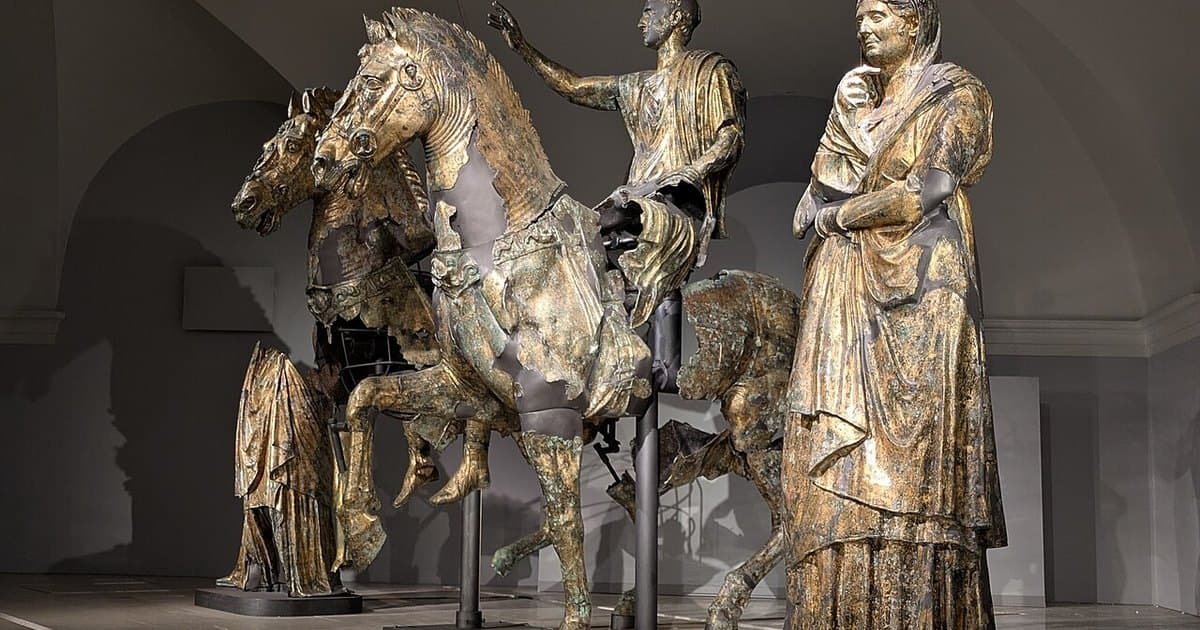
Italy's large Roman bronzes can be counted. Almost all of them ended up in the museums of big cities. One did not: it is in Pergola, a hill town in the province of Pesaro and Urbino, in the Cesano valley. It did not arrive on loan or for a temporary show. It is there because it was found there, in a field, by two men digging a ditch.
Four figures and a pit in the ground
On 26 June 1946, in the hamlet of Cartoceto, at Santa Lucia di Calamello, the brothers Giuseppe and Pietro Peruzzini were digging a drainage channel on the farm they worked as sharecroppers. Their spade struck metal. Out of that pit came around nine hundred kilos of gilded bronze fragments, broken into more than three hundred pieces of different sizes.
Put back together, those pieces form four figures: two men on horseback and two standing women. The dating ranges between the 1st century BC and the 1st century AD. Italy's Ministry of Culture describes the group as the only gilded bronze group to have come down to us from the Roman age: it is a measured formula and it is worth keeping it as it is, without inflating it. Reassembly took decades: after a first restoration begun in the post-war years, a second campaign between the 1970s and 1980s made it possible to fit 318 fragments back into the four figures.
How you build a bronze horse
This is where the visit changes gear. A group on that scale was not carved: it was cast. The technique is lost-wax casting by the indirect method, which compared with the direct method has one big practical advantage: the model is not destroyed in the process and can be reused. It belongs to the same family of operations a founder or a goldsmith still performs today, at a much smaller scale.
- The figure is modelled in clay.
- Plaster moulds are taken from the model and lined on the inside with wax: the thickness of the wax will become the thickness of the metal.
- The wax form is filled with earth and covered on the outside with refractory material.
- It is fired: the wax melts and runs out through channels made for the purpose.
- Molten bronze is poured into the void the wax has left behind.
A whole horse does not fit into a single pour. The figures were made in sections, cast separately and then joined with bronze welds. The alloy is copper, tin and lead, with a high proportion of lead, over thirteen per cent. That is not an aesthetic choice: lead makes the metal more fluid and helps it fill a large, complicated mould without leaving voids.
The gilding is gold leaf, not solid gold
The gold comes after the casting, and very little of it is needed. The gilding was done in leaf: extremely thin rectangles of 24-carat gold applied to the surface of the finished bronze. It is the same principle used today to gild a frame, a wooden statue or a detail of jewellery. Once you know that, you look at the room differently: you are not looking at a block of gold, you are looking at a skin of gold laid over dark metal.
The museum, housed in a convent
The Museum of the Gilded Bronzes and of the City of Pergola occupies the 14th-century former convent of San Giacomo, in Largo San Giacomo. When all the sections are open, the collections are laid out in four parts — local archaeology, coins, historical and artistic works, and contemporary art — arranged around the cloister, on a route that loops back on itself.
The town around it
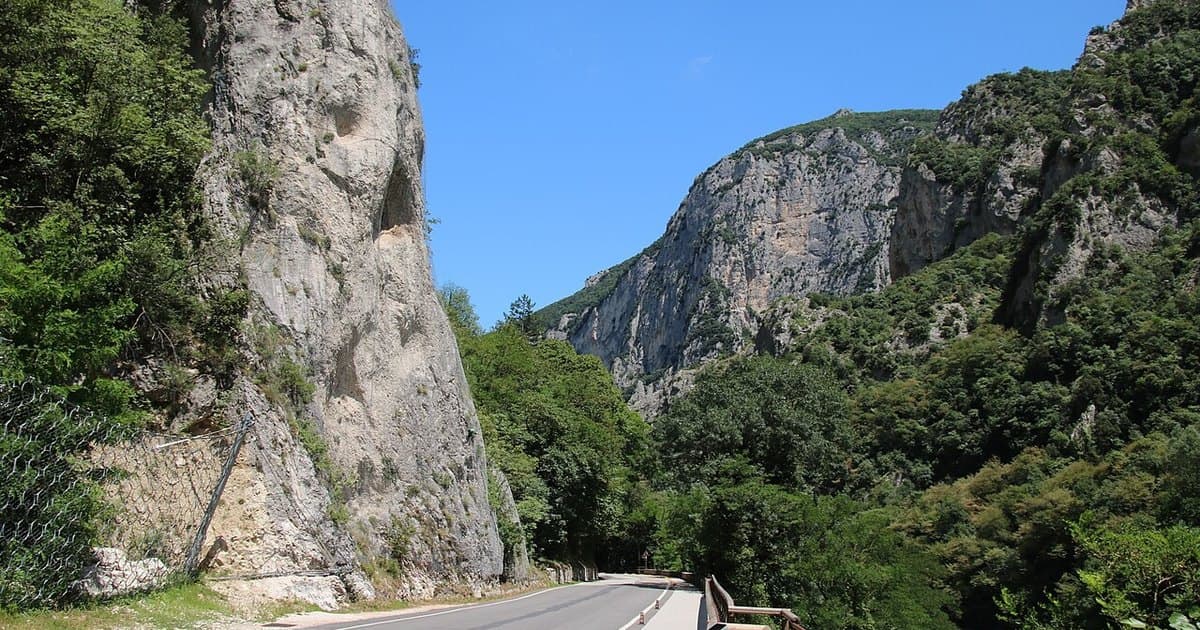
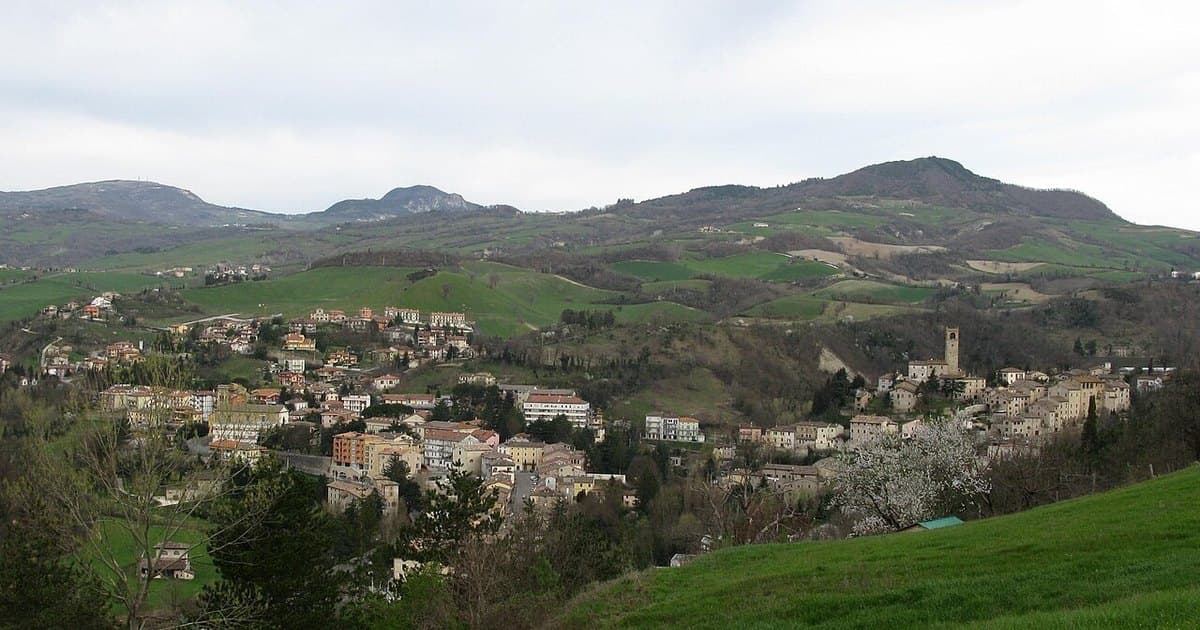
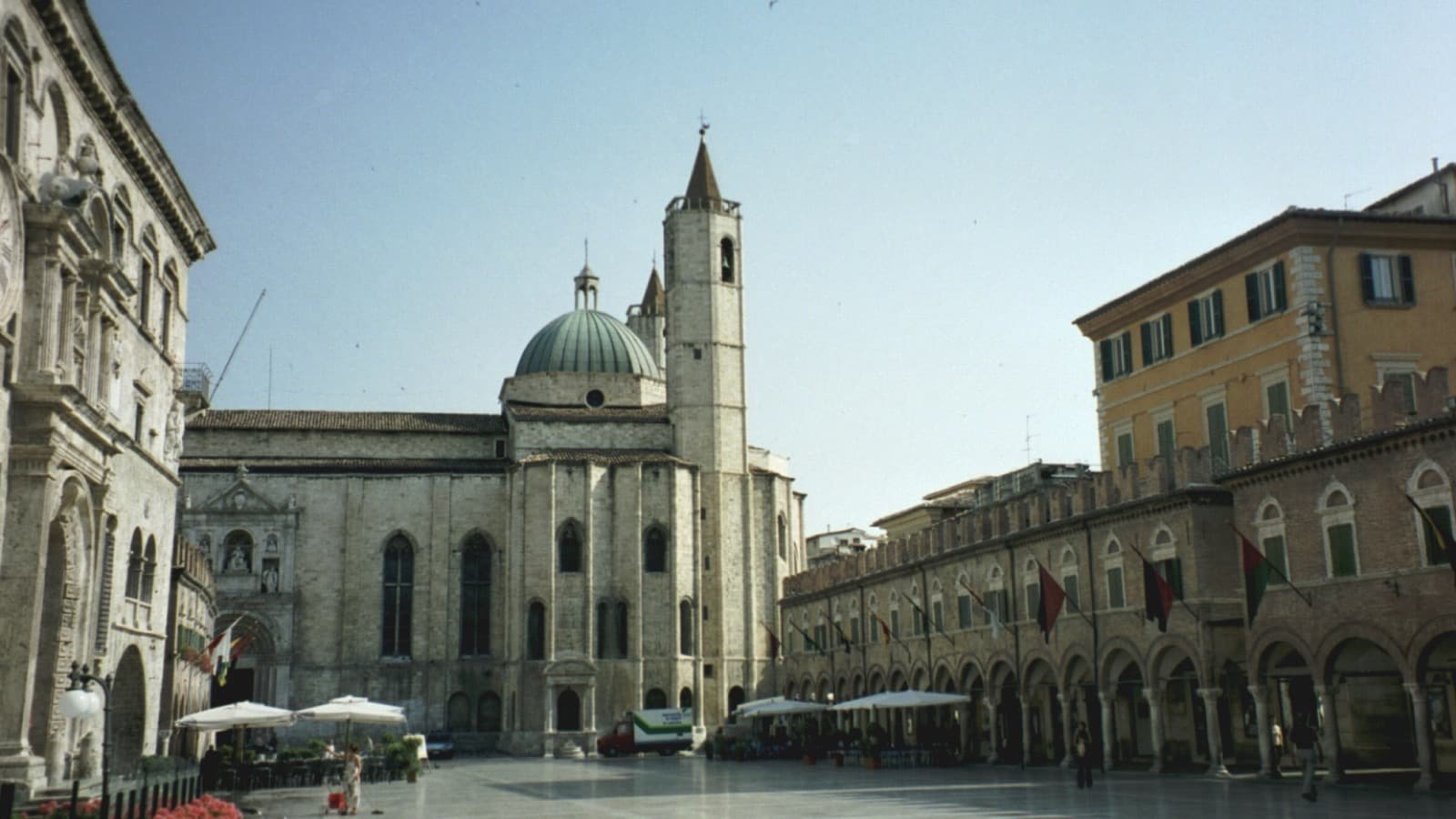
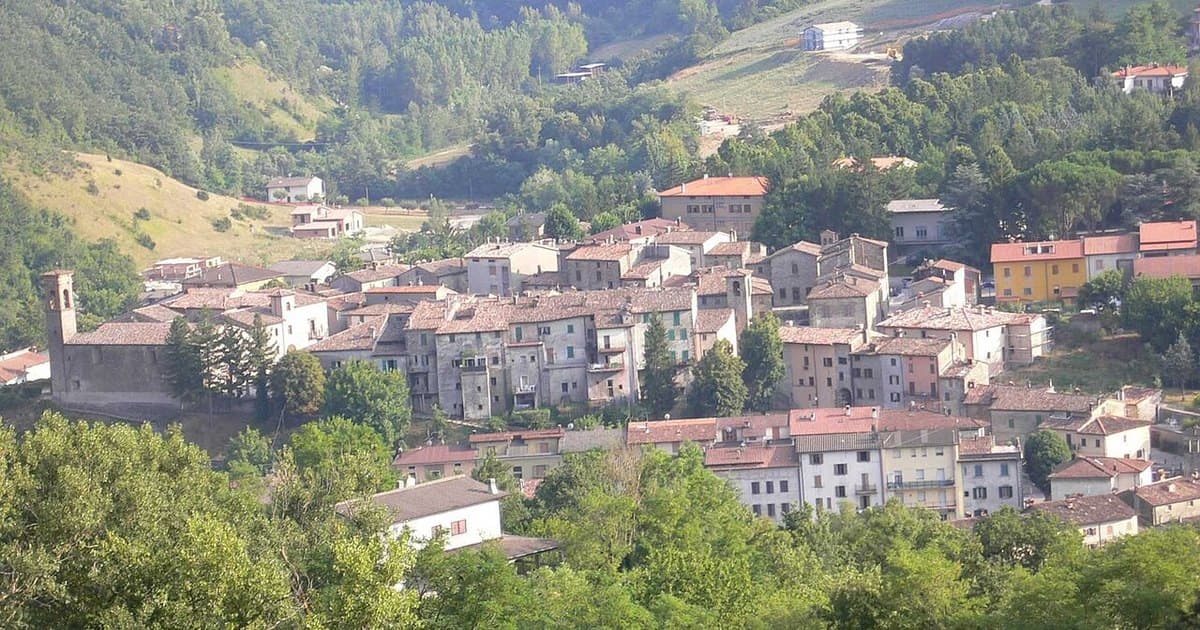
Pergola belongs to the Borghi più belli d'Italia network and carries the nickname "city of a hundred churches", earned through its long spell under the Papal State. The cathedral, Augustinian in origin and dated to 1258, holds together a Romanesque-Gothic bell tower, a late Baroque interior and a neoclassical façade: three eras in one building. Work on the town hall began in 1750 to a design by Giovan Francesco Buonamici and was finished in 1760 by Raimondo Compagnini: it was built in anticipation of city status, granted by Benedict XIV on 18 May 1752. There is also the 18th-century Angel Dal Foco theatre. The town sits where the Cinisco flows into the Cesano, and the valley runs from there down to the sea.
How to hold the day together
- Morning at the museum, then a walk through the centre: cut back as it is by the works, the visit is short, but the group deserves more than a quick pass in front of the display case.
- At the table, the local products are truffle, Pergola DOC wine and visciolato, made by infusing sour wild cherries in red wine.
- Afternoon in Frontone, a little over ten kilometres along the valley: the Castello della Porta has medieval origins, was reinforced to a design by Francesco di Giorgio Martini after Sigismondo Malatesta's attempt to take it in 1445, and has been open to the public as a cultural venue since 2001.
- As an alternative, and not on the same afternoon, Sassocorvaro: it lies further north, in the Montefeltro, and it is a longer drive. The Rocca Ubaldinesca houses the Arca dell'Arte museum: here Pasquale Rotondi sheltered part of the nearly ten thousand works saved during the Second World War across Sassocorvaro, Urbino and Carpegna.
On timing: if you can choose, autumn is when the town is most alive. Pergola's national fair of prized white truffle and local produce takes over the first Sundays of October and fills the old town. Expect more people and harder parking on those days, but also a town at work rather than a town waiting.
Frequently asked questions
- Where can you see the Gilded Bronzes today?
- At the Museum of the Gilded Bronzes and of the City of Pergola, in the former convent of San Giacomo, in the centre of Pergola. The group was at the heart of a long dispute with the archaeological museum in Ancona, settled through display agreements.
- Can you visit the whole museum?
- Not at the moment. Because of the refurbishment under way, only the Gilded Bronzes Hall is open, while the other sections stay closed. Check bronzidorati.com or call before you travel.
- When were they found, and by whom?
- On 26 June 1946 by the brothers Giuseppe and Pietro Peruzzini, sharecroppers, while digging a drainage channel at Santa Lucia di Calamello, in the Cartoceto hamlet of Pergola. Around nine hundred kilos of fragments came to light.
- What is indirect lost-wax casting?
- It is the method for producing a metal object from a model, by way of plaster moulds lined with wax. The wax is melted out and molten bronze takes its place. It is called indirect because the original model survives and can be reused.
- Is half a day enough for Pergola?
- For the museum and the old town, yes. If you want to add Frontone castle, a little over ten kilometres away, you need the full day.