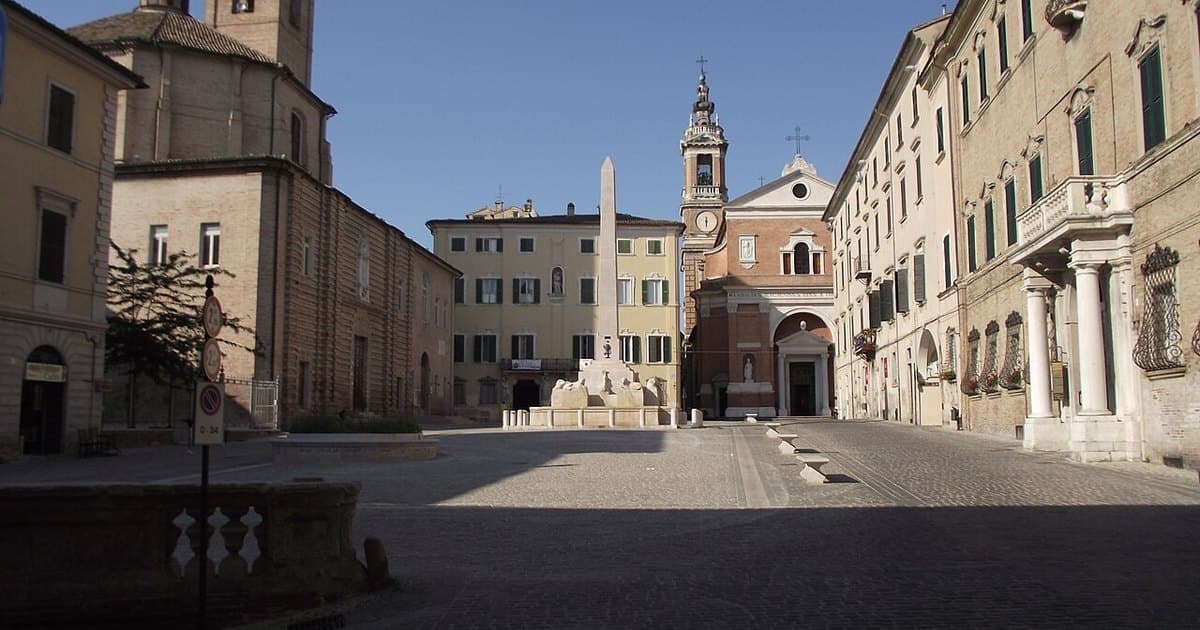
In the nineteenth century Jesi earned a nickname that sounds like a joke today: "the Milan of the Marche". Silk mills, then mechanical industries, sugar refineries, kilns: a small working-class capital in the middle of farmland. Step beyond the walls, though, and the scene flips. Around the town there are no warehouses, only vineyards, and above the vineyards a crown of walled villages that everyone has called "castles" for centuries. It is one of the best contrasts in the Marche: an elegant town and a farming territory that produces one of Italy's most awarded white wines.
That is why Jesi works so well as a weekend: half a day in town, the rest among the hills. No long drives are needed. All you need is an order, and here it is.
Jesi, the town where an emperor was born
Start from the square. On 26 December 1194 Constance of Hauteville, wife of Emperor Henry VI, stopped in Jesi on her journey south and gave birth in a tent set up in the main square. According to the chroniclers she chose to do it in front of the women of the town, to silence those who doubted a pregnancy at forty. That child was Frederick II, the future emperor, and the square now bears his name: a plaque marks the exact spot.
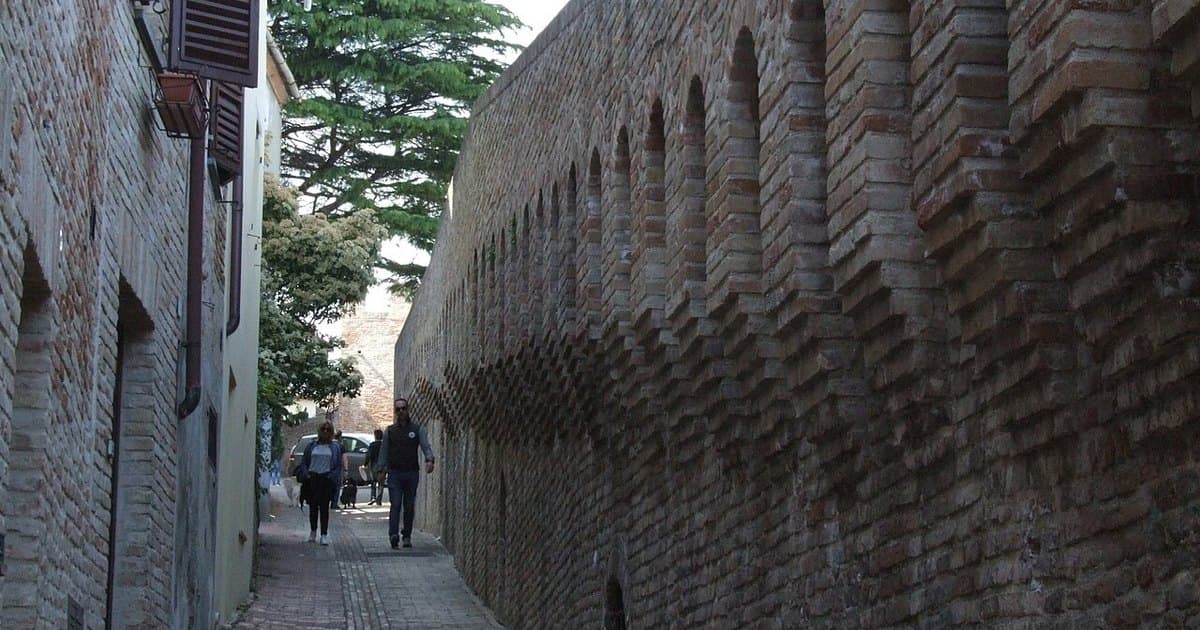
The rest of the centre can be covered on foot in a few hours. Palazzo Pianetti, an eighteenth-century palace, houses the civic art gallery with works by Lorenzo Lotto, including the Santa Lucia altarpiece, and a stucco gallery over 70 metres long, all ornament and frescoes. A short walk away is the Teatro Pergolesi, built between 1790 and 1798 and dedicated to Giovan Battista Pergolesi, the composer born in Jesi in 1710. Finish with a walk along the walls: they are among the best preserved in the region and still trace the town's outline.
The wine that gives the castles their name
Verdicchio dei Castelli di Jesi has held DOC status since 1968, and the Riserva version became a DOCG in 2010. The Riserva production zone covers 22 municipalities in the province of Ancona and 2 in the province of Macerata: in practice, the hills you see from Jesi. It is a grape that Italian wine guides reward with a consistency rare for a white: it ages well, changes character from hill to hill, and every winery interprets it in its own way. For visitors, it is the perfect excuse to climb from village to village.
Three castles to start with
- Montecarotto: the 1509 walls, designed by Albertino di Giacomo da Cremona, enclosing the village, and a nineteenth-century theatre with 150 seats, a small Italian-style jewel of stucco and velvet. All around, wineries where you taste and buy directly from the people who make the wine.
- Staffolo: they call it the balcony of the Vallesina. It sits on a hilltop, and on clear days the view reaches the Adriatic. Elliptical walls with two gates, a fourteenth-century tower and, inside the walls, the Museum of Wine and Rural Life with a wine shop next door.
- Cupramontana: the recognised capital of Verdicchio, home to the Sagra dell'Uva, the oldest grape festival in the Marche, founded in 1928 and held every year in the first week of October.
A tasting is handmade work
A winery tasting, done well, is not an aperitivo: it is a visit to a workshop. Someone tells you about a craft that takes years to learn, shows you the tools, explains why one choice in the vineyard changes what ends up in your glass. It is the same mechanism as a ceramics class or a weaving lesson: hands, material, time. Whoever books a tasting is, deep down, already booking a handmade experience.
You will need a car to get around: the villages are close to each other but scattered across the hills, and the roads connecting them are part of the pleasure. A sensible pace is two castles and one winery a day, without rushing. Hurry is out of place here.
Frequently asked questions
- How much time do you need for Jesi and the Verdicchio Castles?
- A full weekend: half a day for Jesi's historic centre and the rest for two or three villages with one tasting a day. With an extra day you can also cover the quieter side of the valley.
- When is the best time to go?
- September and October, when the vineyards are being harvested and Cupramontana celebrates the Sagra dell'Uva, the oldest grape festival in the Marche, in the first week of October. Spring, with the hills at their greenest, is also an excellent choice.
- Do winery tastings need to be booked?
- Yes, almost always. These are small, often family-run estates: it is best to write or call a few days ahead and agree on a time and the number of people.
- What is the difference between Verdicchio dei Castelli di Jesi and Verdicchio di Matelica?
- Same grape, two different denominations and territories: the Castelli di Jesi sit on the hills closer to the Adriatic, Matelica in an inland valley. Tasting them side by side is a good exercise while you are in the area.
The underlying idea in this corner of the Marche stays the same from start to finish: the best things are made by hand, from the wine to the walls. If the weekend leaves you wanting a closer look at other crafts, the right place to start is the town you set out from.