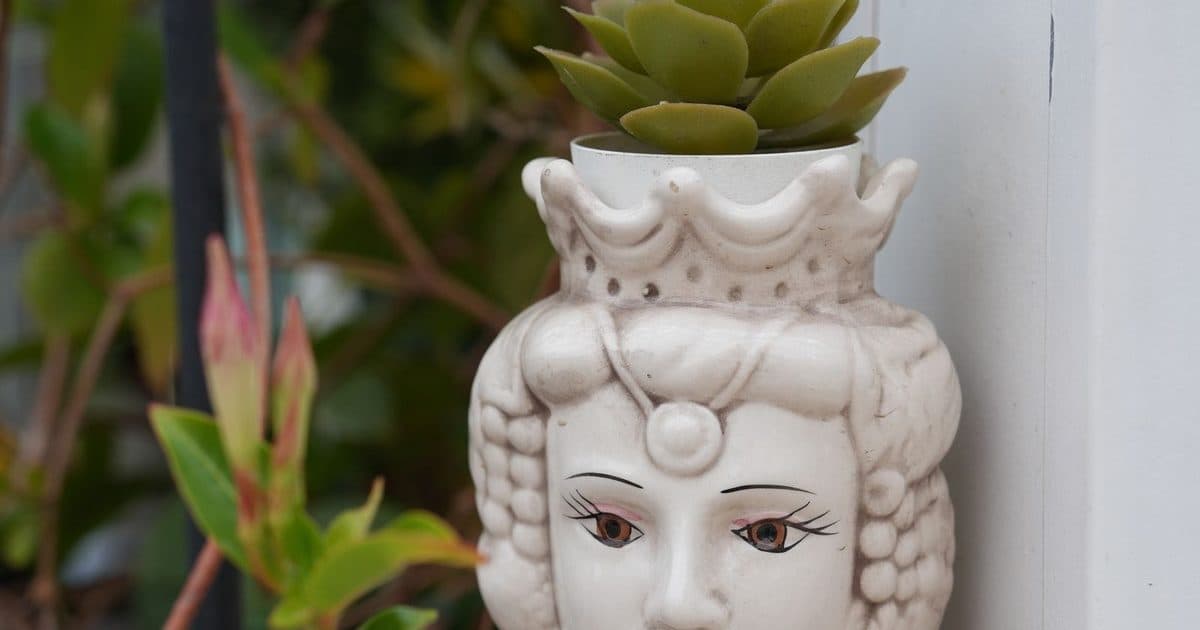
You will see them before anything else in Sicily: on the balconies of Palermo, in the airport shop windows, on tote bags and restaurant plates. The Moor's head vases have become the image of the island people take home, which is exactly why almost nobody knows what they say anymore. One clarification straight away: the Sicilian vase has nothing to do with the Moor's head of heraldry on the flags of Corsica and Sardinia, nor with the dark brown Italian tailors call "testa di moro", nor with the Neapolitan pastry. It is an object of its own, with a legend of its own, darker and better than the souvenir stalls let on. Worth getting straight before you buy one. Or, better still, before you paint one yourself.
The legend, told in full
The version handed down in Palermo is set in the years when the city was under Arab rule, in the quarter known as the Kalsa. A young woman, kept almost in seclusion, spends her days tending the plants on her balcony. A young Moor passes underneath, sees her, falls in love, and she loves him back. It lasts until he admits that a wife and children wait for him at home, and that he must leave. She will not be left. On their last night together she cuts off his head, turns it into a pot and plants basil in it. The basil grows greener than any other on the street, and the envious neighbours ask the potters for pots of the same shape. That, says the legend, is how the Moor's head was born.
It is a tale of betrayal and revenge, not a romance, and that is the first thing the souvenir stalls get wrong. The basil is not a flourish: it grows out of the lover's head and it is the reason the pot gets copied. Another version circulates too, mostly to explain why the heads come in pairs. Here the young woman is from a noble family and her affair with the Moor is secret; when the lovers are caught, both heads end up on the balcony as a warning. Hence the female face beside the male one. The versions do not cancel each other out: each is the way tradition corrected the other.
A story Sicily had already told
If you know Keats, you will hear the echo. In Isabella, or the Pot of Basil, taken from a tale in Boccaccio's Decameron, a young woman of Messina takes the head of her murdered lover and hides it in a pot of basil, watered every day with her tears. Once again a Sicilian woman, a forbidden love, a plant that grows more than it should. Whether the Palermo legend descends from Boccaccio or both draw on something older, nobody can say. But the kinship makes one thing clear: a head inside a pot with basil on top is an image that has been travelling around Sicily for a very long time. Ceramics simply gave it a body.
What they mean today, and how to spot the real ones
On the island's balconies the pair of heads has come to mean the opposite of its origin: prosperity, protection, good wishes for the home. That is the normal life of a folk object: the story drains out, habit fills the space. Then fashion and television turned the heads into a pattern to print on anything, and tourism made them the souvenir of choice. Meanwhile the historic centres of Sicilian pottery, Caltagirone and Santo Stefano di Camastra, keep shaping and painting them by hand; on the shelves, though, their pieces sit next to slip-cast copies decorated with transfers that imitate brushwork.
Telling them apart is not hard. A hand-made head has glaze that pools in the folds, slightly uneven features, visible brushstrokes in the crown of leaves and fruit and, under the base, usually the signature of whoever made it. A mass-produced one has identical edges, flat colour and a label that names nobody. This is not a purity contest: the cast object has its own market. But if you want a piece that carries the story you have just read, you might as well take one more step and put your own hands on that white bisque.
Where to paint one in Palermo, and how it works
The most accessible way to bring home a genuine Moor's head is to decorate one in a ceramics studio, with a Maker who works in maiolica. The piece arrives already shaped and fired once: potters call it bisque, white and matte, ready to soak up colour. You sketch the features in pencil, lay down the background, then paint the turban, the crown of fruit or flowers, the patterns on the cheeks. The Maker glazes it and fires it a second time, and the head comes out glossy a few days later. This is the part travellers underestimate: the second firing cannot happen while you wait, so before booking make sure you know how you will collect the piece, or whether it ships.
Experiences vary depending on what is included. A small head can be painted in a morning and fits in hand luggage; a large one takes longer and needs proper packing. Some Makers shape the bisque themselves and show you that stage; others start from ready-made forms and put everything into the decoration. What moves the price is the size, the glazes, the duration and how many people the teacher follows at once: the same criteria as in our guide on how to choose the right workshop. On Handsome, ceramics workshops are searched by city, and each listing tells you what you take home and when, before you pay.
- Wear clothes that can get stained: ceramic pigments do not wash out of pale cotton.
- No experience needed: the design goes on in pencil first, and the Maker steadies your hand where it matters.
- Ask straight away how and when you collect the piece, especially if you leave Palermo the same day.
- As a couple, paint the male and female faces together: it is the most faithful way to honour the legend. The same cancellation rules apply to both seats, as explained on the cancellations page.
A Moor's head you buy is an object. One you paint is the legend you have just learned, with your fingerprints under the glaze.
Frequently asked questions
- What do Sicilian Moor's heads represent?
- They are maiolica vases shaped like heads, almost always sold in pairs, one male and one female face. They come from a Palermo legend set in the Kalsa quarter: a young woman betrayed by her Moorish lover cuts off his head and uses it as a pot for basil, and the neighbours have the potters copy the shape. Today they stand for prosperity and protection of the home, but the origin is a tale of betrayal and revenge.
- Why do Moor's heads come in pairs?
- Because one version of the legend tells of lovers who are caught and punished, their heads displayed together on a balcony as a warning. Hence the custom of pairing a female face with a male one. In the older version there was only the Moor's head, with basil planted in it.
- Is a Moor's head good luck or bad luck?
- In Sicilian popular tradition it is good luck: a wish for abundance and protection that settled over the legend with time, even though the legend itself is grim. There is no rule about where to keep one; the classic spot is the balcony or the entrance.
- Can I take the head home the same day?
- Usually not: after decorating, the piece needs glazing and a second firing, which takes days. If you stay in town you collect it from the studio; if you leave, agree on shipping beforehand. It is the first detail to check in the listing.
- Can I give the experience to someone who loves Sicily?
- Yes. A Handsome gift card covers a whole workshop and leaves the choice of date to the person who receives it. For ideas on how to wrap it up, see our guide on giving a craft workshop as a gift.
Search by city: every listing tells you what you take home, when you collect it and what is included, before you pay.
Browse ceramics workshops on Handsome