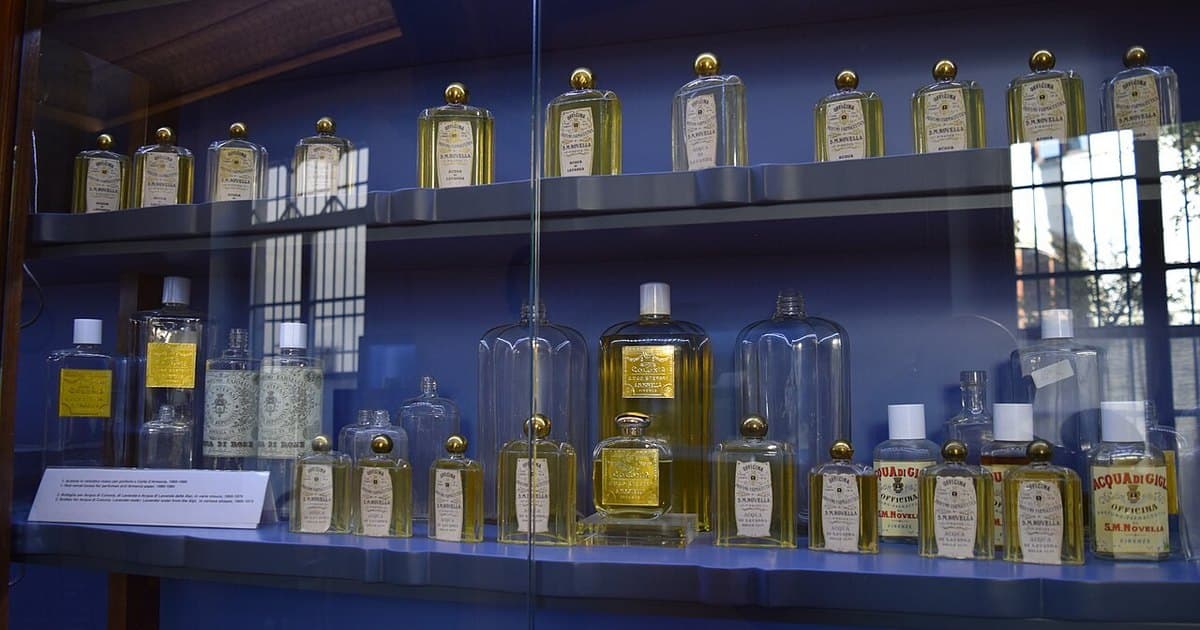
The perfume on your bathroom shelf is built in three layers that open one after the other over hours. That structure was not invented by a twentieth-century brand. Apothecaries worked it out — people who made medicines — and in Florence they were doing it before the word perfumery existed.
1221: it starts with a garden
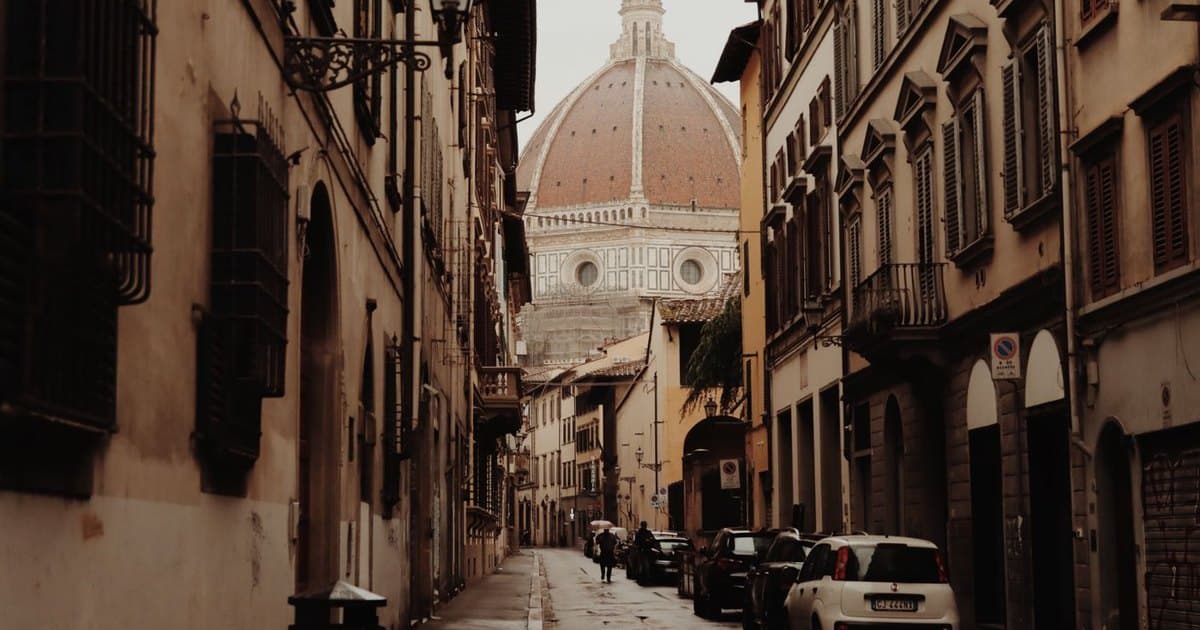
In 1221 twelve Dominican friars obtained the use of the site known as Santa Maria inter Vineas, just outside Florence's inner walls. They grew medicinal herbs and used them to prepare medicines, balms and ointments for their convent's small infirmary.
That detail changes everything: it did not start as trade, it started as an in-house pharmacy. Whoever prepares the remedy does not have to sell it, they have to make it work. That logic held for four centuries and produced recipes written down, corrected and handed on the way a procedure is, not the way a secret is.
1612, the doors open
In 1612 Fra' Angiolo Marchissi opened the officina to the public. Soon after, the Grand Duke of Tuscany granted it the title of Foundry of His Royal Highness. In the eighteenth century the friars' formulas travelled as far as Russia, India and China.
In 1866, when the State seized ecclesiastical property, management passed for the first time to a layman: Cesare Augusto Stefani, nephew of the last friar director. Today the officina presents itself as one of the oldest still trading in the world, on documented continuity of site, activity and tradition.
Acqua della Regina, and what Catherine has to do with it
The most cited creation is Acqua della Regina, composed in 1533 for Catherine de' Medici by the perfumer Renato Bianco. Catherine left Florence to marry the future Henry II of France, taking with her not just a dowry but a way of working.
It pays to be precise here, because this story gets stretched a long way: Catherine did not invent French perfumery single-handed. What she did bring to the French court was a technical culture — distillation, maceration, the use of citrus and aromatic waters — already mature in Tuscany. The transfer happened; the magic did not.
How a perfume is built
The structure we call the olfactory pyramid exists for a physical reason: molecules do not all evaporate at the same speed. Whoever composes works with that.
- Top notes. The lightest, the ones you get in the first minutes: citrus, aromatics, green notes. They are the first impression and the first to go.
- Heart notes. The body of the composition, holding for hours: flowers, spices, fruit. This is where the perfume actually says what it is.
- Base notes. The heaviest molecules, staying on skin and fabric: woods, resins, balsams, musks. They also slow the evaporation of everything else.
Why one costs ten times the other
Three items, and none of them is the bottle. The concentration of odorous material (cologne to extrait is a wide range), the quality of the raw materials (a natural essence carries dozens of molecules, its imitation carries few) and the maceration time, how long the blend rests before bottling. That last one nobody talks about, and it is the one you can smell.
What you can do in Florence
- Walk into a historic pharmacy and just look, buying nothing: the rooms are part of the city's heritage, not an ordinary shop.
- Get the difference between extrait, eau de parfum and eau de toilette explained by someone who works with them, bottles in hand.
- Find a workshop where composing actually happens: half a day building an accord teaches more than ten paper strips.
- Smell in order and take notes. After the sixth trial the nose saturates and stops distinguishing anything: that is physiology, not your fault.
What is left at the end sounds obvious only when said out loud: perfume is a recipe, and recipes can be learned. The nose is not a gift, it is a trained muscle.
Frequently asked questions
- When did the Officina Profumo-Farmaceutica di Santa Maria Novella begin?
- In 1221, when twelve Dominican friars obtained the use of the Santa Maria inter Vineas site and began growing medicinal herbs for the convent infirmary. It opened to the public in 1612.
- What is Acqua della Regina?
- A 1533 composition made for Catherine de' Medici by the perfumer Renato Bianco. It is the best known creation tied to the Florentine tradition.
- Did Catherine de' Medici invent French perfumery?
- No. She brought an already mature Tuscan technical culture to the French court — distillation, maceration, aromatic waters. The transfer is documented; invention from nothing is not.
- Why do two perfumes cost so differently?
- Concentration of odorous material, quality of raw materials, and maceration time before bottling. The bottle matters far less than people assume.
From the hands, not the shop window: workshops with real places.
See artisan workshops in Florence