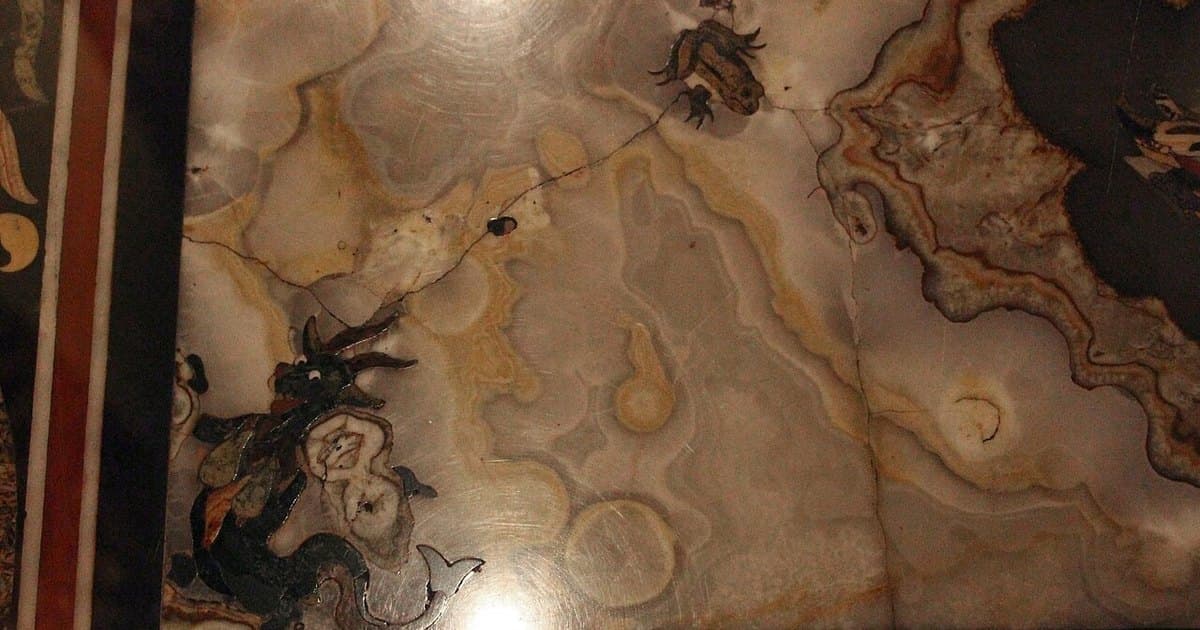
Put your nose ten centimetres from a Florentine commesso panel and look for the brushstroke. There isn't one. What looks like the shadow under a petal is a different slab of stone, cut to shape and slotted against the last one along a joint you cannot see with the naked eye. The colour was not applied: it was chosen, inside a quarry, millions of years earlier.
Florence has practised this by decree for more than four centuries, and almost no visitor goes to see it. Here is how it works and where to look.
What "commesso" means
In this trade, to commit two pieces means to butt them until the joint disappears. Florentine commesso is not mosaic: in mosaic the tesserae are regular, the picture emerges from the whole, and the grout line between them stays visible and is part of the effect. Here it is the opposite. Every piece has the exact shape of one portion of the design — a wing, a sleeve, a wedge of sky — and the work succeeds when the border between two stones can no longer be read.
The practical consequence is that the artisan does not draw the picture with a brush: the vein in the stone does. A slab of jasper shading from red to brown becomes the volume of a ripe fruit, if you cut it in the right place. Cut it in the wrong place and that slab is good for nothing.
Why hardstone in particular
Because it does not fade. A painting ages: pigments alter, varnish yellows, light eats the blues. A panel of lapis lazuli, agate, chalcedony and porphyry has the same colours as the day it was assembled. That was precisely the point for whoever commissioned it: painting that does not die.
1588: when a craft becomes an institution
On 3 September 1588 Ferdinand I de' Medici, third Grand Duke of Tuscany, founded the Opificio delle Pietre Dure. It was not a symbolic gesture: it was the opening of a grand-ducal manufactory, housed in the Galleria dei Lavori in the short wing of the Uffizi, where masters worked on the court payroll.
The model is that of the great state workshops: concentrate the skills, the tools and the stone store in one place, and hold on to the artisans. Over the following centuries the Opificio produced table tops, cabinets, altar frontals and portraits that ended up in courts across Europe — because a commesso gift was, literally, indestructible.
How a panel is made, step by step
- The drawing. It starts from a full-size model, broken down into zones: each zone will become a piece of stone.
- Choosing the slabs. You search the store for the stone that already contains the colour and the shading needed at that exact point. This stage decides the outcome and cannot be redone.
- The cut. The profile is obtained with an iron wire strung on a bow, drawn back and forth with water and abrasive powder. The wire does not cut: it wears away.
- Edging. Each piece is thinned along its profile until it drops into the gap left by its neighbour with no play.
- Mounting. The pieces are fixed to a slate or cut-stone backing that holds the picture together.
- Grinding and polishing. The whole surface is brought to one plane, and only here do the joints finish disappearing.
The surprising part is the time: a panel of average complexity can take months, and not out of slowness. It is the number of pieces. A single bunch of flowers can need several hundred.
What the Opificio does today
It changed trade without changing skill. Today the Opificio delle Pietre Dure is a restoration institute of the Ministry of Culture: the workshops that knew how to cut and bond stone learned to consolidate paintings, bronzes, tapestries and ceramics. There is a scientific laboratory, a restoration archive, a specialist library.
That is one reason the museum is worth it: it is not the display case of a dead craft, it is the shop window of a place that still works.
And if you want to use your own hands
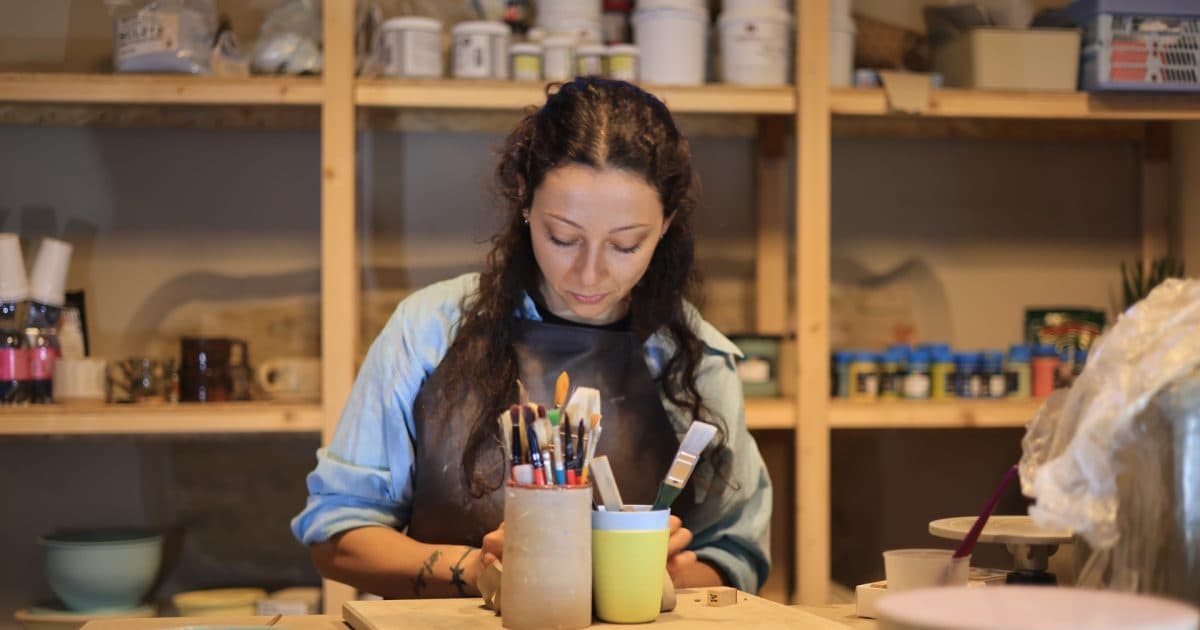
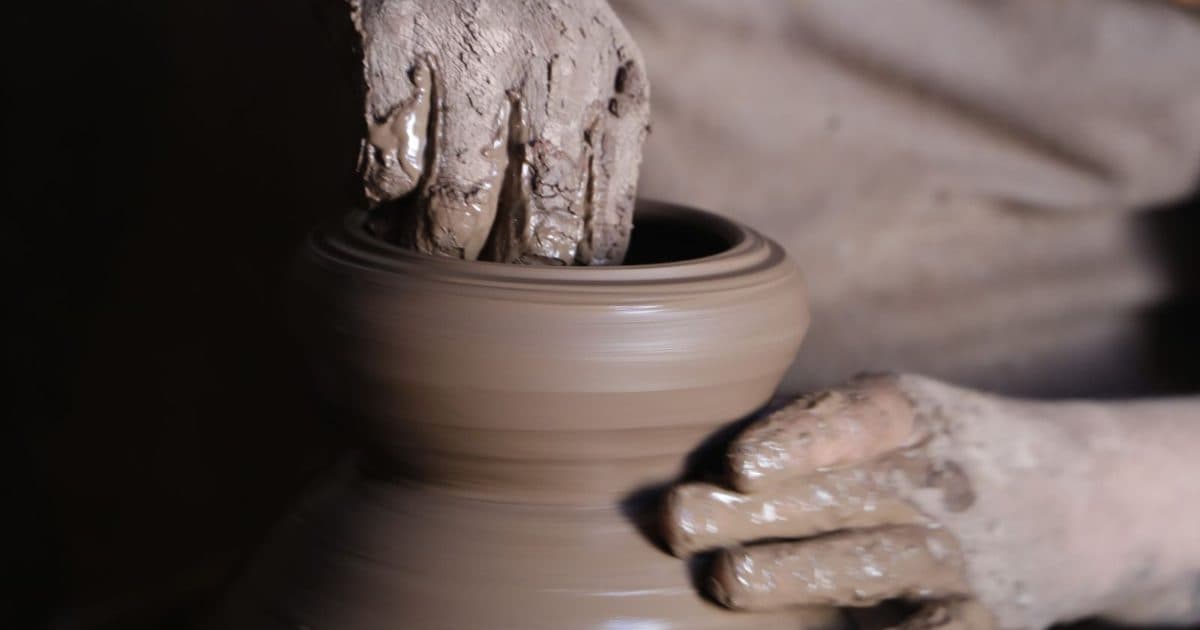
Commesso is not learned in an afternoon, and anyone promising otherwise is selling you something else. But the hand that works hard material — that picks a vein, wears an edge down until it fits, accepts remaking a piece — is the same hand trained in a pottery, mosaic, bookbinding or goldsmithing workshop.
Florence has plenty of workshops that open their doors, many of them minutes from the Opificio. The most honest way to understand what a handmade object is worth is to try making one.
Frequently asked questions
- Are Florentine commesso and mosaic the same thing?
- No. In mosaic the tesserae are regular and the line between them is visible and intended. In commesso each piece has the shape of a portion of the design, and the work has succeeded when the joint can no longer be seen.
- When was the Opificio delle Pietre Dure founded?
- On 3 September 1588, by Ferdinand I de' Medici. Its first home was the Galleria dei Lavori in the short wing of the Uffizi.
- Can the museum be visited?
- Yes. The collection became a museum in 1882 and was rearranged in 1995 into ten rooms. Check hours and tickets on the official site, as they change.
- Which stones are used?
- Hard and semiprecious stones chosen for colour and vein: lapis lazuli, jaspers, agates, chalcedonies, porphyries, marbles. Choosing the slab is the part that decides the result.
Real workshops, with the Maker putting the tools in your hands.
See artisan workshops in Florence