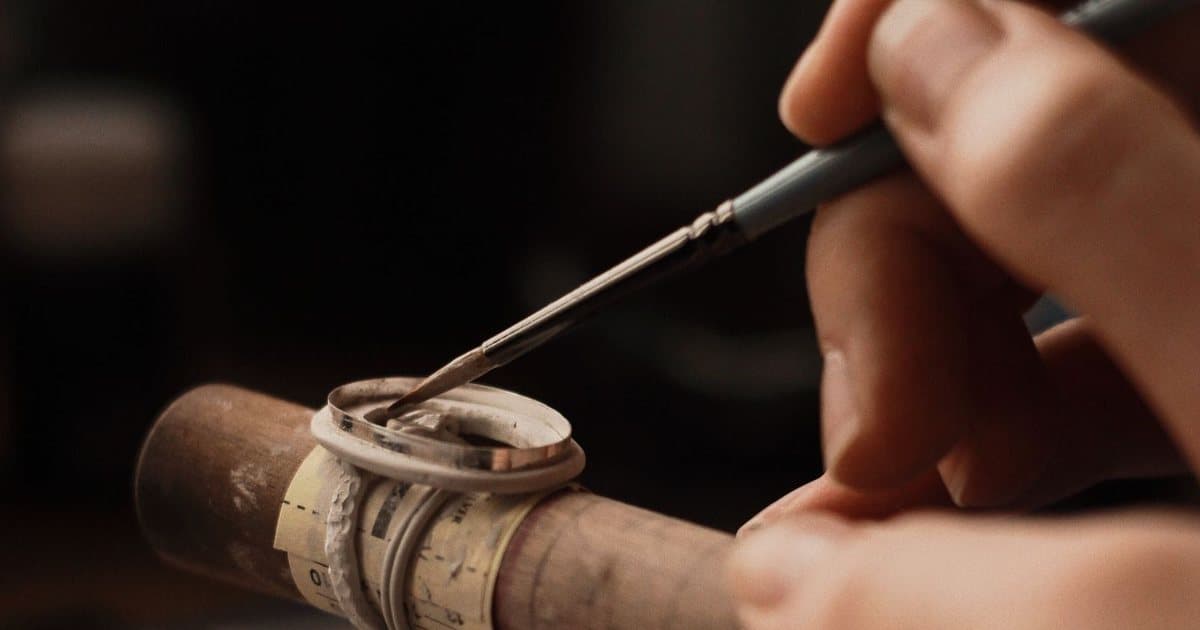
A beginner goldsmithing class usually takes one afternoon and ends with a silver ring on your finger. Put like that it sounds simple, and in some ways it is: the Maker sits you at the bench, hands you the tools and walks you through every step. What is worth knowing before you book is what your hands actually do in those hours, how much metal it takes, and why the ring you leave with will not look like the one in the shop window. If that last part bothers you, better to find out now than halfway through the afternoon.
A studio open to the public is neither a jeweller's shop nor a school. It is a room with a goldsmith's bench, a vice, a drawer of files, a torch and a ring mandrel. You sit high, it is noisy, and you can smell heated metal. The group is small because the Maker has to be able to watch everyone's hands, especially once the flame is lit.
What your hands actually do
A band ring is born from the same gestures every time, and there are fewer of them than you would think:
- Your finger is measured with ring gauges: that gives the exact length of metal to cut.
- You mark and cut the silver wire or sheet with a jeweller's saw, a very thin blade that snaps if you force it.
- You anneal it with the torch: the metal heats up, changes colour and turns soft enough to bend.
- You bend it on the mandrel and push the two ends together until no light passes between them: if light gets through, the solder will not hold.
- You solder the seam, let it cool and clean off the oxide.
- You file, work through abrasive papers from coarse to fine, and choose the finish: satin, hammered or polished.
The time, though, does not go into the spectacular part. The flame lasts a few seconds; files and abrasive papers eat most of the afternoon, and that is where the piece either becomes good or stays rough. People who find finishing boring tend not to enjoy this class: the difference between an edge that scratches and one that slides onto your finger is made in the last twenty minutes.
How much silver it really takes
Less than you would expect. A thin band for an average finger comes out of a few grams: the length depends on your size, the weight on width and thickness. That is why the Maker weighs the metal before handing it over and sweeps up the filings that fall on the bench — not meanness, simply that silver is recovered and melted again. If you want a wide band or a domed profile you need more material, and in many studios the difference is charged separately: ask about it while you read the workshop page, along with what happens if the first attempt has to be redone.
Why the piece comes out imperfect
Because you made it, in one afternoon, with a file held in your hand. The solder line may stay visible against the light, the thickness will not be identical all the way round, and the mirror polish you see in shop windows is nearly always the work of machines and of hours. A ring made at a first class is recognisable, and that is exactly why it is worth wearing.
There is a practical part to factor in too: silver darkens over time. That is normal, it cleans up, and on a ring you wear every day the rubbing does half the job by itself. A class promising a result indistinguishable from industrial jewellery is selling you the wrong thing; on how to read a listing and what to ask before booking, the same reasoning applies as in our piece on choosing a ceramics course in Bologna.
The jewel you buy has to be perfect. The one you make has to be yours.
Plain band or stone: what to pick first time
They are two different formats, not two difficulty levels.
- Band ring: you go through the full cycle — cutting, annealing, soldering, finishing — and leave with a finished object in your own size. The right choice if you want to understand how a ring is born.
- Ring with a stone: the fascinating part is the setting, but it needs a prepared bezel and hands with some mileage. In short classes the stone often arrives on a ready-made element and you work the rest.
First time round, the band gives you more craft and less frustration; the stone photographs better and contains less of your own work. Neither is wrong: what is wrong is booking one while expecting the other.
Who we would not recommend it to
It is not a class for everyone, and saying so upfront saves a wasted Saturday.
- Anyone after a jeweller's-shop result: buy it instead. It will be more precise, faster and guaranteed.
- Anyone on a deadline: wedding bands for a ceremony in two weeks are not improvised at a first class.
- Anyone who hates repetition: half the time is finishing, the same gesture over and over.
- Children: torches, blades and pickling products are not for them. For the right age there are other Bologna workshops sorted by age group.
Bologna, goldsmiths and via Orefici
The trade did not arrive here yesterday. In the Quadrilatero the streets still carry the names of the crafts that worked inside them, and via Orefici is the goldsmiths' street: their guild obtained an autonomous statute in 1299 and its 1298 roll listed 242 members, a lot for the city of the time. A later statute, in 1649, made a distinctive stamp compulsory for every workshop: the ancestor of the hallmark you find inside a ring today. Walking through before or after the class changes the way you look at the windows.
It is also one of the better ways to spend a rainy Saturday, when the centre is walked under the porticoes and it helps to have somewhere indoors to stay for three hours: we lined up several of them in our guide to what to do in Bologna when it rains.
How booking works
On Handsome you see a round figure and it stays that way: the price you read is already everything, with nothing added. You book with a 10 euro deposit on group workshops and settle the rest at the studio, on the day. If you change your mind, cancelling is free up to 3 days before. Handsome keeps no commission on the workshop takings: the payment is credited directly to the Maker's account, which is the person who will teach you how to hold the saw.
Frequently asked questions
- How long does a beginner goldsmithing class last?
- As a rule it fits into half a day, because a band ring is completed in a single cycle and splitting it over two sessions suits nobody. The exact duration is always stated on the workshop page: check it first, since that is what tells you whether it fits your afternoon.
- Do you take the ring home the same day?
- In most classes yes: unlike ceramics, silver does not need firing or drying. The exception is when a final machine polish or a redone solder joint is needed, in which case the Maker gives it to you later. If the ring is a present with a date attached, ask before booking.
- Do I need experience? And is there really a flame?
- No experience needed: these classes assume you have never held a jeweller's saw. The flame is used, but for a few seconds at a time, on a prepared bench and under the Maker's eye. If you would rather not, ask whether a cold version exists, hammered rather than soldered.
- How much does it cost to make a silver ring at a workshop?
- It depends on the metal included, the duration and whether the session is group or private, so the price sits on the individual listing. What does not change on Handsome is how you pay it: a round figure with nothing added, a 10 euro deposit on group workshops and the balance at the studio.
Markets in the city and workshops by Makers in the area.
Craft markets and workshops in Bologna