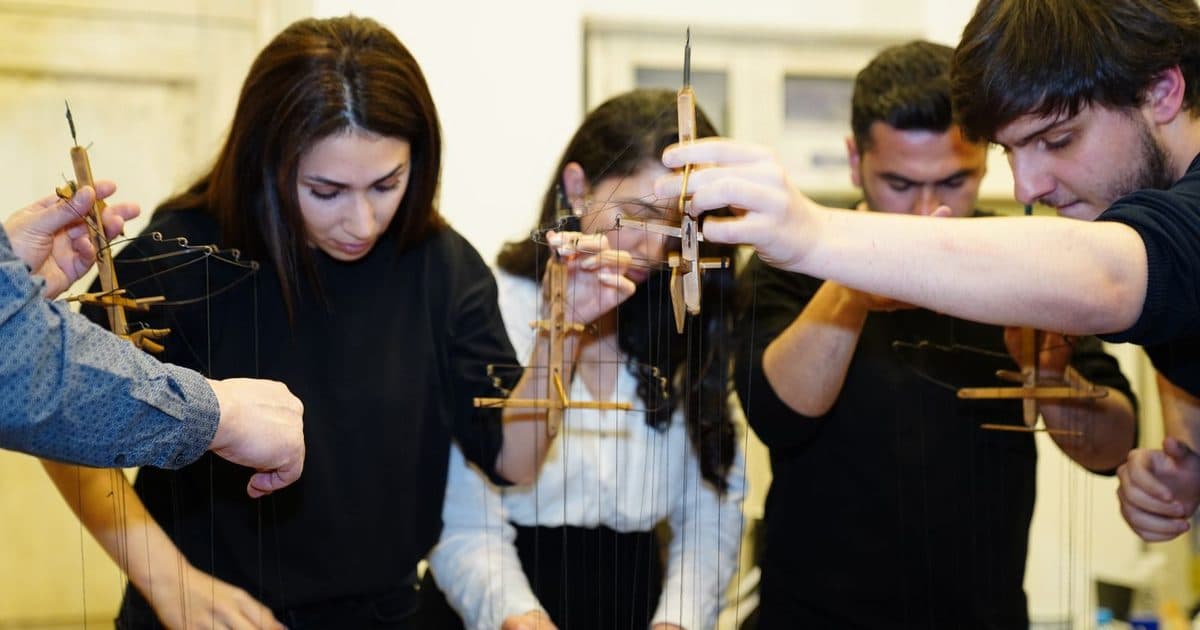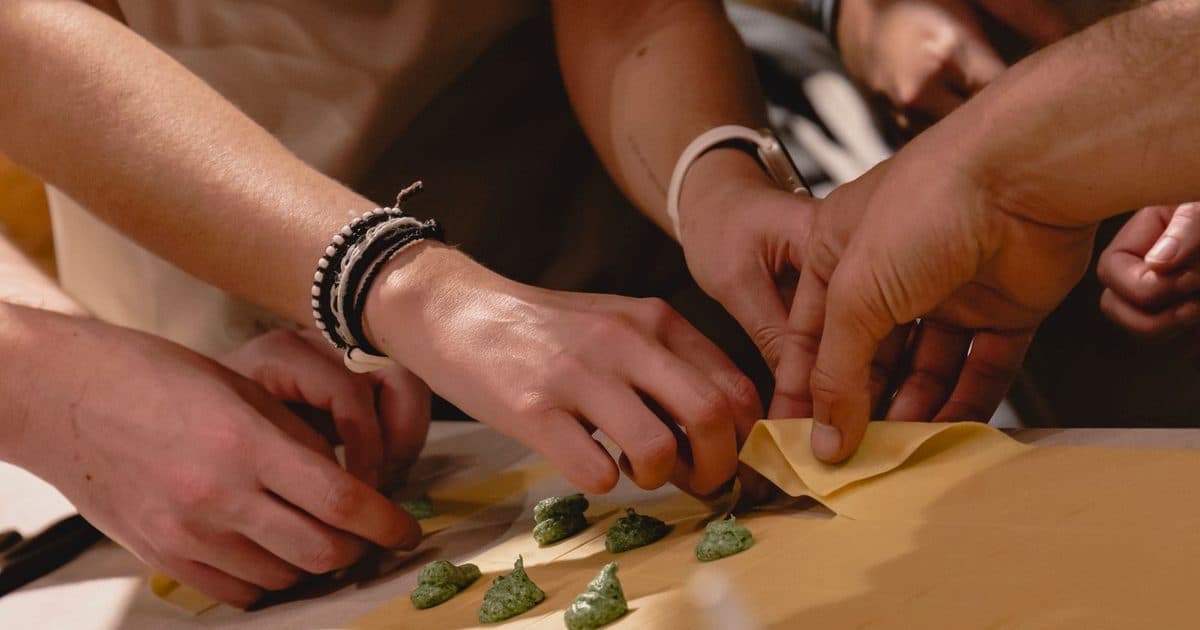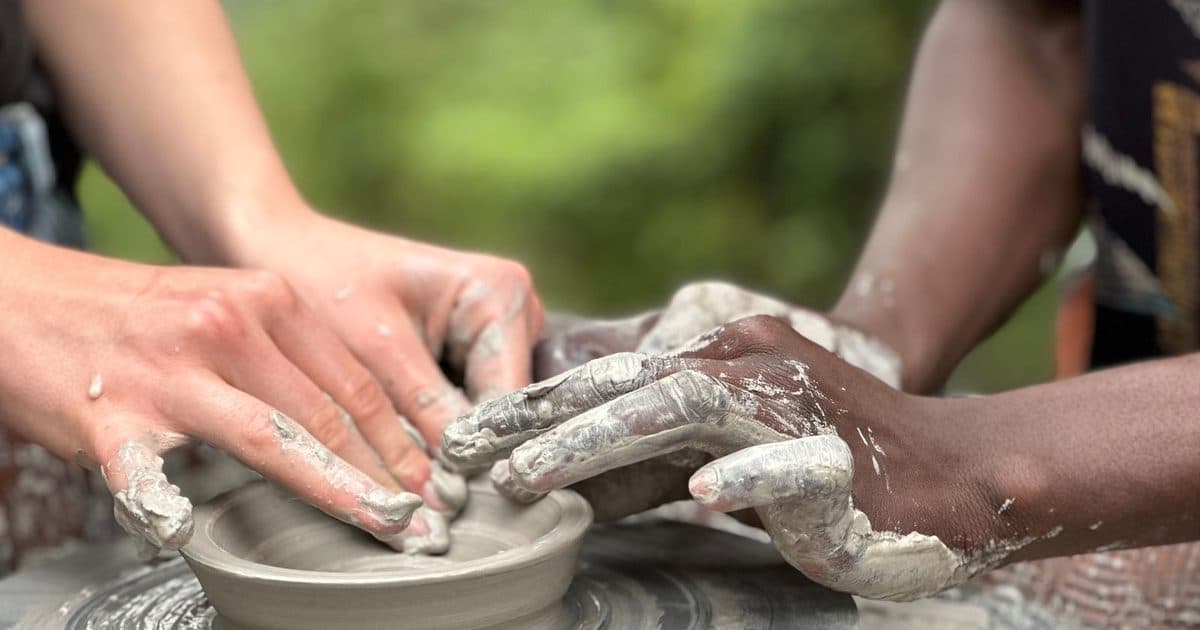

Team building for small companies works when it is short, concrete and leaves something in the office: an afternoon in which 10, 20 or 30 people make an object with their hands, cook together or build one shared piece. It is not a multinational's game scaled down: in a small company everyone already knows everyone, the owner is in the room and every euro per head shows.
Team building in small companies is a different job
In a small company, team building is not there to introduce people: they already know each other. It puts them together for two hours in which nobody is the boss, and leaves a mark still visible on Monday. Four constraints change everything.
- Everyone knows everyone. Ice-breakers are for strangers; with colleagues who have had lunch together for years they become awkward.
- The owner is in the room. That is fine if they do what everyone else does, hands dirty, no opening speech.
- The per-head budget shows. With fifteen employees every extra per head is an invoice line you read: price per person, all-inclusive.
- Half a day is a lot. Stopping work for an afternoon is felt: two or three hours of making, not a day of games.
This is not a niche: according to ISTAT (business economic accounts, 2023 data), in industry and market services large enterprises (250+ workers) are 0.1% of the total and employ 24.4% of workers: roughly three workers in four are in smaller firms. And Gallup's State of the Global Workplace 2026, on 2025 data, gives Europe 12% of employees engaged, the lowest of any region in the world. An afternoon in a studio will not move that number: it can give the group a shared memory that is not a meeting.
Which formats work with 10, 20 or 30 people
With a small group three formats work: an object that stays in the office, a cooking session that ends at the table, a single piece built by many hands. They are real craft workshops, led by verified Makers who practise that craft.
- The object that stays in the office. Ceramics, wood, leather: a mug, a name plate, a tray that on Monday is in the company kitchen. It is the format that ages best; if firing is needed, the pieces are ready a few weeks later and the proposal sets out how they get back to the office.
- The cooking session. Fresh pasta, bread, a local recipe: people work in threes or fours, get it wrong together, eat the result. Ideal when departments never talk: nobody rolls out pasta dough alone.
- The shared piece. A wooden panel for the entrance, a tapestry woven in turns, a set of plates where each person signs one. The format for an anniversary or the end of a season.
The headcount is not a limit, it is the brief: ten fit at one table, twenty need more stations, thirty split into islands or two sessions. The piece on creative team building in Bologna explains how space and facilitation change.
What to avoid: big-corporate games
Avoid anything that assumes strangers, competition or a stage: in a group of fifteen it backfires.
- Competitions with a leaderboard: with the owner playing, the match is never even.
- Physical or trust challenges: anyone with health limits, or simply unwilling, feels excluded in front of everyone.
- The boss's speech: if the company has something to say, say it in the office the day before. In the studio the boss kneads.
A fair warning: in 2018 Harvard Business Review published Stop Wasting Money on Team Building by Carlos Valdes-Dapena, who argues that most corporate team building is a waste of time and money: collaboration improves by working together on the team's real goals, not through an event. Not a reason to give up time together: a reason not to ask an afternoon to do the organisation's job.
How to include part-timers, shift workers and production staff
You include everyone by first naming who risks being left out: the morning part-timer, whoever is on shift, the production worker who does not feel part of 'the office'. Time, format and venue are chosen around them.
- List who is never there: part-timers, shift workers, the satellite site, the latest hires. They are the audience.
- Choose the time around them. If the warehouse closes at 5, everyone starts at 3; with shifts, two short sessions.
- Do it in working hours, or treat it as such. A 'voluntary' Saturday event excludes anyone with children or another life; your payroll consultant tells you how to classify the hours.
- Ask about needs beforehand: accessibility, diets, allergies, space. The request form has a notes field for this, and the Maker prepares accordingly.
- Pick a craft where the shop floor starts ahead: wood, leather and ceramics reverse the roles without saying so.
People, city, one or two dates and an indicative budget: we get back to you within 24 hours, no obligation.
Request a proposal for your teamWhen to do it: Friday afternoon, pre-Christmas, end of season
The right moments are three: Friday afternoon, the weeks before Christmas, the end of an intense period. In all three the company gives time rather than taking it.
- Friday from 3pm. Two hours in the studio, then everyone goes home with their piece.
- Before Christmas. It replaces or joins the company dinner and the object becomes the gift (to use one supplier for the gifts too, see Christmas gifts for employees). In December, studios' free dates go fast: book well ahead.
- After a heavy season. Year-end close, a production peak, a trade fair. After, not during, and never when half the group is on holiday.
If you are based in Romagna or the Marche, where Handsome has the most Makers, the piece on creative team building on the Romagna Riviera covers which workshops work best for a group.
The budget: per person, all-inclusive, no surprises
Think per person, times the headcount, covering everything: the Maker's time, materials, space, lunch if any, delivery of the pieces. The quote must also say in writing what it excludes (travel, branded set-up, gadgets), how you pay and what happens if the headcount changes.
For orientation, updated September 2026: the public group workshops in the Handsome catalogue cost roughly between 25 and 80 euro per person. A corporate event is tailored to the group and changes with numbers, materials, duration and venue: there is no price list. The breakdown is in the guide on how much a creative team building costs.
On Handsome the proposal comes with a total price for the group, all-inclusive: for the same headcount, nothing is added afterwards. You pay a deposit online to Handsome, which covers the organisation service and is e-invoiced through the SDI system, and a balance directly to the Maker, who invoices the company for the service. Two invoices, one figure, known before you confirm.
How to tell if it worked, without survey theatre
It worked if, two weeks later, the object is still in use, people talk about it without being asked and someone asks when it happens again. The feedback form filled in on the way out, with the owner next to you, measures good manners, not the event.
- The object is visible. The mugs in the company kitchen get used, the photo of the pieces goes round the chat without HR posting it.
- People bring it up on their own. After ten days ask three people from different departments: would you do it again, what would you change.
- Someone who never spoke, spoke. If the production worker who skips every dinner spent two hours at the table with accounts, the afternoon did its job.
How it is organised with Handsome
Handsome is an Italian marketplace of creative workshops run by verified Makers: ceramicists, weavers, woodworkers, cooks, goldsmiths, leather and glass artisans. For companies it is a single point of contact: describe the group, we select the right Maker and manage every step.
- Fill in the form at handsomemakers.com/en/aziende in three steps: company and contact; headcount, indicative budget per person, city and a preferred date (plus an alternative); type of experience, objective and, in the notes, needs and space (your premises or the Maker's studio).
- Within 24 hours we get back to you; the proposal states the Maker, the date, the total price for the group and how it splits into deposit and balance. Format, duration and venue are agreed together.
- You confirm with the online deposit; the balance goes to the Maker, who invoices the company.
- On the day the Maker arrives with the materials or welcomes you in the studio.
If the group is friends or family, the route is private events. For a complete checklist from brief to the day after, see the HR guide to creative team building.
Frequently asked questions
- How many people do you need for team building in a small company?
- The form does not set a number: the proposal is built on the one you give. Usually ten people fit at one table with one Maker; twenty need more stations and a repeated demonstration; thirty are organised in islands or two sessions. The headcount shapes space, materials, sessions and price: that is why it goes in the request.
- How long does a creative team building last for 10 or 20 people?
- A hands-on workshop usually runs two or three hours of activity, plus welcome and clean-up: it fits in an afternoon and does not stop the company for a day. The exact duration is agreed in the proposal, based on craft, headcount and venue.
- Can it happen at our premises or does it need the Maker's studio?
- Both, depending on the craft. Many crafts travel: the Maker brings materials and tools, and you need real tables, a sink and protectable surfaces. Wheels, kilns and fixed machinery usually need the Maker's studio. Say in the form's notes whether you have your own space; if unsure, the proposal weighs both.
- How much does team building cost for a small company?
- There is no price list: it depends on craft, headcount, materials, duration and venue. Group workshops in Handsome's public catalogue cost between roughly 25 and 80 euro per person (September 2026); a corporate proposal is tailored. Insist on a total for the group, all-inclusive, before you confirm.
- What if someone cannot make it at the last minute?
- Agree a range of participants and a date by which you confirm the final headcount, usually the day the Maker buys the materials. After that date, ask how the proposal handles absences: by then the materials are usually bought. For whoever could not be there, a [gift card](/gift-card) for a workshop of their choice includes them anyway.
At your premises or in a studio: numbers, dates and objective. We get back to you within 24 hours; total price, one point of contact.
Request a proposal for your team