In Sant'Ippolito the best thing in town is not behind glass. It sits two metres off the ground, above someone's front door: a carved portal, a corbel, a moulded frame, a niche with a small stone figure in it. You walk past and miss it, because it is not in a shop window. It is in the wall.
The village lies in the middle Metauro valley, in the province of Pesaro and Urbino, a few kilometres from Fossombrone. Since the 14th century it has been known as the "Paese degli Scalpellini", the village of stonemasons, for the talent of its sandstone workers. This guide has one purpose: to teach you to read the walls as you walk.
Why the stone ended up everywhere
The area had quarries of yellow and blue sandstone, both the frost-vulnerable kind, which does not survive the weather, and the frost-resistant kind. Having two grades of stone within reach changes everything: the first works indoors, on fireplaces, altars and balustrades; the second holds up outside, on portals, window frames, balconies and coats of arms. A dense network of workshops grew around those quarries, working for a market far wider than the village itself.
The village's reputation goes back a long way. Around the middle of the 14th century, when the Palace of the Popes was under construction (work began in 1335 and continued until 1352), local tradition places a stonemason from Sant'Ippolito, Aimonetto, in Avignon. In the 15th century, at the court of Federico da Montefeltro, local masters worked alongside Luciano Laurana, Francesco di Giorgio Martini and a group of "Lombard masters" of the art of stone, some of whom went on to live here. The practical result is what you see walking through the centre today: where many people can carve, the neighbour's house gets carved too.
How to recognise a stonemason's hand
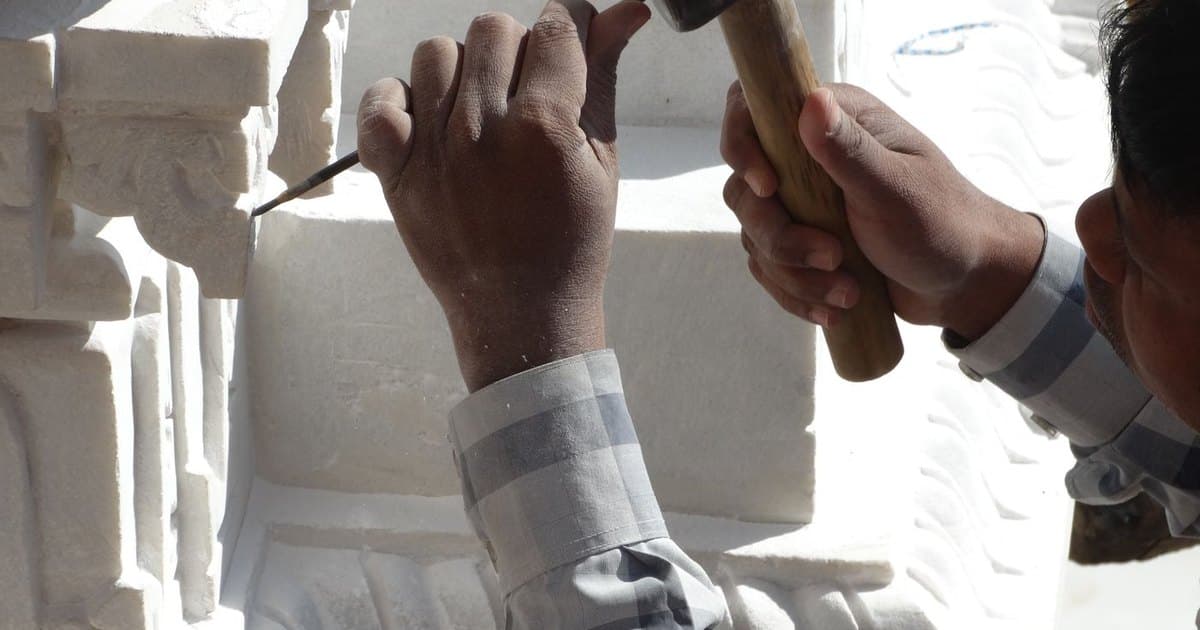
The tools are few and each leaves its own signature. The point chisel, the subbia, is a pyramidal tip used for roughing out: it leaves deep furrows and a stippled surface. The toothed chisel, the gradina, comes next and levels things off: it leaves parallel lines, a combed effect. Progressively finer chisels finish the job, struck with a mallet. Telling those three marks apart is half the game.
- Look at the hidden spots: the back of a niche, the reverse of a moulding. That is where the mason stopped finishing, and the tool marks are still legible.
- Find the joints: a portal is not one block but several dressed stones set together. See where one ends and the next begins, and whether the profiles line up.
- Notice repetition: if the same motif appears identically on different houses, the same workshop or the same set of patterns is behind it.
- Watch the edges: sandstone wears first on corners and wherever the rain hits. A moulding rounded on top and crisp under the overhang has simply taken water for centuries.
- Count the niches: almost every house has one, often with a small sandstone figure. It is the most common sign and the most ignored.
Sandstone ages differently from hard stone. It is a sedimentary rock: sand-sized grains held together by a natural cement of calcium carbonate, silica or iron oxide. It cuts well and fast, which is exactly why ordinary houses could afford decoration. Its enemy is frost: water enters the pores, freezes and lifts off flakes. That is why details round over and surfaces powder away, while a harder stone tends to chip and stay sharp. A worn moulding is not neglected. It is old, and it has been working.
The centre works like an open-air museum
The village's historic and artistic route strings together sandstone works set on the outside of buildings, dating from the 16th to the 18th century. There is no ticket and no opening time: the collection is the street.
- Do one slow lap without taking photos: it calibrates your eye to the colour of the local stone.
- On the second lap, look up. Corbels, mouldings and coats of arms often sit at first-floor height, above a walker's line of sight.
- Pick a portal you like and go hunting for its twin: finding the same moulding twice is the quickest way to grasp how much one workshop produced.
- Finish with the churches. There the same hands had more time and richer clients, which gives you a yardstick for what you saw on the houses.
The museum of the craft and the carving in the square
The Museo del territorio - Arte degli Scalpellini is a scattered museum, and its documentation centre is in Palazzo Bracci, on Piazza Garibaldi, a 19th-century building. Inside there are panels on quarry work, reconstructions of the workshops, a collection of stoneworking tools and photographic records of the works spread across the area, along with sculptures made during the professional courses held in the village.
The other thing to know about is Scolpire in Piazza, an international artistic residency of sandstone sculpture founded in 2000 and organised by the municipality together with the Pro Loco: sculptors worked in public and the pieces were conceived for urban and environmental regeneration projects in small municipalities and natural areas across the Marche. It ran at the end of July for years, and the last documented edition is the 17th, from 25 to 31 July 2016. No editions have been published since: call the municipality before you plan a trip around it. In 2024, within the Pesaro Italian Capital of Culture programme, the village did devote a full week to the craft, "Sui passi di Aimonetto", from 21 to 27 October, with more than thirty events.
The most underrated craft in the Marche
Ceramics end up in shop windows, wood and iron sit in workshops with the door open, embroidery is worn by someone. Stone is not: it stays in the walls, nobody buys it as a souvenir and it does not fit in a suitcase. That is why a village that exported stonemasons for centuries stays off the local tourist circuits.
This craft is worth understanding with your hands, not only with your eyes. Stone carving takes a long time to learn, but the first step is immediate: pick up a mallet and feel how much sandstone gives way, and how much a hard stone pushes back. Workshops of this kind are rare and almost always seasonal, so it pays to look for them where the trade is still at home.
Frequently asked questions
- How long do I need in Sant'Ippolito?
- The historic centre is walkable. If you genuinely stop to look at portals, corbels and niches, allow a morning, and bear in mind the village is a few kilometres from Fossombrone, so it pairs well with a day in the Metauro valley.
- Is the stonemasons' museum always open?
- No. The Museo del territorio - Arte degli Scalpellini does not keep daily hours: it opens for events and by appointment. The documentation centre is in Palazzo Bracci, on Piazza Garibaldi. Call the municipality first on +39 0721 728144.
- When does Scolpire in Piazza take place?
- Nobody can say right now. The sandstone sculpture residency, founded in 2000 and organised by the municipality together with the Pro Loco, was held at the end of July for years: the last documented edition is the 17th, from 25 to 31 July 2016. No editions have been published since, the event's website is offline and the municipal page has no content. Ask the municipality directly before planning a trip around it.
- Can you learn stone carving in the Marche?
- Opportunities are rare and mostly seasonal. Sant'Ippolito has hosted professional stoneworking courses, and some of the sculptures produced there entered the museum's collections. It is worth checking periodically what is running in the area, because these workshops appear in waves and fill up quickly.