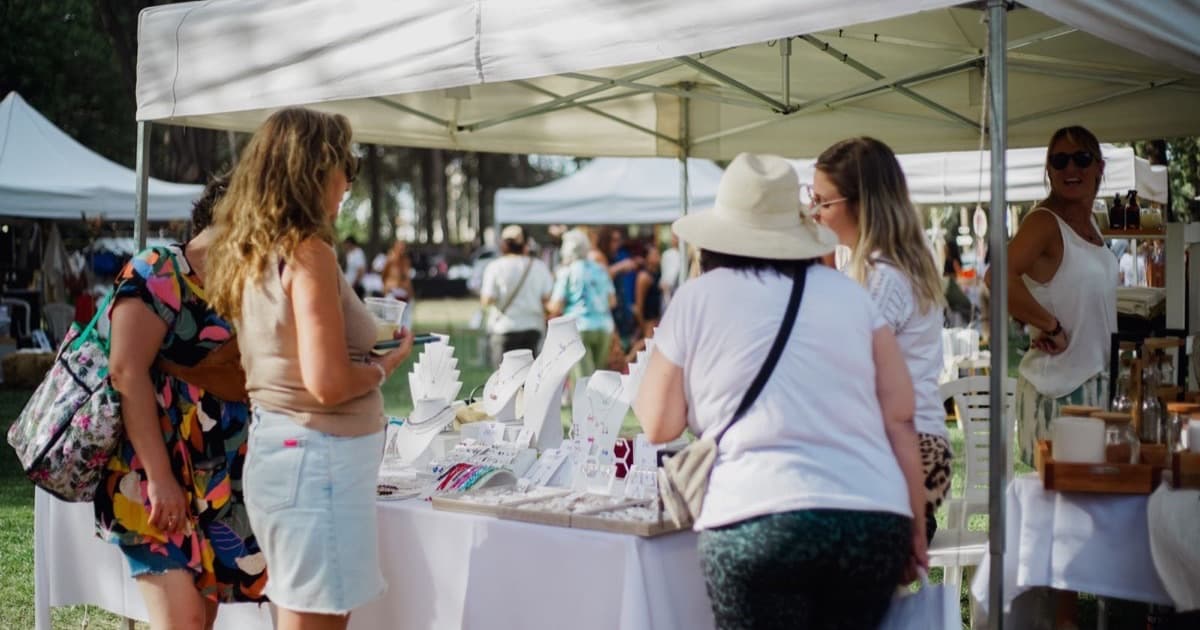
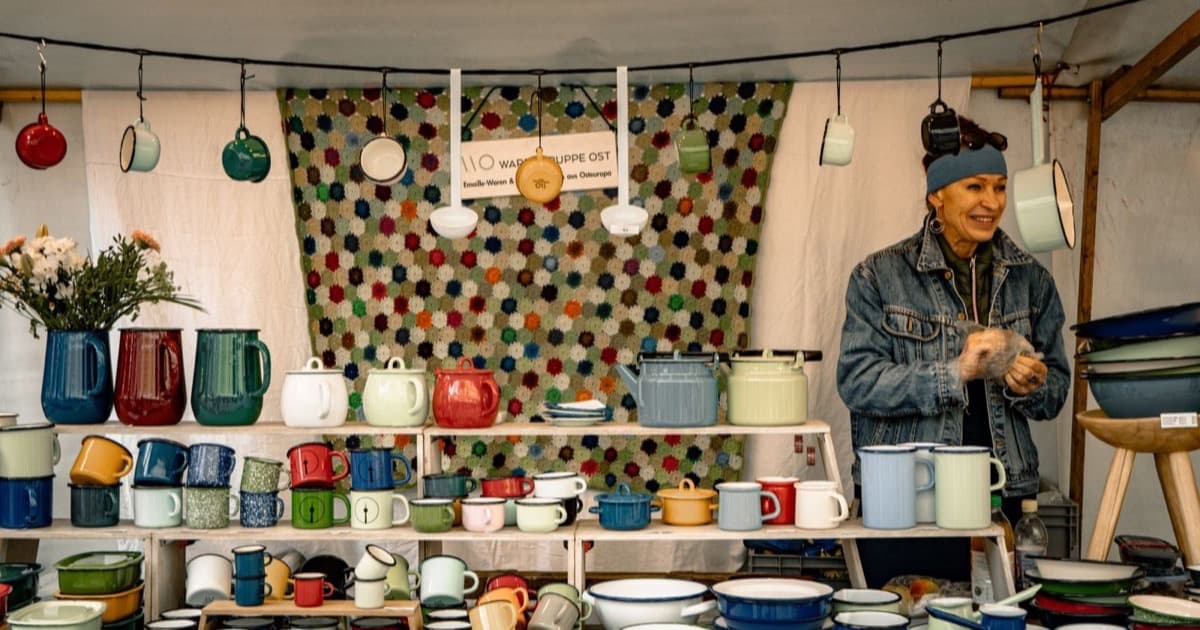
You spend Saturday behind a stall. You sell a few pieces, you get plenty of compliments, you go home tired and with the feeling of a good day's work. Then a week goes by and nothing has happened: nobody wrote, nobody came back. The problem isn't the market: it's that the stall was the finish line instead of the starting line.
Anyone who stops at your table is already giving you the hardest thing to get: attention, in person, with your work in their hands. In Bologna, between the markets in the centre, the ones in the courtyards and the neighbourhood fairs, that's hundreds of people in a single day. The leap isn't selling more that day — it's giving those people something concrete to book, before they turn away.
A stall doesn't sell objects: it opens a door
An object costs twenty, thirty, fifty euros and gets bought on impulse. A workshop costs more, it means checking a calendar and deciding with someone else. Two different decisions, and the second one is almost never made standing in front of a stall. What you can get on the spot isn't the booking: it's that the person knows the workshops exist and can find them in three seconds.
So think of the table on two levels: what people buy today and what they book later. If the second level isn't there — no date, no sign, no link — the only thing left from the day is the till.
The three things to put on the table
You don't need window graphics or a custom display. You need three things, and they all fit in a bag.
- A real date, written large. Not «I run courses too»: «Saturday 18 October, 3pm, six seats». A specific date forces the brain to answer yes or no; a vague promise asks for nothing and gets nothing. The date has to be published and bookable already: if someone searches while standing there, they must find it.
- Your profile QR code. From your Maker area on Handsome you download a PDF with your profile QR code, ready to print: whoever scans it lands on your page with your workshops and dates. Print it in A5, put it in a table menu holder, done. Nothing to write down, nothing to remember, no scraps of paper to lose.
- One «made in the workshop» object, with a tag. Among the other pieces, put one of the things people make in the course, with a tag saying: «you make this yourself in the workshop on 18 October». That's the difference between «how lovely» and «I could do that»: the second sentence is the one that leads to a booking.
Link the workshop to the market: your date shows up on their page
This is the step almost nobody takes, and it's free. When you publish a workshop on Handsome, the form asks: «Is it held at a partner market or fair?». Pick the market and your workshop is proposed to the organiser; once they approve, it appears on that market's page on Handsome, alongside the event.
Which means anyone looking for the market — and plenty of people do in the days before — finds you too, with your date and your price, without you spending a euro. It's the same mechanism you can see on the page of the Comunella Market in Bologna: the event at the top, the Makers' workshops underneath.
- The organiser approves it: it's a courtesy, not an automatic step. Ask them in person when you confirm the stall.
- It only works if the workshop has a future date: a workshop with no dates appears nowhere, neither on the market page nor in the catalogue.
- If the market runs two days and you're teaching only on Sunday, publish the Sunday date: the market page shows what is actually bookable.
The live session: a demonstration worth more than any sign
Many Bologna markets are happy to host live workshops: a separate table, an hour, a handful of seats. If the organiser offers it, take it. Not for the money from that session — often it's symbolic — but because while you work with four people sitting down, ten more stand and watch. Those ten have seen what happens in your course: the best description you could write, and you didn't write it.
Rule of thumb: keep the live session short and finished. A small object that comes out complete in fifty minutes convinces far more than a big piece left halfway. People watching should think «I could do that», not «that takes forever».
Free profile, calendar and bookings with an online deposit: you set your price, the money lands in your Stripe account and Handsome takes no commission on the workshop.
Publish your dates on HandsomeWhat to say in thirty seconds, without selling
Someone picks up a piece. You have half a minute. You don't need a speech: two sentences and a question will do.
- How it's made: «this is fired twice, the second time with smoke — that's why every piece comes out different». You talk about the process, not the price.
- That it can be learned: «I teach it on the 18th, six of us, you leave with your own».
- The question: «are you here more for the object or to try making one?». They answer for themselves, and you know whether to point at the piece or at the QR code.
The three days after: what the platform does instead of you
Whoever books at the market gets the confirmation straight away and an automatic reminder before the date, with the address and what to bring: you don't have to remember on Friday night. After the event the review request goes out, and reviews on Handsome are verified: only people who actually booked and attended can leave one. Those are what convince the next person — the one who wasn't at the market.
The rest takes ten minutes that same evening: post a photo of the stall and write the next date. Not «thanks to everyone who came by» — everyone writes that and it asks for nothing. «On 18 October we're making this again, six seats»: whoever saw you today remembers the table and taps.
The three mistakes I see most often
- A stall with no dates. «I do run courses, write to me» is the polite version of «there are no courses». Without a published date, the market is just a day of sales.
- A flyer with your phone number. It costs money to print, it ends up in a pocket, it gets crumpled. A QR code leads to a page that updates itself: if the date changes, the printed slip lies, the QR doesn't.
- A discount for everyone. «Book today and I'll take ten euros off» teaches whoever hears it that your price is negotiable — and they'll tell the person who paid full price last week. If you want to give something, give an extra (more material, a print), not a lower price.
The sum worth doing
A stall has a cost: the organiser's fee, the pieces to prepare, the day itself. Measure it only against that day's takings and it usually comes out even or barely ahead. Measure it also against the bookings in the following weeks and the sum changes: a full workshop is often worth more than a whole Saturday of stall sales, and those people come back.
That's why it's worth knowing how many people found you after the market. On your profile you can see the bookings that came in; with the Pro plan also profile visits and saves — useful to tell whether the day left anything beyond the till. If you're still unsure about prices, there's How much to charge for a workshop in Bologna; to go beyond markets, Selling craft experiences online in Bologna.
Frequently asked questions
- Do I need Maker Pro to link my workshop to a market?
- No. Linking a workshop to a market and the profile QR code are both in the free plan. Pro (€9.90 a month or €95 a year) adds visibility and tools such as profile analytics, but you don't need it to be at the market.
- Can the organiser refuse to link my workshop?
- Yes: their page stays theirs and they approve what appears on it. In practice it's rare for them to turn down a workshop that fits the market, but it's good manners to tell them beforehand, not after.
- Can I take bookings at the stall, on my own phone?
- You can have the person book from their phone with the QR code: they pay the deposit and get the confirmation immediately, and the booking is theirs. Avoid taking cash «to hold a seat»: it leaves no record, and if they don't show up you have nothing.
- What if I sell almost nothing at the market?
- It happens, and it says little about your work: it depends on the weather, where your stall is, who's walking by. The useful question is a different one: how many people passed your table and now know you run workshops? If the answer is «none», the stall is the problem; if it's «plenty», the day worked even with a thin till.
- How many dates should I have published when I go to a market?
- At least one in the following two or three weeks. A single close date works better than five scattered across the months: someone who has just seen your work decides now, not in March.
Publish your dates, link them to the market and print the QR code: at your next stall, whoever walks by has something to book.
Open your Maker profile