To exhibit at craft markets in Milan, you pick the market that suits what you make, read the call for exhibitors with its requirements, fee and deadline, and ask the organiser for real numbers before paying for a stall. Fairs on public land, such as the Sant'Ambrogio fair, go through the City of Milan, with an application due at least sixty days ahead; independent markets select through a form and a fee. A stall really pays off when the people who stop can book one of your workshops in the days after, with a date already published and a QR code leading to your profile.
October is when December gets decided: applications for Sant'Ambrogio 2026 closed on 6 October, and anyone who turns up late at independent markets gets the pitches that are left, not the good ones.
Craft markets in Milan: three routes to exhibiting
City fairs and the Sant'Ambrogio fair
Every year the City of Milan publishes a Bando Fiere, the call that sets the calendar of city fairs. The 2026 one lists nine fairs: it opens with the Tredesin de Mars on 15 March and closes with the Sant'Ambrogio fair, from 5 to 8 December, the Oh Bej! Oh Bej! fair around the Sforza Castle. The general rule is clear: city fairs are open to traders licensed for commerce on public land. Sant'Ambrogio is the exception, because it also admits artisans and 'mestieranti', people who sell their own original creative work, and sets aside a share of pitches for each of the two groups, allocated by draw. In the 2026 line-up, out of 237 stalls, 44 are for mestieranti and 21 for artisans.
- Applications are online only, on the Impresainungiorno platform of Milan's one-stop business office (SUAP), with a digital signature, a certified email (PEC) address and the stamp duty paid through PagoPA.
- They must arrive at least sixty days before the fair: for the 2026 edition the City set the last day as 6 October, with the pitch draw on 20 November. If you are thinking about it now, the realistic target is 2027.
- In the draw for the pitches reserved for makers of creative work, priority goes to those listed in the city's Register of operators of their own creative work (Registro degli operatori del proprio ingegno). There is also a catch for anyone who already runs a business: as a maker of creative work you can only exhibit what you make through that business if you are on the Register.
- The call, the calendar and the rankings are on the Fiere page of the Fare Impresa portal (in Italian).
You apply to the City for the Register with a form and a 16 euro revenue stamp, sent by registered post or handed in at Via Larga 12, and it lasts 36 months. You need to be on the register of artisan businesses or have a VAT number, plus a short CV and a report showing that your pieces are self-made and not mass-produced; anyone who already holds a sales licence cannot register. Besides priority at Sant'Ambrogio, being on the Register lets you apply for a pitch on certain city streets. Requirements and forms are on the City's page on operators of their own creative work (in Italian).
Artigiano in Fiera, in Rho
Artigiano in Fiera 2026 runs from 5 to 13 December at Fiera Milano Rho, on the M1 line to Rho Fieramilano. It is a private trade fair, with proper stands, nine days of opening and costs far from those of a table in a courtyard. One channel worth knowing about is the regional group stand: some Regions and Chambers of Commerce book an area, split it into modules for businesses from their territory and collect applications months ahead.
Independent markets
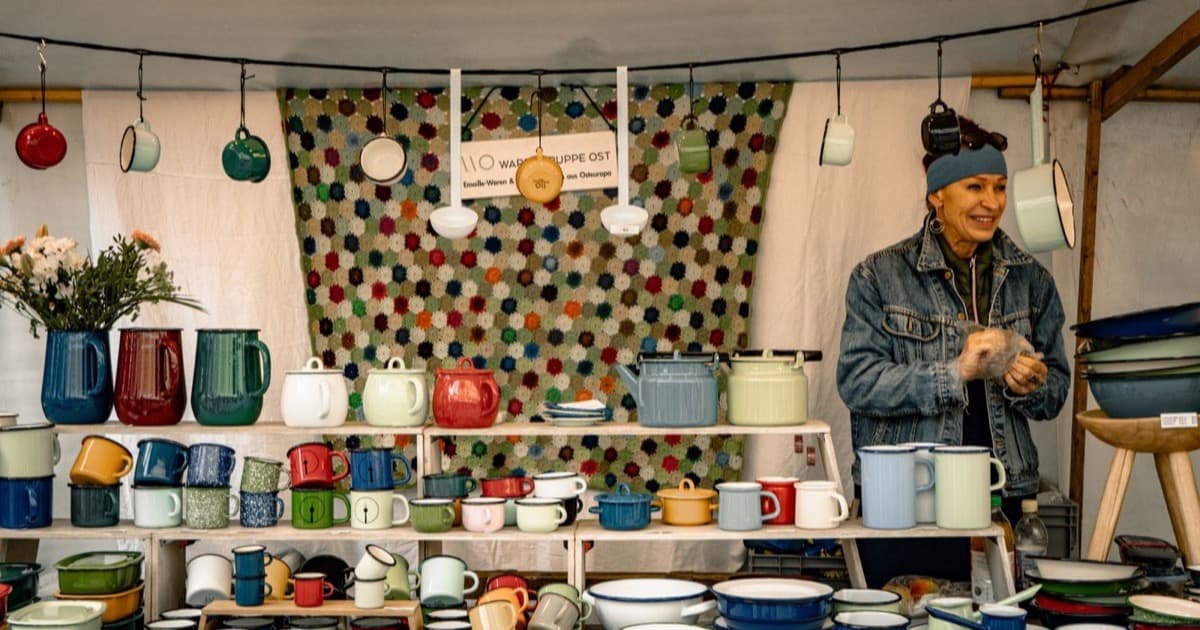
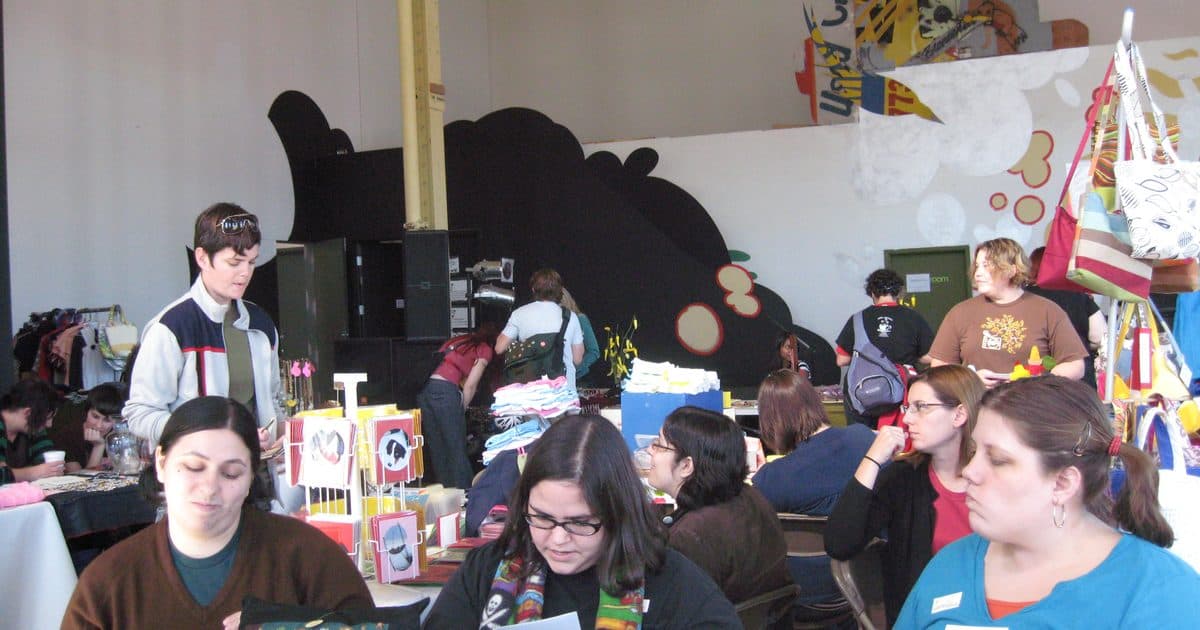
They are run by associations, venues and collectives, in courtyards, social clubs and former industrial spaces, with a form and a fee. One example with public rules is East Market, at Via Mecenate 88/A, in a covered former aircraft factory: one Sunday a month, usually the second to last, open to private sellers, hobbyists and traders selected by the staff, with registration valid for one edition only and pitches of 2 by 2.5 metres. It started out around vintage and second-hand goods, with areas for art, design and upcycling: most visitors come for those, so ask which area you will end up in. Design Week has its own guide: Fuorisalone and Milan Design Week as a maker.
What to ask before paying for a stall
The fee is paid up front; the footfall is discovered afterwards. That is why the questions should be asked in writing, before you hand over a single euro.
- What does the fee include? Table, gazebo, chair, power, lighting. In December it is dark in Milan before five: a stall with no light simply disappears after that.
- How many people came last time, what kind of crowd, and how did you count them? Tickets, registrations, a rough guess: three different answers. If there is no number at all, that is an answer too.
- How many exhibitors, and how many do what I do? The fifth ceramics stall at the same market splits the same crowd five ways.
- Set-up and take-down times, and where do I unload? In the city centre, with a van, logistics decide half the day.
- What if it rains? Indoors, postponed, or you just stay under the gazebo. And if the market is cancelled, is the fee refunded?
- Can I run a live workshop? Space, table, which materials are allowed (clay, hot glue, open flames) and whether the organiser lists it in the programme.
- Do I need a VAT number? At City fairs the call sets the rules; at independent markets the organiser decides whom to admit, hobbyists included, but the tax obligations of selling stay with you: if you have no VAT number, ask an accountant how to treat the sales before the day.
If you have a VAT number, remember that stall sales must be recorded for tax like any other: ask your accountant how to issue the receipt away from your studio, before the day rather than after.
What to bring to the stall
- Pieces across several price bands: something to buy on impulse, something to give as a present, a couple of statement pieces that catch the eye.
- A card reader, charged, plus some change. People without cash rarely come back later.
- Battery lights, an extension lead and tape, even if power is included.
- Price tags on every piece, plus bags and wrapping paper: in December people buy to give.
- Your profile's QR code printed on card, and a sign with your next workshop date, written large.
- A notebook to jot down what you sell and what people ask you: you will need it in the evening.
From stall to booking: a date and a QR code
An object is bought standing up, in a minute. A workshop is not: it costs more, it is chosen with someone else, it has to fit a calendar. At the stall you are not trying to close the booking, you are making it easy to do later. You need two things, and you prepare them at home.
- Publish a date before the market. A real date, two or three weeks away, with a set number of places. “I also run courses” asks nothing of anyone; “Saturday 12 December, 3 pm, six places” does. Give yourself a few days: your profile has to be approved by the team, usually within 24-48 hours, and your Stripe account must be connected before you can receive deposits.
- Prepare your profile's QR code. Your Handsome profile has a public address: turn it into a QR code with any free generator and print it large. With Maker Pro it comes ready-made: under Tools → Social card you will find the QR poster for your studio, a print-ready PDF. Put it in a table-top menu holder and stick a copy to the front of the stall. More uses: QR codes in the studio.
- Place one “made in the workshop” piece among the others, with a tag saying on which date people can learn to make it. It is the difference between “how lovely” and “I could make that”.
- Prepare a single sentence: how it is made, that it can be learnt, and when. Then point to the QR code.
People who book pay only the deposit online, 10 euro per place for group workshops, and settle the rest with you on the day of the workshop. The deposit is collected directly into your Stripe account and is paid out to your bank about five days after the workshop. Handsome takes no commission on the workshop price; Stripe's normal payment fees still apply.
In December some of the people who stop are looking for a present, not an experience for themselves. With Maker Pro (9.90 euro a month with the first month free, or 95 euro a year) and your Stripe account connected, you can switch on your own gift card: it is bought from your profile, the money goes into your Stripe account and it can be spent only on your workshops. Without Pro there is no Maker gift card, and a published date remains your best card to play. How to use it over the holidays: Gift cards for your workshops.
A live demonstration at the stall
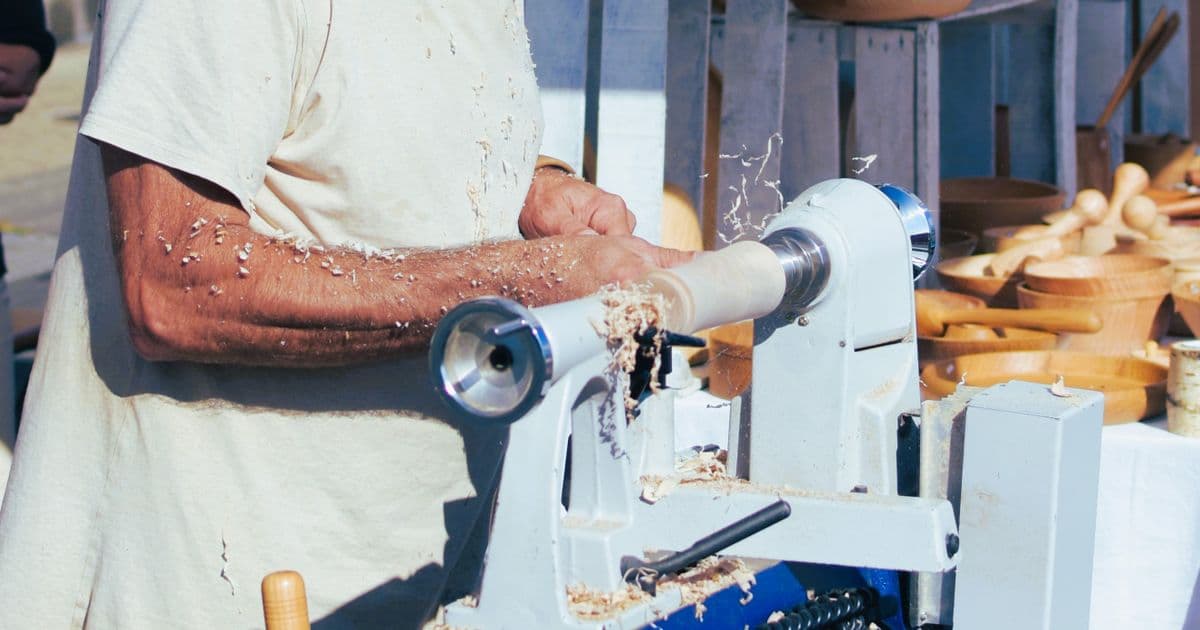
While you work with three people sitting down, ten more stand and watch: that is the best description of your workshop there is, and you did not have to write it. If the organiser allows it, keep the sessions short and complete, with a small object finished in half an hour: onlookers should think “I could do that”, not “that takes forever”.
If the market is on Handsome, the session can become a bookable workshop. When you create the workshop, the location step asks whether it is held at a partner market or fair (“Si tiene a un market/fiera partner?”): choose the market and save. The request goes to the organiser, and only once they approve does the workshop appear on the event page, provided it has a future date.
In the dashboard, the Markets near you panel shows upcoming markets in your province, or upcoming ones elsewhere if there are none in yours, with an Open call label when they are looking for exhibitors. You apply from the market's page, with your profile already approved; the stall fee is agreed directly with the market and Handsome takes nothing. If your application is accepted, your name appears in the Exhibitors section of the market's page, with a link to your profile.
The same goes for workshops: there are no bookable workshops in Milan on Handsome yet. Whoever publishes now is the first to show up for anyone looking for workshops in Milan, and a December market becomes the most direct way to get known in person.
Do the maths the same evening
On the evening of the market you are tired, but it is when you remember everything. Ten minutes with the notebook is enough.
- Costs: fee, materials, transport, any help at the stall.
- Takings: how much you sold, and which pieces.
- Questions: what people asked most often. If lots of them wanted to know whether you run courses, you already know what to publish.
- Bookings: those that come in over the following two weeks, added to the tally as they arrive.
A market is worth it if the day's takings plus the bookings of the following weeks exceed the fee, the materials and the day's work. After three or four markets you have your own numbers and no longer need to rely on the organiser's. How a stall works in other cities: Exhibitors at Bologna's craft markets and Craft markets in Rome.
Frequently asked questions
- How do you take part in Milan's Christmas markets as an exhibitor?
- You choose the market, read the call for exhibitors and apply on time. For the Sant'Ambrogio fair the application goes to the City of Milan, online, at least sixty days ahead; for Artigiano in Fiera you go through the organiser or a regional group stand; for independent markets you use the organiser's application form.
- Do you need a VAT number to exhibit at a market in Milan?
- It depends on the market. City fairs require a licence for commerce on public land, or, at the Sant'Ambrogio fair only, being an artisan or a maker of original creative work; the city's Register of operators of their own creative work requires a VAT number or registration as an artisan business. At independent markets the organiser decides whom to admit and some accept hobbyists too, but how your sales are treated for tax remains your responsibility.
- When do you apply for the Oh Bej Oh Bej fair?
- At least sixty days before it opens, on the Impresainungiorno platform of Milan's SUAP office. The 2026 edition runs from 5 to 8 December and applications closed on 6 October 2026: anyone thinking about it now can prepare for 2027.
- How much does a stall at a craft market in Milan cost?
- There is no single figure. At City fairs, whoever is given a pitch pays the fee for occupying public land, which varies with the area and the street; at independent markets and at fairs such as Artigiano in Fiera each organiser sets its own fee. Before paying, ask what it includes, how many people came last time and how many exhibitors do the same work as you.
- When is Artigiano in Fiera 2026?
- From 5 to 13 December 2026 at Fiera Milano Rho, reached on metro line M1 to the Rho Fieramilano stop.
- How do I get people who pass my stall to book a workshop?
- Publish at least one date with a set number of places before the market and bring a QR code that opens your Handsome profile: you can make it with a free generator, or download the ready-made poster if you have Maker Pro. People who book pay a 10 euro deposit per place online and settle the rest with you on the day of the workshop.
Free profile. A bookable date and your profile's QR code: that is all you need at the stall.
Publish your date before the market