A workshop does not sell like an object. You look at an object and decide; a workshop asks someone to block out a Saturday, travel to you and trust you for three hours. That is why the channels that work for a necklace do not work for a pottery class. Here are the six channels where artisan workshops actually sell, what each one costs and who it brings.
The six channels, one by one
1. Your own website
The channel you fully control: nobody changes the rules on you, nobody keeps a percentage beyond the payment processor. But a site only sells if it has a calendar with seats, a form and a payment, and if somebody finds it: on its own it brings nobody. It costs maintenance time every month, and that time exists even when you do not invoice it. The honest guide to building one is in how to build a website that takes bookings.
2. Instagram and WhatsApp
This is where your work looks best and where trust is built. It is not a booking system: direct messages make you the receptionist, counting seats, remembering who paid, chasing people who went quiet. Excellent for sparking interest, as long as there is a link at the end where people book on their own. The full comparison is in website or Instagram for artisans.
3. Event ticketing services
They sell tickets for a specific date: handy if you run a few sessions a year and want the money upfront. The limit is that they treat your studio like a concert: little story, few photos, no profile left standing once the event is over. Fees change often, so check the official pricing page on the day you publish.
4. Tourist experience marketplaces
They bring volume, mostly visitors in town for a few days. In exchange they keep a significant percentage of every booking and usually own the relationship with the customer. The right channel if you are in a heavily visited area with weekday seats to fill; the wrong one if you are counting on the person who lives twenty kilometres away and might come back.
5. Artisan experience platforms
They sit in between: calendar, seats, payment and emails like a website, search traffic like a marketplace, but focused on craft. The two real differences between one and another are how much they keep and whether they leave you the contact details of whoever books. The seven questions to ask first are in platforms for artisans: how to choose one.
6. In person: markets, fairs, your shop window
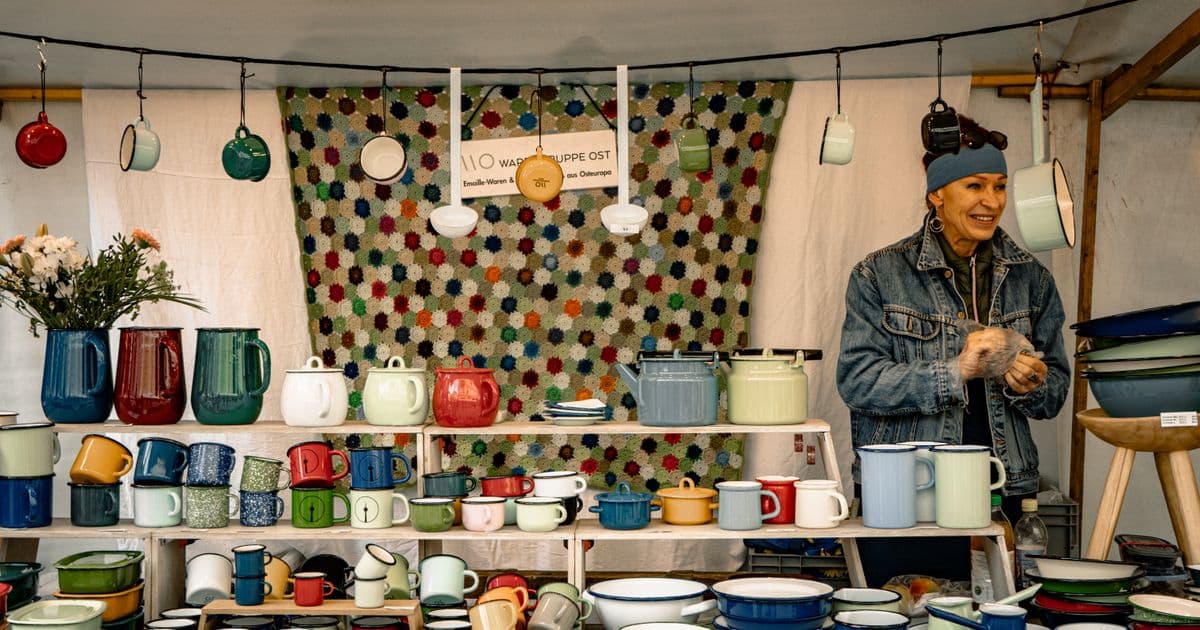
It looks like the least digital channel and it feeds the digital ones best: at a market stall you talk to a hundred people in a day. The trick is to sell dates as well as objects: a sign with a QR code pointing to your booking page turns the stall into a shop for your calendar. How that works in practice is in from the market stall to bookings.
How to combine them without losing your mind
- Pick one place where booking happens. One page, one calendar, one source of truth about free seats. Everything else points there.
- Use the other channels as road signs. Instagram, the market, the flyer in the shop down the road: their job is to get people to the page, not to handle the booking.
- Put the link where people actually click. Profile bio, first comment under the post, auto-reply to messages, email signature, QR code on the stall.
- Add a second channel only when the first is full. Two calendars that do not talk to each other will sell the same seat twice, and there is no worse first impression for a new customer.
The mistakes that cost you bookings
- Writing DM me for details. Every message is a person waiting for your reply before deciding: half of them do not wait.
- Hiding the price. People who cannot find it assume it is high and close the page. A published price filters, and filtering saves you both time.
- Photos without people. The finished object is beautiful, but someone buying a workshop wants hands, tables, dirty aprons: they want to picture themselves there.
- No cancellation rule. When the first last-minute drop-out arrives you improvise, and you are the one who pays for improvisation.
Handsome, in three lines
Handsome is the fifth channel on the list. The Maker profile is free: you publish workshops with calendar, seats and automatic sold out, and every listing has its own page in Italian and English. Whoever books pays a deposit online and the balance at your studio; the deposit lands directly in your Stripe account and Handsome keeps nothing: 0% on your takings, only Stripe's fees remain. The contact details of whoever books stay yours, so the channel never holds your address book hostage.
Frequently asked questions
- What is the best channel for selling an artisan workshop?
- It depends who you want in the room. For people nearby who might return, Google search and local word of mouth work; for visitors, experience marketplaces work. There is no best channel in the abstract, only the right one for the seat you need to fill this month.
- Should I sell on several channels at once?
- Yes, but only if booking happens in one place. Advertising everywhere is fine; managing seats in three different calendars ends with the same seat sold twice.
- Full payment online or just a deposit?
- For group classes a deposit works better: it filters out the undecided without asking full trust from strangers, and you collect the balance at the studio. For private sessions or expensive materials you can raise the upfront share.
- How do people find me when they search for a class in my town?
- Two things are needed: a page about that class in that town, and a few links pointing to it. A Google business listing plus an indexable booking page cover most local searches.
Free profile, page in Italian and English, deposit online and balance at your studio.
Publish your first workshop