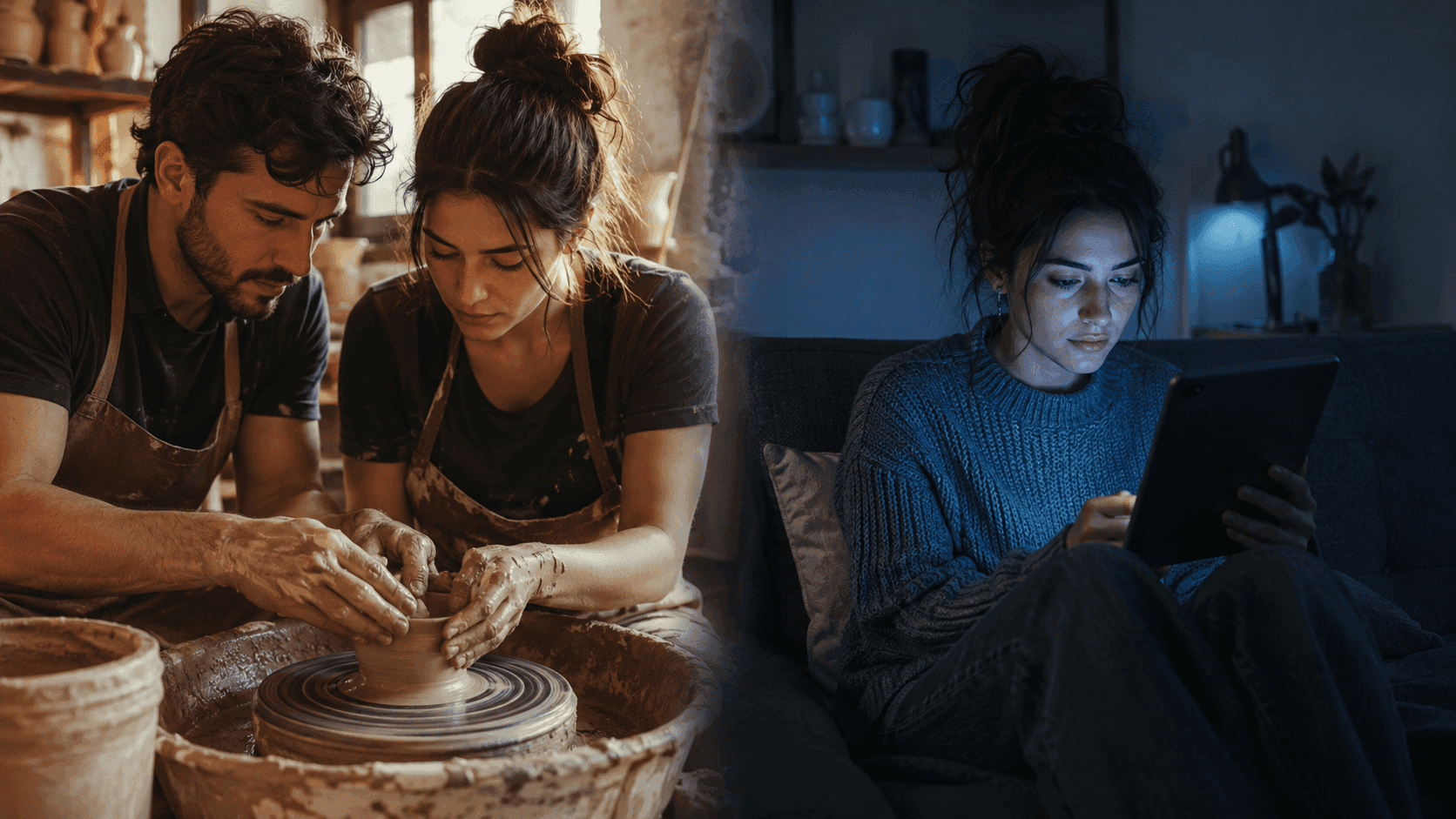
Many artisans are afraid of Skillshare, Domestika and MasterClass: 'how can I ask €65 for 3 hours when they offer unlimited access at €9.99/month?'. The short answer: you are not selling the same thing they are. They sell information. You sell presence. They are two different markets that overlap only on the surface.
7 concrete differences
1. Manual vs visual learning
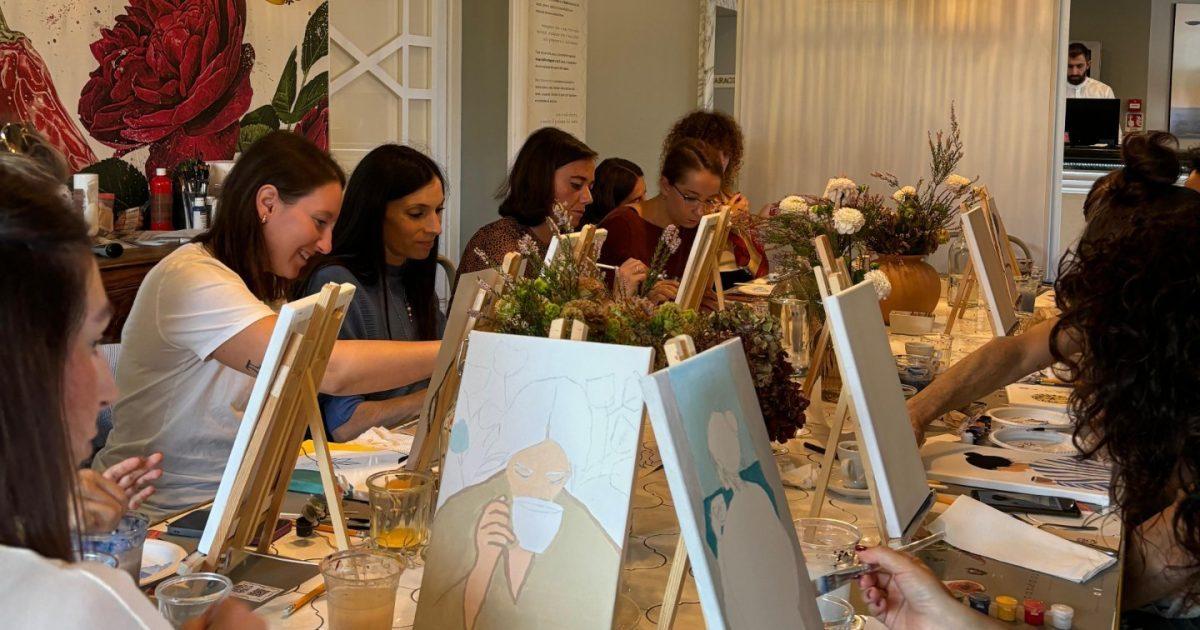
70% of learning a manual technique (the wheel, mosaic, cutting leather) happens through physical correction of posture: of the wrist, of finger pressure, of the angle of the tool. A video cannot correct your wrist when you get it wrong. You, in the studio, can.
2. Real materials and environment
Clay at 18 degrees in the studio behaves differently from clay at 28 degrees in the customer's living room. Pâte brisée in Bologna in autumn is a different thing from pâte brisée in Cagliari in August. Online you don't control the environment; in the studio you do.
3. Immediate vs delayed correction of mistakes
Online, a beginner makes 30 minutes of accumulating mistakes before rewatching the video. In person, the mistake is caught at second 5. The speed of feedback is the main variable in improvement (Ericsson 1993, on the 10,000 hours).
4. A social experience
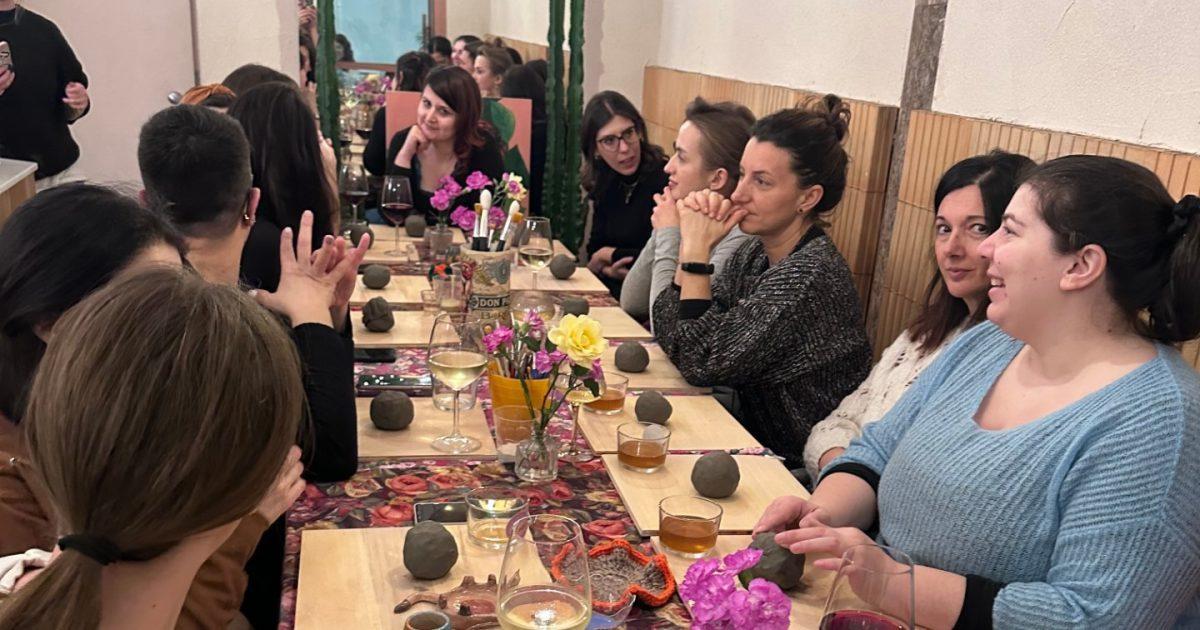
Skillshare is solitude + algorithm. An in-person workshop is 6 people laughing, getting things wrong, telling each other where they come from. 80% of workshop participants confirm they chose it 'to get out of the house', not 'to learn'. You are selling an evening, not a lesson.
5. A ritual act
Subscribing to Skillshare is a transaction: €9.99, click. Booking a workshop is a small ritual: I choose the date, I tell my partner, I get dressed, I catch the train, I cross the neighbourhood, I ring the studio doorbell. The experience starts 5 hours before the workshop and ends 2 days later. Online it starts and ends when you click play.
6. A tangible souvenir
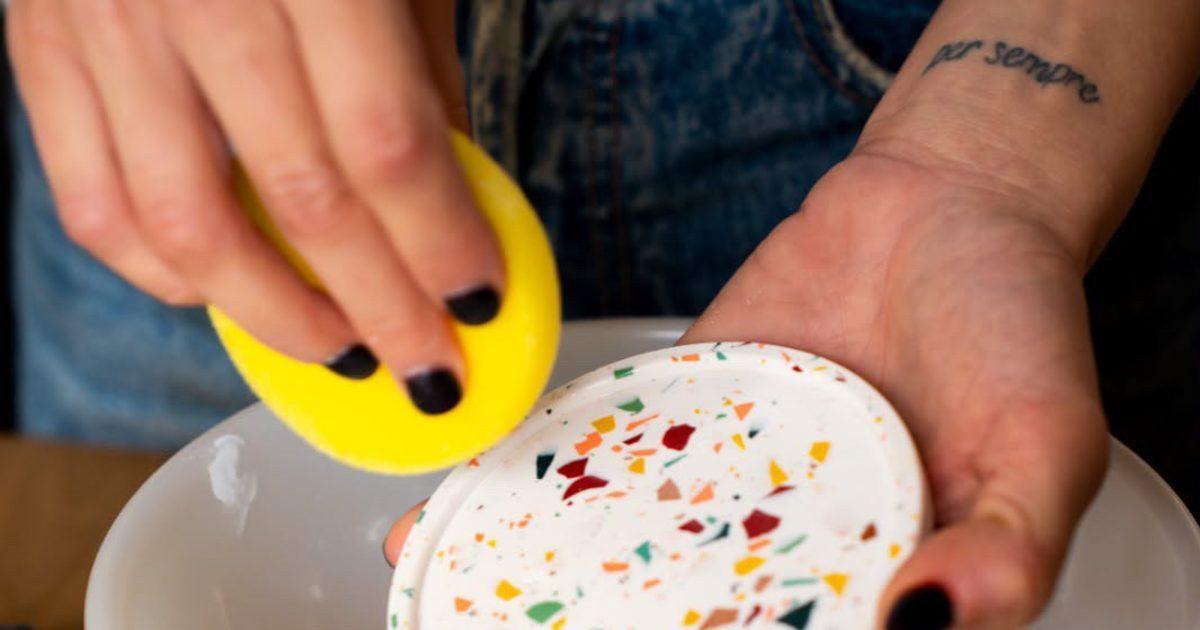
What do I take home from a Skillshare video? Abstract knowledge. What do I take home from a workshop? A bowl with my signature, a necklace I soldered myself, a soap that smells of the studio. The physical object is a memory that ages with you.
7. A story to tell
'I did a raku ceramics workshop in Faenza with the granddaughter of a historic ceramicist' is a story. 'I took a Domestika course' is not. The difference can be quantified: an in-person workshop gets talked about 7 times on average (Instagram, dinner, the office, family, the dentist), an online course 0.5 times.
When online wins
Online is not the enemy, it is complementary. It wins when:
- The customer lives in areas with no local studios (small villages in central-southern Italy, the mountains)
- They want a theoretical introduction before investing in a workshop
- They are looking for a very rare niche (e.g. Islamic art) that is impossible to find offline
- They have a budget of < €30/month for a hobby
- They want to learn at their own pace, over 6 months rather than in 1 day
When you win (the physical studio)
- Learning manual techniques that need correction of posture/pressure
- An emotional experience (a gift, an anniversary, a travel memory)
- Socialising (team building, groups of friends)
- A tangible object as a souvenir or gift
- A tourist customer who wants to 'do something real' in the city
- A customer who has already learned online and now wants to make the leap to in-person
How to position yourself without fear
In your workshop description, don't defend yourself against Skillshare. Simply sell the 7 elements that YOU offer: real-time correction, materials on site, the group, the ritual, the object, the story. Let the customer realise on their own that it is a different category of product.
Publish your workshop on Handsome
On Handsome you don't compete with online courses: you occupy a different category. Free sign-up, premium-accessible positioning. Start building your niche of customers who are looking for physical presence, not on-demand video.
Frequently asked questions
- Is it worth also running online courses to widen my audience?
- Yes, but as a funnel towards the in-person workshop. Example: an introductory Domestika course at €9.99 → at the end of the course, a link saying 'come to my studio in Faenza for the live masterclass' at €95. 3-5% convert. Don't replace in-person with online.
- What do I say if a customer tells me 'it's free on YouTube'?
- 'On YouTube nobody corrects your wrist when you get it wrong. In my studio, I do. And you take home the bowl, not the theory.' A crisp line, not a defensive one. Whoever chooses YouTube is not your customer.
- Do competitors' Instagram tutorials steal my customers?
- No: they build awareness. A customer who has watched 10 of your Instagram tutorials for free is a customer who, when they want to take things seriously, pays €75 without hesitation. Tutorials are lead magnets, not competitors.