

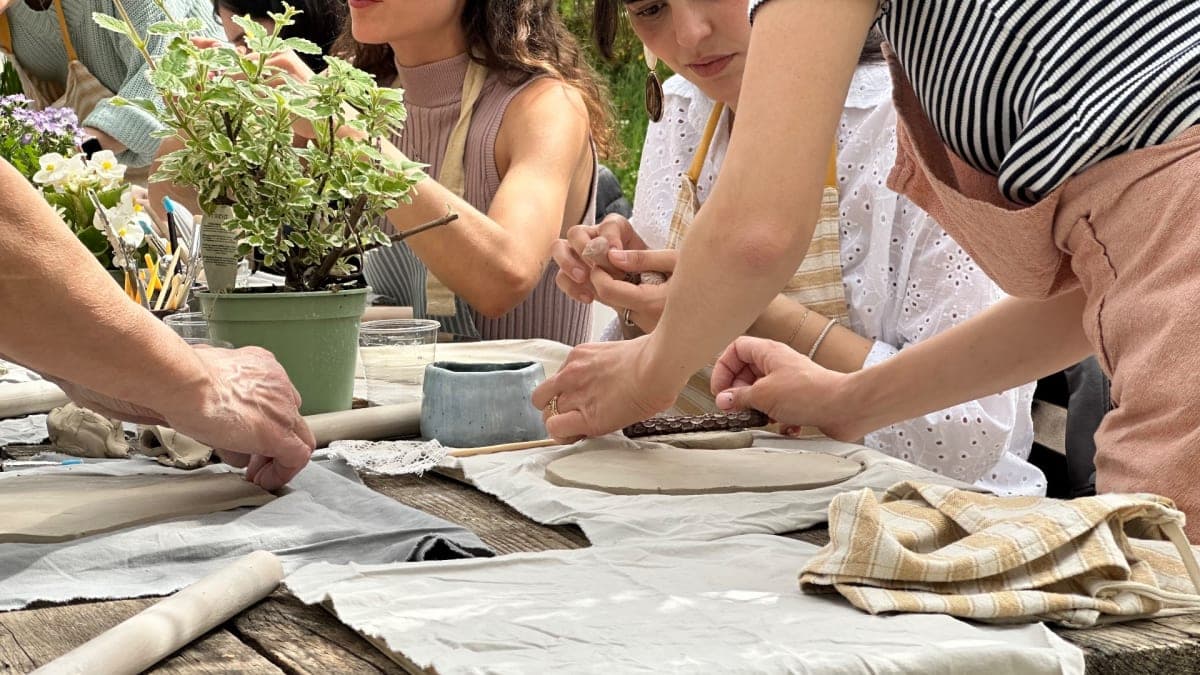
“I would, but I have nowhere to do it.” That sentence stops more first workshops than any tax question, and it holds up poorly, because most courses do not happen in an equipped studio: they happen on a big table, with good light and a sink within reach. The rest you bring in a box.
Venues that actually work
Your home
The most common choice for a first course and perfectly legitimate for a small group. It costs nothing and gets you started. Two caveats: check your building rules if you expect frequent comings and goings, and be honest in the listing — saying it takes place in your home studio is information, not a flaw. People booking a craft experience often prefer exactly that.
A room rented by the hour
Almost every town has rooms, coworking spaces and shared studios rented by the half day. The most flexible option: you pay only when the course fills, without committing to a monthly lease for something you are still testing.
A café, a restaurant, a wine bar
Outside opening hours their rooms sit idle. Many are happy to host, especially if the workshop ends with drinks your participants buy: you get the venue, they get custom in a dead slot. It is the easiest partnership to propose, because it explains itself in one sentence.
Outdoors
Gardens, courtyards, terraces, off-season beaches. Excellent for techniques that do not mind wind and dust, and the photos alone repay the effort. Always have a rain plan, written into the listing before anyone asks.
Shops, concept stores, other people's studios
A homeware shop, a bookshop, a plant nursery: anyone with a space and a customer base but no event to offer them is your natural partner. You bring the content, they bring the people.
Libraries, civic centres, associations
Often rooms at token cost and an audience already used to signing up for activities. Slower and more bureaucratic, but a stable base for a regular course.
What to check before fixing a date
- How many people fit seated comfortably, not standing. A table for eight seats six in a ceramics workshop.
- Water and a toilet. Without running water half of hands-on crafts become awkward; without a toilet, a three-hour course is unworkable.
- Power and sockets, if you use kilns, heat guns or sewing machines.
- Who answers if someone gets hurt. Ask the owner how the space is covered and consider your own public liability policy: it costs little and takes the worry away.
- Collecting finished pieces, if your technique needs firing or drying. If the space is not yours, agree first where they stay and how you hand them back.
- Parking and transport. Put it in the listing: it is the first question you will get.
How to word it in the listing
Do not hide the venue, explain it. “We meet in my home studio, in the centre of Cagli, a table for six and coffee on the house” is more convincing than a bare address, because it tells the customer what kind of afternoon awaits. If the venue changes from one date to the next, say so and say how you let people know.
Once you have the space, the first workshop takes half an hour to build: title, duration, seats, price, one date. If you want to see how others tell it, look at the workshops published on the portal and read how they describe the venue.
Frequently asked questions
- Can I run workshops at home?
- Yes, for small groups it is the most common way to start. Check your building rules if you expect frequent traffic and state clearly in the listing that it takes place in a private space.
- Do I need insurance?
- It is not always legally required, but public liability cover is advisable: you work with people handling tools, paints, kilns or knives. Ask your insurer about an extension for teaching activities.
- What does an hourly space cost?
- It varies widely by town and type of space, so do not trust an average found online: get two or three local quotes. A practical rule is that the venue should not cost more than a couple of seats' takings.
- Can the venue change between dates?
- Yes, each date can have its own location. What matters is that the published address is always the real one: anyone already booked has to be told of any change.
- What if it rains and the workshop is outdoors?
- Write the plan B into the listing before anyone asks: postponed to the next date, moved indoors or refunded. Deciding it in advance avoids arguments on the day.
You need a table, not a studio. The profile is free and a first course takes half an hour to build.
Publish your first workshop