Brisighella is in the province of Ravenna, 12 km from Faenza, 50 from Ravenna and 70 from Bologna: you get there by car on the SS 302 road, or by train on the Faentina line. It is one of I Borghi più belli d'Italia (Italy's Most Beautiful Villages) and holds the Italian Touring Club's Orange Flag. The centre is small and entirely walkable, so a single day really is enough. Below: what to see, what is actually true in the story they tell you about Donkey Alley, and — with an honest note about distances — how to add an artisan workshop to the trip.
Three hills, three monuments
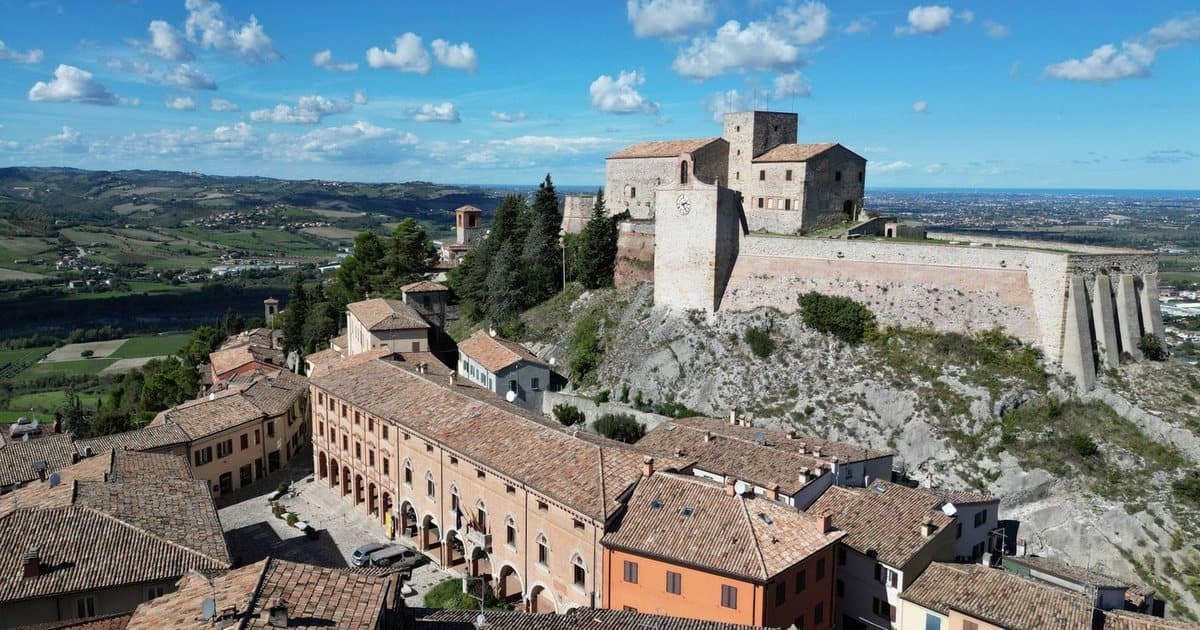
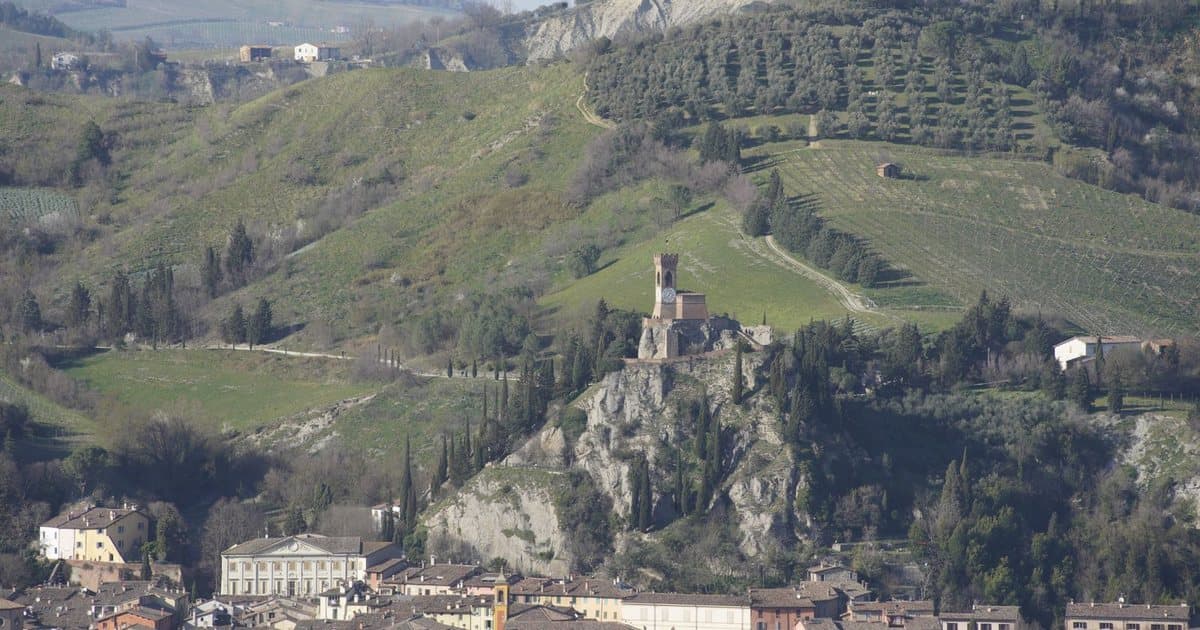
The village is squeezed into the lower Lamone valley, at the foot of the Tuscan-Romagnol Apennines, with three spurs of chalk rock rising above it. Each one carries a building, and those are the three monuments in every photograph of the place. This is not scenery built for visitors: they were control positions, and you understand that the moment you start climbing.
- Rocca Manfrediana, built in 1310 by the Manfredi, lords of Faenza. It still has the chain holes for the drawbridge, the corbels and loopholes, the guards' walkway along the walls. It passed to Cesare Borgia between 1500 and 1503, then to Venice from 1503 to 1509, which added the great tower and the defensive walls.
- Torre dell'Orologio, the clock tower, built in squared blocks of chalk rock; the original structure is attributed to Maghinardo Pagani. What you see today is the complete rebuild of 1850, when the six-hour clock was installed.
- Santuario del Monticino: the present building dates from 1758 and holds a polychrome terracotta plaque from 1626 by an unknown artist. The facade was redone in 1926 to a design by Edoardo Collamarini; the interior frescoes are from 1854, by Savino Lega of Faenza.
You climb them on foot from the centre. It is not mountaineering, but it is a real climb, with stairways and unpaved stretches: closed shoes, and a bottle of water in summer. If your legs are limited, pick one and take your time — the reason to go up is to look down at the village, and all three give you that.
Via del Borgo, known as Donkey Alley: what it really was
Its official name is Via del Borgo. It is an elevated street that runs covered inside the buildings, lit by a row of arches of varying width looking onto the square below. It is not an arcade and it is not an alley: it is an entire floor of houses crossed by a street, and there is not an easy second example of it in Italy. Being covered, it is also one of the few things in Brisighella that still works in the rain.
Its origin is military. Via del Borgo was built around the 14th century as a patrol walkway: it was the oldest defensive bulwark of the settlement, and at the time it was open to the sky. When the military function fell away, the street was covered and absorbed into the buildings that grew around it, becoming housing. The village's official sources give no precise year for that change, so be sceptical of anyone who dates it to the decade.
The donkeys come later. The quarter was inhabited by the birocciai, the carters who brought gypsum down from the quarries above the town, in the Monticino area, using small donkeys. The structure still tells that trade: the stables stood in front of the arches, the dwellings on the upper floors, and the carts were kept in large chambers carved into the chalk that opened onto the square. Hence the nickname, which by now has overtaken the real name.
PDO olive oil and gypsum: two products of one landscape
Olio Extravergine di Oliva Brisighella PDO is produced within the administrative territories of Brisighella, Faenza, Riolo Terme, Casola Valsenio and Modigliana. The specification requires at least 90% olives of the Nostrana di Brisighella variety and sets the harvest between the start of veraison and 20 December each year. In practice: come in November and you find the town in the middle of the olive campaign, which is when you understand what the label is talking about.
Gypsum, on the other hand, is the stone the village is built on and the reason the carters existed at all. Quarrying above Brisighella ended in the late 1980s, and the former Monticino quarry became an open-air Geological Museum, inside the Vena del Gesso Romagnola regional park: you walk through a disused quarry reading the stratigraphy off the walls. It is entirely outdoors, so in the rain skip it and stay under the arches.
One day in Brisighella, in order
- Early morning: the hills. Climb while the air is still cool. Rocca Manfrediana, the clock tower and, if you have the legs, the Monticino sanctuary.
- Mid-morning: Via del Borgo. Walk it in both directions. It changes completely depending on how the light hits the arches, and on the second pass you notice what you missed on the first.
- Lunch. Inland Romagna cooking, not beach food. The PDO oil is on almost every table: ask for it explicitly and taste it on its own, on bread.
- Afternoon: the former Monticino quarry. It sits near the sanctuary, so you close the circle between the gypsum in the quarry walls and the gypsum the covered street rests on.
- Before leaving: shopping. Oil, and whatever the hills are producing that season. Simple rule: buy where they let you taste first.
And an artisan workshop? Let's talk about distances
One thing needs saying plainly: there are no workshops published in Brisighella on Handsome. Faenza, 12 km away, is the city of majolica and would be the natural pairing — if that interests you we cover it in Faenza, city of ceramics and in ceramics workshops in Romagna for beginners — but there are no bookable experiences there either at the moment. We would rather tell you now than send you to an empty page.
The nearest Makers are in the Rimini side of Romagna and just over the border into Le Marche: Rimini, Cattolica, Gradara, Pesaro. From Brisighella that is over an hour by car, so it is not something to squeeze into the same afternoon. Two realistic options. First: two days, Brisighella on Saturday and the workshop on Sunday, heading down towards the coast, perhaps taking in the villages of the Valmarecchia. Second: keep the two apart and give the workshop its own weekend. If you are coming from outside the region the same logic applies as in a day trip from Bologna: Brisighella is 70 km from Bologna, the workshops considerably further on.
How booking a workshop on Handsome works
If you are heading down to the coast and want to add half a day inside a workshop, the mechanics are short to explain and hold no surprises at the moment of paying.
- You book online with a deposit — 10 euros for group workshops — and pay the balance on site on the day.
- No commission on the workshop takings: the payment goes directly into the Maker's account.
- The round figure you see is the price: nothing is added afterwards.
- Free cancellation up to 3 days before, which when you are booking a weekend away is the line that matters most.
Frequently asked questions
- How much time do you need for Brisighella?
- A full day is enough. The historic centre is walkable and the three hills are reached by short climbs. Add the open-air Geological Museum at the former Monticino quarry and a long lunch, and your Saturday is full without rushing.
- Why is it called Donkey Alley?
- Because the quarter was home to the birocciai, the carters who used small donkeys to bring down gypsum quarried above the town, in the Monticino area. The street's official name is still Via del Borgo: it was built around the 14th century as an open defensive walkway, and only later covered and inhabited.
- When is the best time to go?
- November, if the oil interests you: the Brisighella PDO specification sets the harvest between the start of veraison and 20 December, so the town is working the olives then. In spring and autumn the climbs to the three hills are easier than in high summer. In the rain, Via del Borgo is covered and holds up; the former quarry does not.
- Are there artisan workshops in Brisighella on Handsome?
- No, and none in Faenza at the moment either. The nearest published experiences are in the Rimini area and along the border with Le Marche — Rimini, Cattolica, Gradara, Pesaro — over an hour's drive from Brisighella. Treat them as two separate trips, or as the two days of one weekend.
The experiences published today are concentrated mainly around Rimini, Cattolica, Gradara and Pesaro. City, date and time are always shown on the listing: check them before you book.
See the workshops available