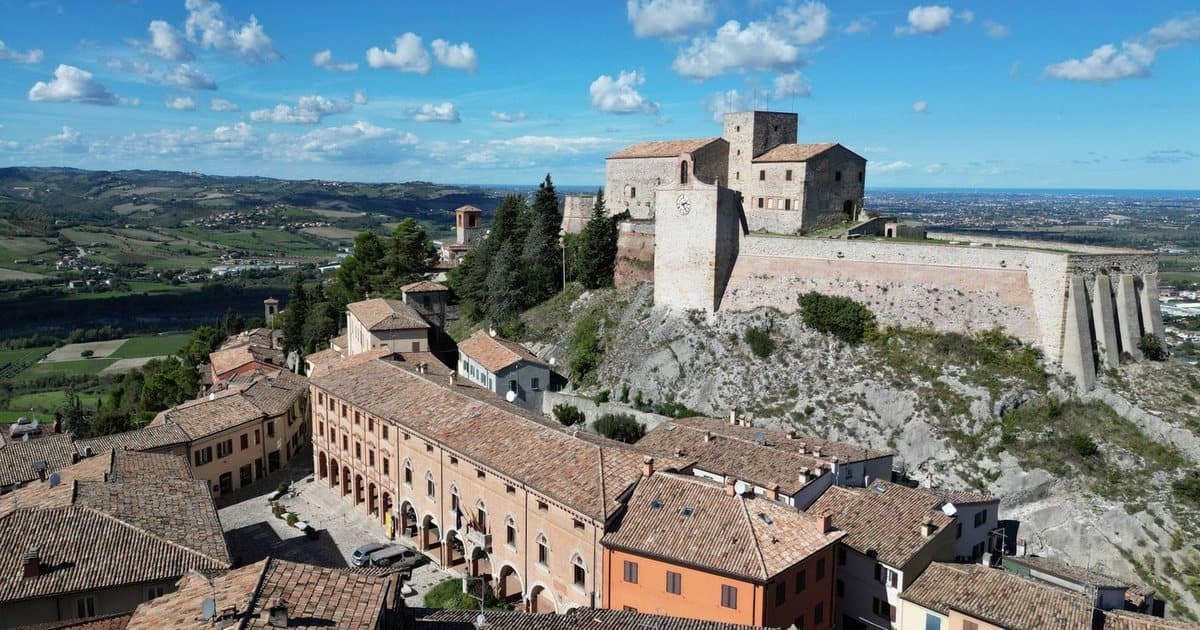
Three villages, one day, one car. Longiano, Verucchio and Montefiore Conca all sit inland, behind the Romagna coast: the first on the low hills of the province of Forlì-Cesena, the other two in the province of Rimini, one in the Marecchia valley and one in the Conca valley. They are a few kilometres apart, each has a Malatesta fortress you can walk into, and — this is what makes the day work — each has something completely different inside. Here is what you actually see in each one, how long it takes, and the order that makes sense.
Why these three work well on the same day
They share one thing and differ in three. What they share is the Malatesta, the family that ruled Rimini and much of Romagna and left a standing fortress in all three towns. What differs is what you find inside, and that is why the loop never gets repetitive: a 20th-century art collection in Longiano, an archaeological museum covering almost three thousand years ago in Verucchio, 14th-century frescoed halls and a view that reaches the sea on clear days in Montefiore Conca.
As for official recognition, the Emilia-Romagna regional tourism portal lists Longiano and Montefiore Conca among the villages holding the Touring Club Italiano's Bandiera Arancione, and Verucchio and Montefiore Conca among the Borghi più belli d'Italia, Italy's most beautiful villages. Labels, yes — but they tell you something practical: small, well-kept historic centres you can walk end to end, set up to welcome people arriving from outside.
Longiano: a castle with Morandi, Matisse and Chagall inside
The Castello Malatestiano is the centre of town in the literal sense. The municipality traces its origins to the 7th-8th century and cites a document from 1059 in which it already appears as a defensive castle. The Malatesta held it from 1290 to 1463 and reinforced it with new bastions; in 1519 Count Guido Rangoni received Longiano as a fief, removed some Malatesta fortifications and added a walkable loggia. Until 1989 the town hall was inside: this is a building that has stayed useful for a thousand years.
Today the castle is the permanent home of the Fondazione Tito Balestra, created to preserve the art collection of the Longiano poet Tito Balestra. According to the Ministry of Culture, it holds roughly two thousand three hundred works — paintings, drawings and sculptures — with names such as Maccari, Mafai, Rosai, de Pisis, Morandi, Guttuso and Sironi, plus international presences including Matisse, Chagall and Goya. It is a serious collection inside a small town: if you are expecting four paintings on a wall, you are badly wrong.
What else there is to see in Longiano, beyond the castle:
- Teatro Petrella, inaugurated in 1870 and named after the composer Errico Petrella, who conducted his opera *I Promessi Sposi* for the occasion. It is a horseshoe-shaped Italian-style theatre with two tiers of boxes and a gallery, 205 seats in all; its philological restoration was completed in 1986.
- The Museo Italiano della Ghisa, housed in the former church of Santa Maria delle Lacrime in the historic centre: cast-iron street lamps, fountains, benches and railings — the kind of urban furniture you look at every day without ever seeing it.
- The historic centre, which takes very little to walk. The castle's address is Piazza Malatestiana: get there and you have got everywhere.
Realistic timing: a short half day if you go into both the castle and the cast-iron museum, an hour and a half if you stick to the Foundation and two laps of the square. The municipality lists the castle as open Tuesday to Sunday, with different hours in August: check the day before, because seasonal opening times in these villages always shift a little.
Verucchio: the Malatesta fortress and tombs from three millennia ago
Verucchio sits in the Marecchia valley, on top of a rocky spur. The Rocca Malatestiana, also called Rocca del Sasso precisely because of that position, is one of the largest and best preserved Malatesta fortifications, with overlapping building phases from the 12th to the 16th century. And it is no ordinary fortress in the family's story: Malatesta da Verucchio was born here, the founder of the dynasty whom Dante calls the "Mastin vecchio", the old mastiff, in the Divine Comedy.
You really do get inside: the great hall, the courtyards, the Malatesta family tree, the 13th-century cistern, and the keep with its panoramic terrace at the top, from which you see the coast and the upper valley hills at the same time. It is the moment when you understand, without needing any explanation, how a family based here managed to hold the valley for centuries.
The other reason to stop is the Museo Civico Archeologico, at via Sant'Agostino 14. It tells the story of the Villanovan-Etruscan community that lived here between the 9th and the 7th century BC, through material recovered from the necropolises excavated at the foot of the town: pottery, amber pectorals for women's garments, and a wooden throne from a princely tomb. Wood that reaches us from almost three thousand years ago is not something you see often in a museum.
If the Marecchia valley wins you over and you want to stretch the weekend, the natural continuation is up the valley: we cover it in San Leo and the Rimini hinterland and in Marecchia valley villages and artisan workshops.
Montefiore Conca: the fortress you see from far away
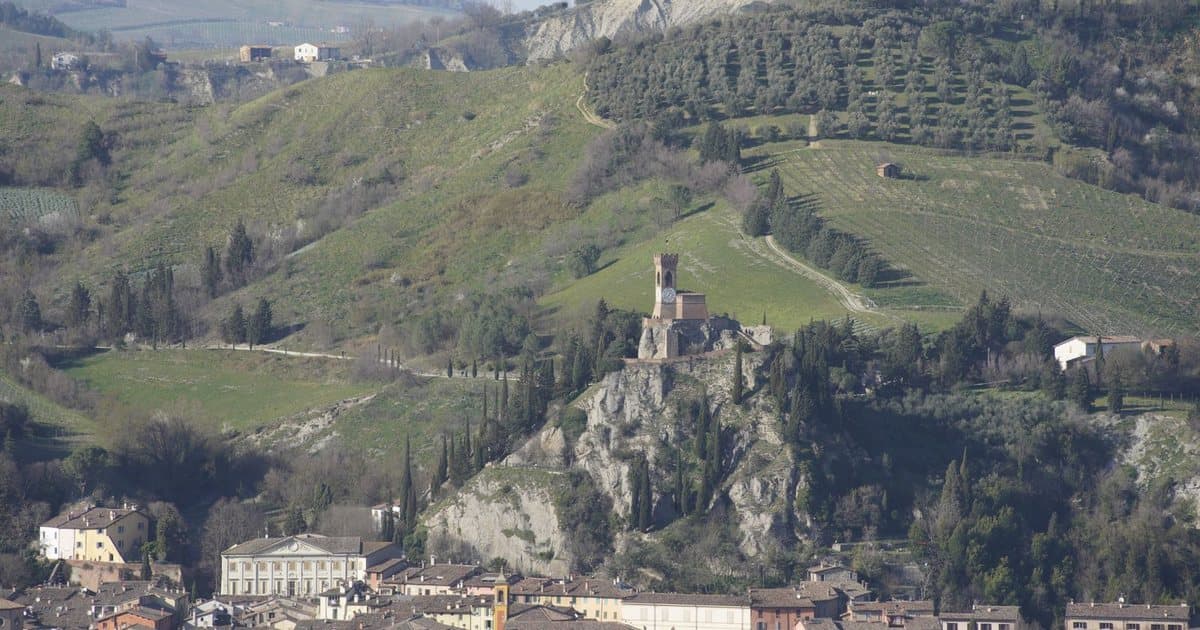
Montefiore Conca is in the Conca valley, and it is the village you see standing above the hills before you even get close. The municipality dates the Rocca Malatestiana to around 1337, built by Malatesta Guastafamiglia: by 1347 it was standing and fully operational, enough to host the King and Queen of Hungary. It stayed in Malatesta hands until 1458, and it was never only a military fortress — it was also a residence and a place of representation.
Inside, the two rooms to look for are the Sala dell'Imperatore, with frescoes by the Bolognese painter Jacopo Avanzi dating to around the middle of the 14th century, and the Sala del Trono, named after the lord Ungaro Malatesta, which today holds fragments of the frescoes moved here from the Sala dell'Imperatore. There are also original wooden balconies and steep staircases running through the building, so wear comfortable shoes. Three reasons to climb up here:
- The view. The municipality writes that from the promontory, on clear days, the view takes in the coast from Fano to Ravenna.
- The excavations. The fortress has yielded pottery, Venetian glassware, coins, weapons and a bronze seal: the everyday objects of the people who actually lived here, not just the dates of battles.
- The village around it, small and uphill, with the fortress above your head from wherever you look at it.
The inland rule applies here too: check opening days and hours before you set off, because they are not the same all year, and in some periods access to the fortress is organised as guided tours at fixed times.
The order that makes sense
The loop works north to south, following the geography: Longiano is furthest north, on the hills towards Cesena; Verucchio sits in the middle, in the Marecchia valley; Montefiore Conca is furthest south, in the Conca valley, towards the border with Marche. Doing them in this order means never doubling back on the same road.
- Early morning: Longiano. This is the village where you spend the most time indoors, so it holds up even if the sky looks uncertain. Castle and Fondazione Tito Balestra, then the Museo Italiano della Ghisa if you have room.
- Lunch: on the road or in Verucchio. Climbing towards the Marecchia valley you are already halfway through, and eating at the top of the village saves you getting straight back in the car.
- Early afternoon: Verucchio. Rocca del Sasso and the archaeological museum. If you have to pick one, pick the fortress: the keep terrace alone justifies the climb.
- Late afternoon: Montefiore Conca. Last stop on purpose. Low light over the Conca valley is the best way to close the day, and the view towards the coast at that hour is a different thing entirely.
If it rains, or if you want to bring something home
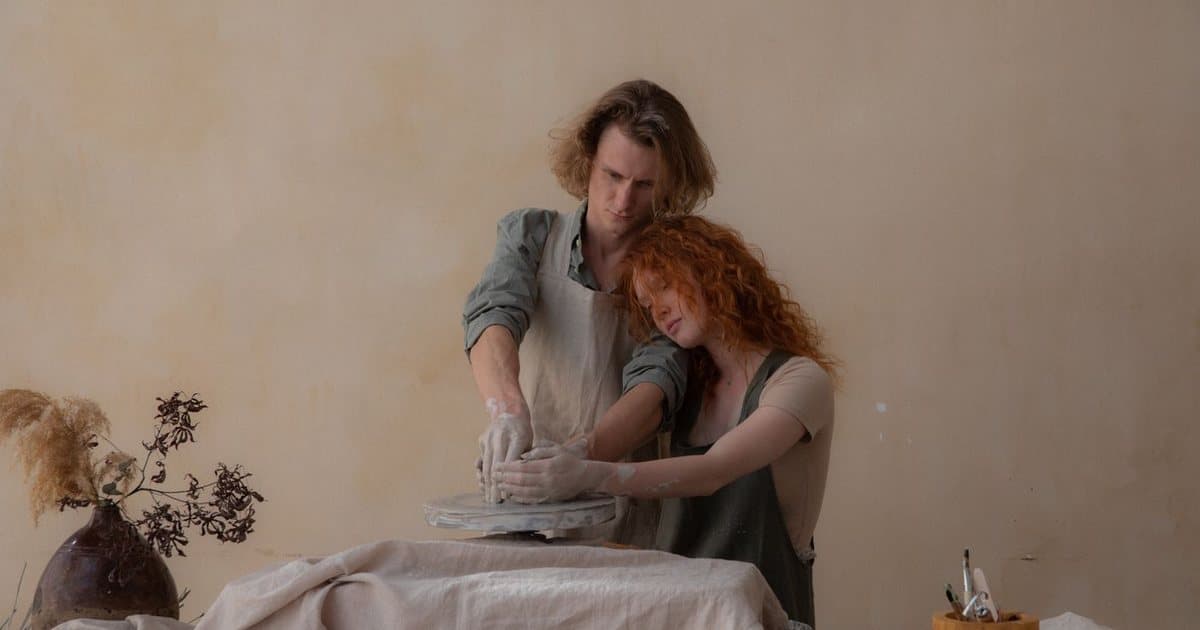
A village loop is a day of looking: you walk, you look, you take photos. If you then fancy doing something with your hands — or if the weather flips your plans, in which case there is what to do in Rimini when it rains — the same area has artisan studios that open their doors for a few hours: ceramics, jewellery, different materials depending on who is available on those days. It is the simplest way to take home an object you can tell a story about, instead of a fridge magnet.
On Handsome it works like this: you book online with a deposit (10 euro on group workshops) and settle the rest on site on the day. There is no commission on the workshop takings, the payment goes directly into the Maker's account, and the round figure you see on the page is already everything. Change your mind and cancellation is free up to 3 days before.
Frequently asked questions
- Can you really see all three in one day?
- Yes, on one condition: go inside two of the three and limit yourself to a walk in the third. Three full visits plus the museums turns into a packed, rushed day. You need a car, because the three villages sit on three different slopes and the direct connections between them were not designed for tourism.
- Which one is best if I can only do one?
- It depends what you are after. Verucchio for the larger fortress and a significant archaeological museum, with the wooden throne and the amber pectorals from the Villanovan necropolises. Montefiore Conca for the view and the 14th-century frescoed halls. Longiano if you care about 20th-century art: the Fondazione Tito Balestra, inside the castle, holds roughly two thousand three hundred works according to the Ministry of Culture.
- Are the fortresses suitable for children?
- They are real castles, with steep stairs, wooden balconies and high terraces: children usually love them, but they need watching and closed shoes. Leave the pushchair in the car, because all three historic centres are uphill and the paving is not smooth.
- Do I need to book?
- Not for walking around the villages. For the interiors it is worth phoning or checking the municipal website the day before: hours change with the season and in certain periods the fortresses can only be visited on guided tours at fixed times. You will not find opening hours or ticket prices in this article precisely because they change faster than an article does.
Experiences published by Handsome Makers near the Rimini coast. Book with a deposit and settle on site, free cancellation up to 3 days before.
See workshops in the Rimini area