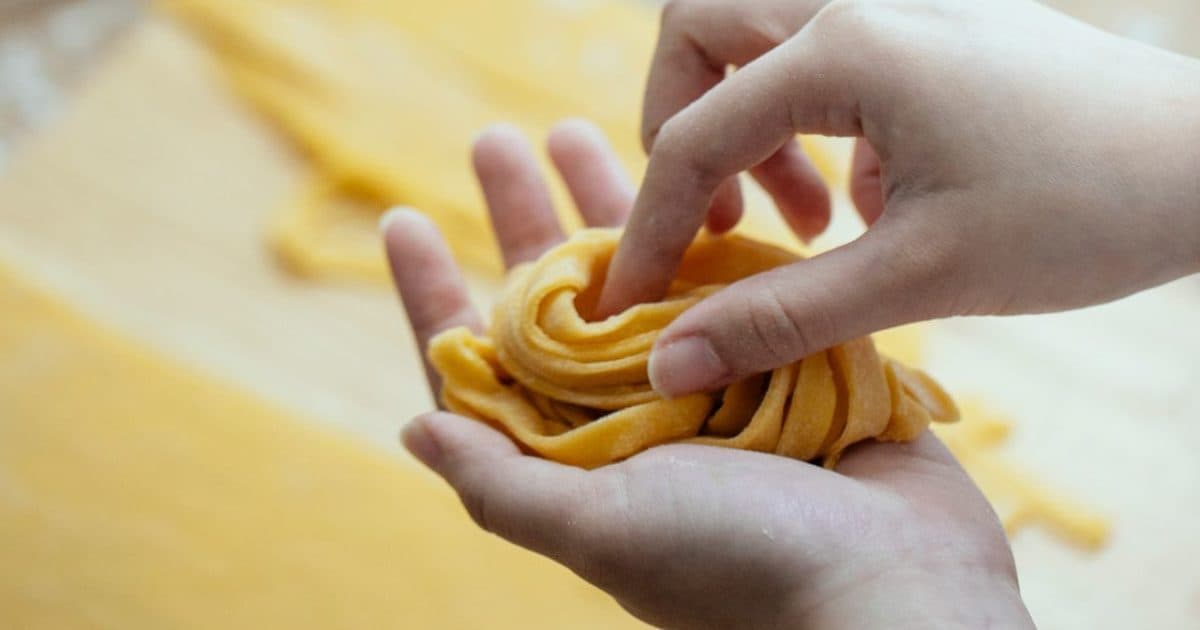
In a sfoglina class in Bologna lasting a few hours you learn three concrete things: how to make egg and flour dough, how to roll it out with a wooden rolling pin, and how to turn it into tagliatelle and tortellini using your hands alone. You do not become a sfoglina, the traditional pasta maker, because that is a craft that takes years. But you leave with the pasta you made, with the right proportions in your head and with a gesture you can repeat at home.
The Bolognese recipes filed at the Chamber of Commerce
In Bologna some recipes are not just oral tradition: they are documents filed at the Chamber of Commerce, so they are dated and verifiable. They carry no force of law and oblige no one, but they set a shared reference point. It is the thing a good class explains to you before letting you touch the flour.
- Tagliatella: the recipe and the measurement were filed on 16 April 1972 by Francesco Majani and Alcino Cesari, on behalf of the Accademia Italiana della Cucina. Cooked tagliatella must be 8 millimetres wide, around 7 when raw, and that measurement corresponds to the 12,270th part of the height of the Asinelli Tower. The sample is kept in a case at the Chamber of Commerce (Bologna chronology, Biblioteca Salaborsa).
- Tortellino, the filling: filed on 7 December 1974 by the Dotta Confraternita del Tortellino together with the Accademia Italiana della Cucina. It contains pork loin, prosciutto, mortadella, Parmigiano Reggiano, egg and nutmeg, and the filling must rest at least 24 hours before being used (Bologna chronology).
- Tortellino, pasta sheet and shape: in 2008 the production characteristics were filed too. The Dotta Confraternita indicates a sheet cut into squares of 3 centimetres per side, a finished tortellino weighing 5 grams and a dough of 10 eggs per kilo of flour, that is one egg per hundred grams (the filed recipe).
- Ragu alla bolognese: the renewed version was filed on 20 April 2023 and replaces the one filed on 17 October 1982. For six people it indicates 400 grams of minced beef and 150 grams of fresh pork pancetta, plus onion, carrot, celery, wine, tomato passata and tomato paste (Bologna Chamber of Commerce).
The same city chronology also records a later variant, chestnut tagliatelle, filed on 12 October 2006. The point is not to memorise dates: it is to understand that here pasta is a documented fact, and that the measurements your Maker will mention are not being invented on the spot.
Why Bolognese sfoglia is rolled with a mattarello
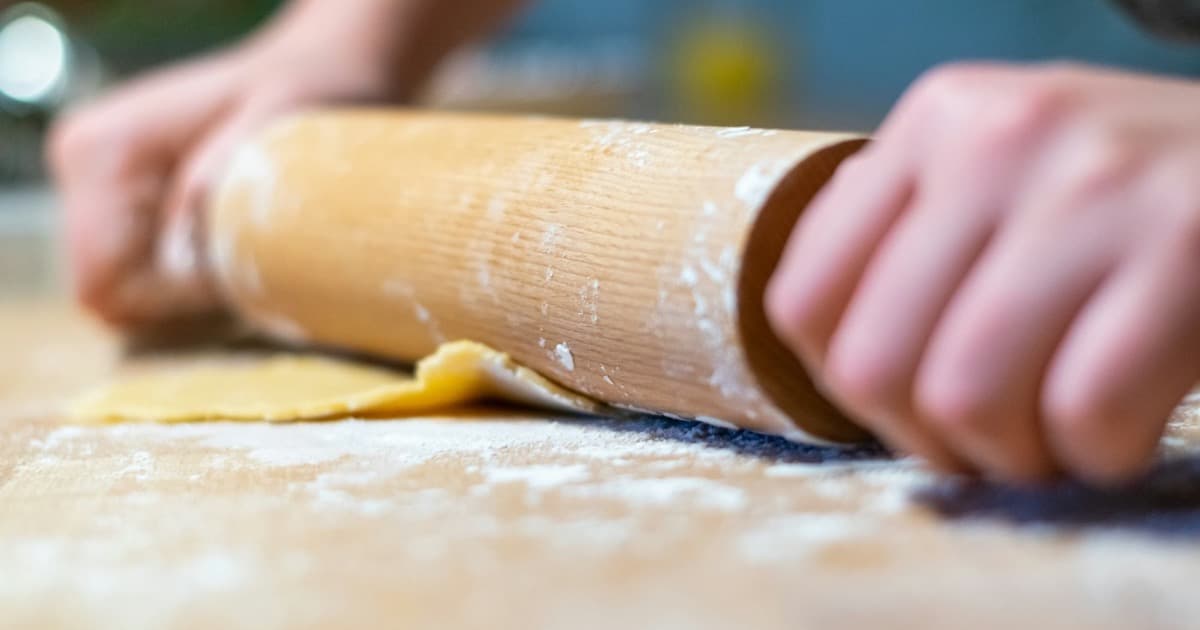
The difference between hand-rolled and machine-rolled pasta is not folklore. The mattarello spreads the dough in every direction, while rollers always stretch it the same way while compressing it. Hand-rolled sfoglia stays slightly porous and uneven: that is the surface that holds the ragu instead of letting it slide to the bottom of the plate.
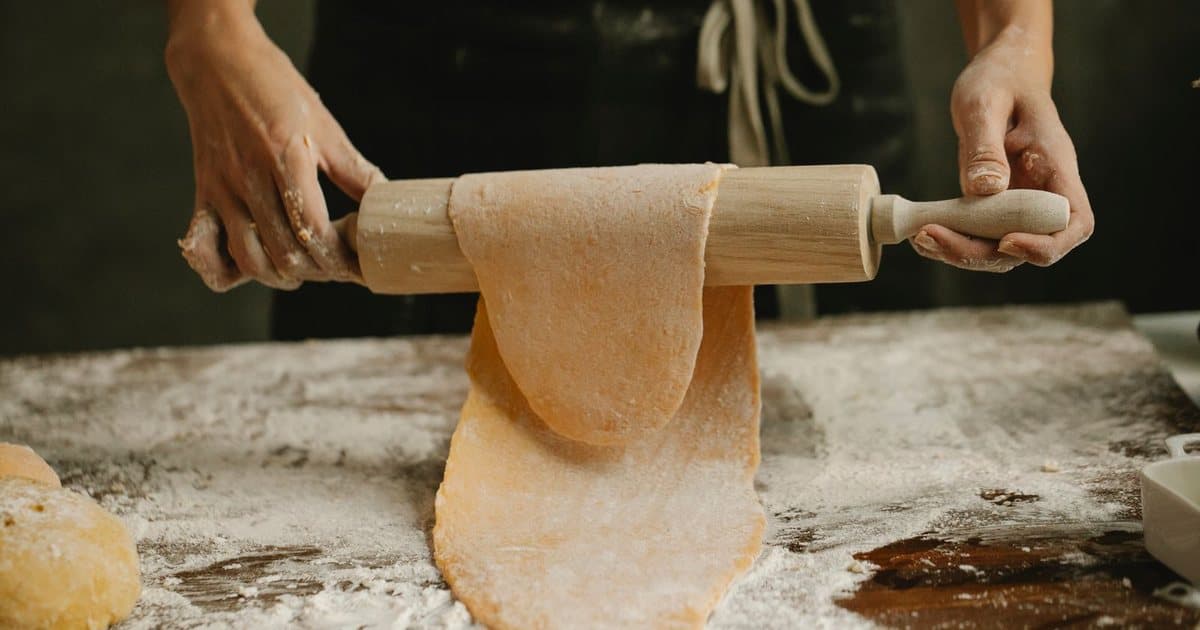
The second reason is control. Sheets for tortellini must be worked quickly, while they are still damp and close without cracking. Sheets for tagliatelle, on the other hand, need to dry for a moment before cutting, otherwise the strands stick together. They are two different sheets from the same dough, and by hand you decide in real time when to stop. In class this is the part that takes the most time: you do not push the rolling pin with your arms, you guide it with your body weight.
What you actually do in a workshop of a few hours
- The dough. Eggs and flour on the board, the well, a fork and then only your hands. The proportions are the ones in the filed recipe: one egg per hundred grams of flour.
- The kneading. You work the dough until the ball is smooth and firm, then it rests covered. This is the step almost everyone underestimates, and it decides whether the sheet will tear or not.
- The rolling. You start from the centre, wrap the sheet around the pin and widen it while turning it constantly. It takes consistency, not strength.
- The cutting. Rolled sheet and knife: at that point the 8 millimetres stop being an anecdote and become something you actually measure.
- The folding. Squares, a dot of filling, a triangle fold and a turn around your finger. It is the gesture you learn by watching rather than by listening.
- The tasting. Many workshops cook part of what you made and eat it together. Check on the event page whether tasting is included, because it is not automatic.
Date, time, location and all-inclusive price are written on every event page.
See the available workshopsBy hand or by machine: what changes for you
- By hand: you learn the gesture, it takes longer, the sheet comes out uneven and rough, and the sauce clings to it. This is the Bolognese school.
- By machine: faster and more uniform, handy with large groups or with children, but you skip the part that in Bologna is the real craft.
- When in doubt, ask first: many workshops use the rolling pin for the sheet and the machine only as a comparison. If it matters to you, read the workshop description or message the Maker before booking.
Is it suitable for people who have never cooked
Yes, and in fact that is the most common audience. You do not need to know how to cook: you need patience and a willingness to get your hands dirty. Almost everyone's first sheet comes out thick and crooked, and that is fine: the Maker corrects your posture, the flour on the board and the pressure. If you are bringing children, check the age range stated by the Maker on the event page. If you want to understand the format itself first, you can read what an artisan workshop is.
What you take home
- The pasta you made, raw, to be cooked the same day or frozen straight away.
- The proportions, which are few and simple: eggs, flour and a filling with precise rules.
- The rolling pin gesture, which you forget far less than you would expect.
- The difference between a good sheet and a mediocre one, which after a class you recognise even at a restaurant.
How the price works on Handsome
The price shown on the event page is the price you pay, and nothing is added at the moment of payment. Handsome takes no commission on the workshop revenue: the payment is credited directly to the Maker's own Stripe account. The round figure the customer sees is the price paid — with no costs added on top — and Handsome invoices the Maker nothing: only the standard Stripe processing fee applies.
There is no single price list, because each Maker sets their own. What makes it vary is concrete: the duration, the ingredients, whether filling and ragu are included, how many people are at the table, whether a tasting or a lunch is part of it, and the venue. Cancellation rules are the same for everyone and you can read them on the cancellations page.
If you are a group or you want to give it as a gift
For a birthday, a hen party or a work team you can request a dedicated date through private events: tell us how many you are and what you need, and we handle the rest with the Makers in the area. If it is a gift, the gift card is valid for 12 months on any workshop on the platform and works like a wallet: whoever receives it picks the date they prefer and, if the experience costs less, the remaining credit stays on the card.
Frequently asked questions
- How long does a sfoglina class in Bologna last?
- It depends on the workshop and on what you prepare: a session with dough, rolling, cutting and folding usually fits into a few hours, while formats that also include lunch last longer. The exact duration is always stated on the event page, together with date, time and location.
- Do I need cooking experience?
- No. Most participants have never rolled a pasta sheet before. The Maker starts from the dough and corrects your posture and pressure on the rolling pin as you go. If you are bringing children, check the age range indicated on the workshop page.
- Do you use a rolling pin or a pasta machine?
- The Bolognese tradition is the mattarello, which spreads the sheet in every direction and leaves it porous. Some workshops also use a machine, for speed or with larger groups. If it matters to you, read the workshop description or ask before booking.
- Is the tagliatella recipe really filed with the authorities?
- Yes. Recipe and measurement were filed at the Bologna Chamber of Commerce on 16 April 1972: cooked tagliatella must be 8 millimetres wide, around 7 when raw, and the sample is kept in a case at the Chamber of Commerce. The tortellino filling is filed too, since 7 December 1974.
- Can I take home the pasta I made?
- Generally yes, and it is one of the reasons people go. Fresh egg pasta should be cooked the same day or frozen straight away. The event page states whether the product is included and whether a tasting on site is part of the session.
- Can I give a fresh pasta class as a present?
- Yes, with the Handsome gift card: it is valid for 12 months on any workshop on the platform and works like a wallet, so if the chosen experience costs less the remaining credit stays on the card. For groups and private occasions you can instead request a dedicated date through private events.
Experiences with local Makers: all-inclusive price and 0% commission on the workshop revenue.
Find a workshop in Bologna