
Corporate welfare stopped being an exotic line in the HR budget a long time ago. The question today is no longer "should we do it?" but "what do we put inside it?" And that is where every plan starts to look the same: shopping vouchers, fuel cards, subscriptions, the odd online course. Legitimate tools that nobody talks about on Monday morning. This guide starts from a different premise — a craft experience in the basket, a real workshop with a Maker — and explains what it takes to make it hold up, in Rome, in front of your payroll adviser.
One blunt disclaimer, because this is where articles about welfare do the most damage: you will not find tax advice here. You will find the general framework, the sources behind the numbers, and the questions to ask whoever is selling you the service. How your specific case is classified is decided by your payroll adviser: not by a supplier, and not by us.
What counts as corporate welfare, in general terms
The perimeter is drawn by Article 51 of the Italian income tax code (TUIR), which lists what does not form part of employment income. Letter f) of paragraph 2 covers works and services provided by the employer for purposes of education, instruction, recreation, social and health assistance or worship, provided they are offered to all employees or to categories of employees. A craft workshop points at that box: it is recreational and educational at once.
Paragraph 3 governs fringe benefits instead: the value of goods and services provided does not form part of income up to an overall limit that is ordinarily 258.23 euro. For the 2025, 2026 and 2027 tax years that limit rises to 1,000 euro for employees generally and to 2,000 euro for those with dependent children, under Article 1, paragraphs 390 and 391, of Law 207/2024.
The rule that matters most is not the figure: it is that going over the threshold does not tax the excess, it taxes everything. If someone without dependent children receives 1,300 euro of benefits in a year, the taxable amount is 1,300 euro, not 300. An experience added in November, on top of a year of vouchers already handed out, has to be counted in advance.
- Fringe benefit (Art. 51, paragraph 3): it can go to a single person, but it enters the annual tally and the all-or-nothing rule.
- Works and services (Art. 51, paragraph 2, letter f): no threshold of that kind, but the audience must be all employees or a homogeneous category.
- Formalities: the 2,000 euro threshold requires a declaration from the employee stating the tax codes of their dependent children, plus notice to union representatives where they exist.
- Deductibility: it changes depending on whether works and services are granted voluntarily or under a contract, agreement or company regulation; in the first case the five-per-thousand limit applies (Article 100 TUIR).
- Meal vouchers, for comparison: the 2026 budget law (Law no. 199 of 30 December 2025) replaced "euro 8" with "euro 10" in Article 51, paragraph 2, letter c) of the TUIR, raising the exempt amount for an electronic voucher to 10 euro a day; paper vouchers stay at 4 euro.
Why an experience is worth more than a voucher
A voucher is money in disguise. It does its job — it arrives, it gets spent, it helps at the end of the month — and then it disappears into Saturday's grocery run. It leaves no memory and sparks no conversation. It is useful and invisible: which is why a plan made only of vouchers does not move the internal mood by a millimetre.
This is not an isolated impression. In 2003 Leaf Van Boven and Thomas Gilovich published in the Journal of Personality and Social Psychology the reference study on the subject, "To Do or to Have? That Is the Question": comparing experiential and material purchases, people more often associated the experience with the memory of having been happier.
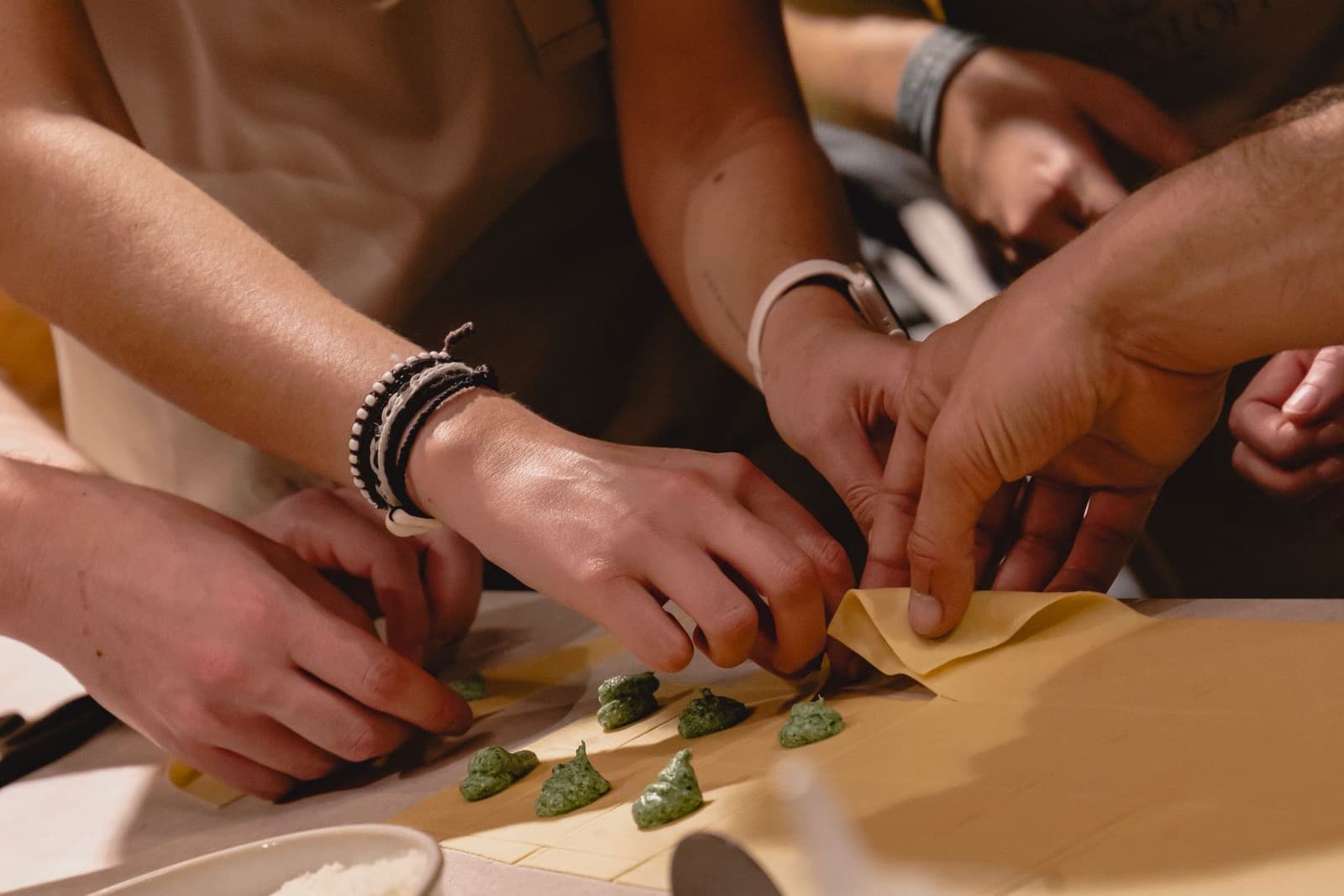
Inside a company the effect is amplified, because a workshop does something meetings cannot: it puts people at the same table with their hands busy. Nobody arrives already good at it, the org chart stops mattering for three hours, and people who had never spoken end up passing each other a tool.
- A voucher is spent alone, an experience is done together: the return on the team never shows up on the invoice.
- A voucher lasts as long as a checkout queue; an object made with your own hands stays in sight for years.
- A voucher is identical from Bolzano to Palermo; an experience belongs to the place where your people live and work.
- A voucher has no date, an experience does: it goes into the calendar and becomes an occasion.
- A voucher says nothing about the company handing it out; the choice of a workshop, and of which one, says plenty.
Rome, where the standard catalogue stops working
Rome is an enormous pool of demand: headquarters of large companies, public administrations and agencies, professional firms and a multitude of small businesses spread across every quadrant. A great many employers, a great many welfare baskets to fill, and a catalogue that almost always arrives pre-packaged, identical to the one offered in any other city.
On the supply side, the ground is there. The capital has a dense, layered craft fabric: long-standing workshops that have been at it for decades alongside studios opened in the last few years, spread across very different neighbourhoods. It is a fabric no national welfare catalogue has ever mapped workshop by workshop, because mapping it means going there in person.
Then there is a very Roman constraint: Rome is the largest municipality in Italy by area, at 1,287.36 square kilometres. "Near the office" means nothing until you specify the quadrant, because EUR, Tiburtina, Portuense and Monti are different cities for practical purposes. An experience that forces half the team across town at rush hour has already lost half its participants: on how to solve that, see creative team building in Rome, on site or off site.
How an experience fits into a welfare plan
- Define the audience before the content: everyone, one department, a homogeneous category or a single person. That choice determines the track.
- Take the proposal to your payroll adviser with the real price in hand: classification is based on the normal value of the service.
- Choose the format: an individual instrument to be used whenever the recipient likes, or a private group session on a single date.
- Set the value at the full price of the experience, materials included, so nobody has to top it up out of their own pocket.
- Check the dates actually exist before announcing the initiative: a workshop has a physical capacity, it is not an infinite shelf.
- Put in writing what happens to no-shows, who pays if a date is moved, and by when the instrument has to be used.
If the benefit travels on an instrument — a voucher, a coupon, a gift card — the constraints are written down. The interministerial decree of 25 March 2016 states that these documents cannot be used by anyone other than the holder, cannot be converted into cash or transferred to third parties, and must entitle the holder to a single good, service or work for the entire face value, with no top-up payable by the holder. Circular 28/E of 2016 from the Italian Revenue Agency clarifies the only exception: the cumulative voucher, within the 258.23 euro limit.
Number of people, budget per head, which quadrant of Rome and when: we assess the request and tell you honestly what we can cover.
Tell us what you needThe eight questions to ask a supplier before signing
An experience is a service with a date, a place and a maximum number of people: three variables digital catalogues handle badly, because they were built to sell codes.
- Who runs the session? Someone who practises that trade every day, or a facilitator trained on a kit?
- How many people are at the table? Above eight or ten you stop working and start watching.
- What do people take home, and when? In ceramics the piece has to be fired: it almost never leaves the same day.
- Are materials included in the price shown, or do they appear later, at checkout?
- What happens if the date has to move, who decides the postponement and who bears the cost.
- How are no-shows handled, and whether an empty seat can be recovered on another date.
- Is the instrument issued in the recipient's name and does it meet the conditions required for such documents?
- Who is the company's point of contact, from the proposal to the day of the event, and how to reach them.
On price the Handsome rule is a single one: what you see is what you pay. The proposal for your company shows an all-inclusive price per person (materials, Maker, organisation) and, for the same number of people, nothing is added afterwards. What a session actually looks like, we described in what a craft workshop is.
The mistakes that derail a plan built on experiences
It is almost never the law that creates the problem, it is the organising. These are the stumbles that come up most often.
- Picking people one by one while staying on the works-and-services track, which instead requires a homogeneous audience.
- Adding the experience in December, on top of a year of benefits already granted, without redoing the sum.
- Issuing an instrument that does not cover the full price and finding out late that the employee cannot top it up.
- Booking a workshop that holds eight for twenty people: a craft studio's capacity is physical, not commercial.
- Promising a finished object on the same day in disciplines that require firing or drying.
- Scheduling in August without checking closures, as we explain in what to do in Rome in August.
Frequently asked questions
- Can a craft workshop be part of a corporate welfare plan?
- It can, if it falls within the purposes set out by law, typically recreational or educational, and if you meet the conditions of the track you choose: a homogeneous audience for works and services, or the annual threshold as a fringe benefit. The classification is validated by your payroll adviser.
- What is the fringe benefit threshold in 2026?
- The ordinary limit under Article 51, paragraph 3 of the TUIR is 258.23 euro. For the 2025, 2026 and 2027 tax years it rises to 1,000 euro for employees generally and 2,000 euro for those with dependent children, under Article 1, paragraphs 390 and 391, of Law 207/2024. Once the threshold is exceeded the entire amount becomes taxable, not just the excess. Thresholds can change with each budget law: have yours checked by a payroll adviser before granting anything.
- Can I give the experience to only some employees?
- It depends on the track. As a fringe benefit, a good or service can be granted even to a single person, as long as it stays within the annual threshold. As a work or service with recreational or educational purposes, the exemption assumes an offer addressed to all employees or to categories of employees.
- Is it better to give an instrument or to book the session directly?
- An instrument leaves people free to choose, but it must be set at the full price because no top-up by the holder is allowed. A private session pays back more in terms of relationships, but it needs a single date: in Rome that means choosing the quadrant before the craft.
A welfare plan is not judged by what it is worth, but by how much people are still talking about it three months later. Vouchers do their job; an afternoon with your hands in a material is the only item in the basket people take home in the literal sense.
The Rome catalogue is still being built: if the craft you are looking for isn't there yet, write to us from the business page and we'll look at your request together.
Go to the Rome page on Handsome