In Rome the problem is not that nobody walks past your door. It is the opposite: everybody does, and everybody is in a hurry. 2025 closed as a record year for Roman tourism: 22.9 million arrivals, 12 million of them from abroad, and 52.92 million overnight stays, up 3.42% and 2.87% on the previous record, set in 2024. Those are the figures released by Roma Capitale from the survey by the Ente Bilaterale del Turismo del Lazio.
Do the division and you get the number that matters to anyone who works with their hands: just over two nights per arrival, meaning a schedule filled in before departure, with the compulsory sights already in it. The Colosseum Archaeological Park alone closed 2024 with more than 14.7 million visitors: it is the most visited state cultural site in Italy.
Then there is a second number, quoted far less often. In its report on the economy of Lazio, the Bank of Italy calculated that in 2025 spending by foreign tourists in the region grew by 19.2%, but 11.1 of those points came from Jubilee visitors. More than half of that surge rested on an event that has now closed. The flow stays; the extraordinary push does not.
It is the perfect setting for the wrong decision: dropping your price to catch the flow. And it is the quickest way to turn a workshop into a souvenir stall with an artisan inside it.
The flow is not your market
Almost twenty-three million arrivals are not the same number of potential customers. They are a river running along a route decided elsewhere: the three or four sights you have to see, a shopping street, the trip home. On that route you are not competing with another ceramicist: you are competing with the leftover hours of someone who has already spent their budget and their time on what they came for.
Your market is a smaller and much more defined slice: people who have already seen Rome, people staying longer than two nights, couples and small groups after something that doesn't involve a queue, and the people who live in Rome all year round. Even a narrow slice, against numbers like these, is a huge pool: but you don't reach it with a discount, because it isn't looking for you on price.
Against imports, the price race is lost before it starts
The souvenir shop two doors down isn't better than you: it is built differently. It buys mass-produced objects, pays a fraction of the retail price wholesale, and makes its money on volume and location. Its cost contains no hour of skilled labour, and its quality has to stand up to no comparison: nobody compares fridge magnets.
Your floor is a different one. You can't go below a certain figure, not out of pride, but because below it you are the one paying to work: that figure contains materials, waste, energy and above all your hours. It is a race you don't lose on skill, you lose it on arithmetic. And races lost on arithmetic are races you don't enter.
Then comes the less visible damage, the one about perception. Someone meeting you for the first time cannot judge quality before trying it: they use the only clue available, the price. Three hours sold for the price of a souvenir don't communicate good value, they communicate “something quick, lots of people, little time for me”. Anyone after the real thing skips you, anyone after a cheap filler books and never comes back.
- Lower the price and you lower expectations: from then on you are judged against that promise.
- You attract the hardest customer: whoever chooses on price demands more and reviews worse.
- A low price is almost impossible to raise: people who have already booked will read the fair figure as an increase.
- The margin disappears when you need it: a kiln to repair, materials to restock, a week with the door shut.
Rome has already picked a side
There is, though, a positioning lever you didn't have to build yourself. Rome has decided that its centre must not fill up with trinkets: inside the UNESCO area minimarkets and souvenir shops now come to almost three thousand, and in May 2026 the ban on opening new ones in the smaller units was extended by another three years, to 2029. Four months earlier, in January, the Council of State had sided with the city, recognising that the instrument chosen by the Assemblea Capitolina was lawful. Rules change, though, and exemptions exist: before you open or move, the up-to-date version comes from your Municipio's front desk, not from an article.
Then there is the figure that jars. In August 2026 the CGIA research office lined up the numbers of a craft sector emptying out: over twelve months the active craft businesses in Rome fell from 61,374 to 58,034, 3,340 fewer, 5.4%; in Lazio, between 2015 and 2025, the count went from 113,943 to 86,262 businesses, 27,681 fewer, 24.3%; across Italy more than 400,000 artisans have gone in ten years, roughly a quarter of the category. The city has decided that cheap trinkets are not the future of its centre: but a rule defends your square metre, not your positioning. That stays your job.
Building the price, line by line
A price isn't decided by looking at everyone else's and taking two euros off: it is calculated, and only then compared. There are six lines, and almost every mistake comes from forgetting two of them.
- All of your time. Not just the hours at the bench: preparation, welcome, cleaning, firing, messages, bookings. A three-hour session easily takes up five.
- Materials, waste included. With beginners things break and get started again: count the piece you lose, not only the one that works.
- The fixed share of the space. Rent, utilities, insurance, depreciation of tools and kilns, divided by the hours in which the space actually produces income, not by the hours it is open.
- Payments and paperwork. Payment fees, time spent on receipts and invoices, taxes: inside the price from the start, not discovered at year end.
- The invisible work of the tourist. Answering in English, explaining how to get there, dealing with the no-show whose flight ran late: in Rome that is a real line.
- The margin. It is what lets you buy a new glaze, redo your photographs or stop for a week without closing shop.
Once the sum is done, the number has to be compared with the market: not to fall into line, but to know where you stand. Sitting above the average holds up perfectly well, as long as you say precisely what justifies it: a small group, good materials, a piece that leaves finished.
To see where you are positioning yourself before settling on a figure.
Compare average prices by disciplineThe workshop is the product that selects the customer
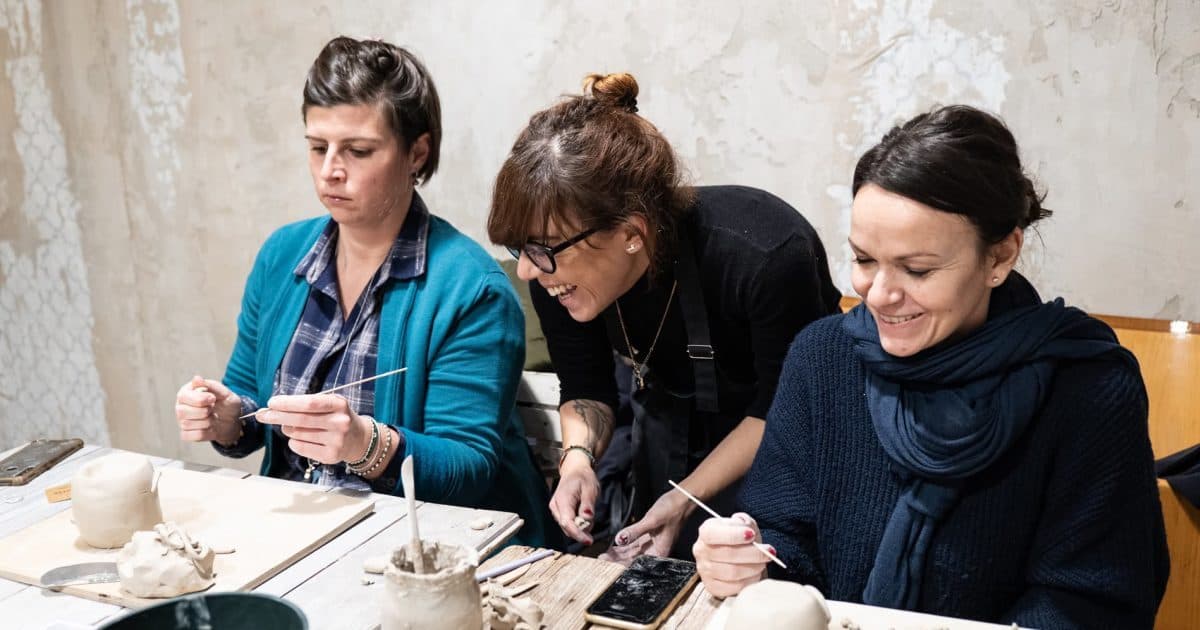
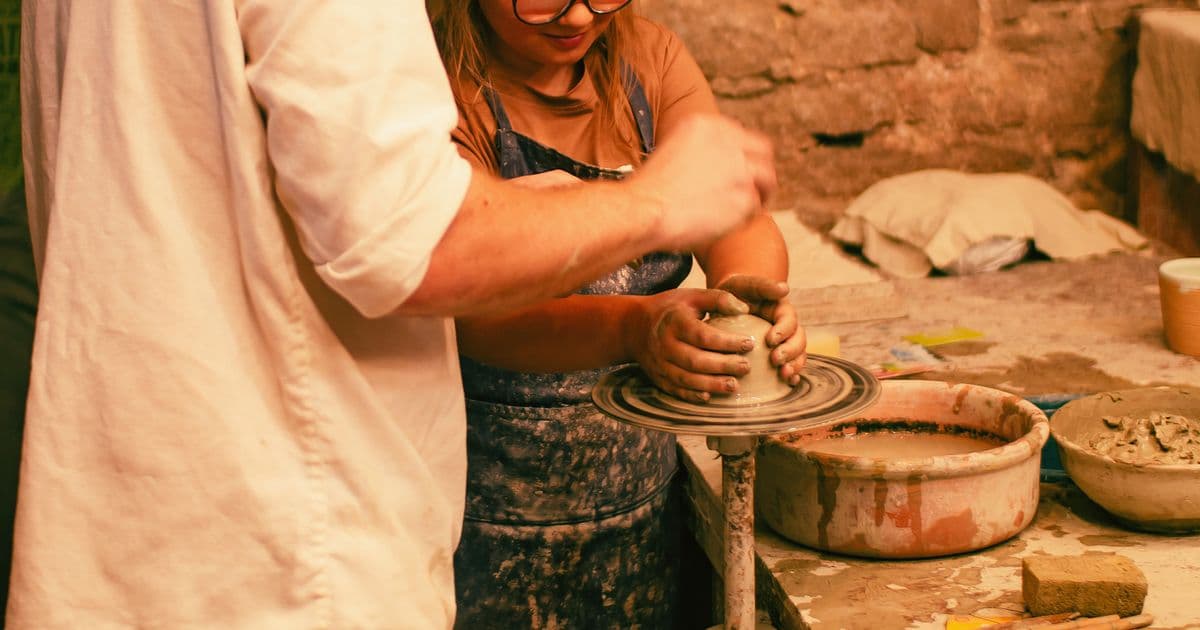
For anyone who makes objects, a workshop isn't a stopgap for the empty months: it is the highest-margin line on your price list. It doesn't go through stock, because a seat at the table isn't produced in advance and doesn't go unsold. And the costs of a session are almost all fixed: your time, the space and the kiln don't change whether there are four people at the table or seven. The only variable line is materials: the margin moves by filling up, not by discounting.
But the most useful property in Rome is another one: the workshop selects the customer by itself. Anyone who puts three hours inside a Roman day has already decided to spend on an experience rather than on objects and has already ruled out the queue. No stall can apply that filter: it sells to whoever walks past, and whoever walks past has chosen nothing.
There is a question of wallets, too. The souvenir and your experience draw on the same line of spending, the one left over after hotels and restaurants: that is where the match is played, and that is where the difference has to be spelled out. Because you are not selling an object identical to a thousand others: you are selling the hours in which it comes into being, and those sit on no shelf.
- Someone who has tried it understands what your pieces cost: they have felt how hard it is.
- Someone who has tried it buys later, often online and from their own country, because now they know who you are.
- Someone who has tried it tells the story: an afternoon with dirty hands is a story, a shop purchase isn't.
Four details that change bookings in Rome
Positioning shows up in operational details before it shows up in words: the nearest stop and the minutes on foot are worth more than any adjective.
- Language. In 2025 twelve million of the twenty-two point nine million arrivals came from abroad: a listing in English too, and one line stating which language you run the session in, remove the main doubt.
- The time slot. Visitors have their middle hours taken up by monuments. Late afternoon and early morning are the two free windows, and they are also when locals can make it.
- The suitcase. Write down how big and how heavy what they take away is, and whether it survives hand luggage: it is the question everybody asks and almost nobody answers in the description.
- Firing. If the piece doesn't leave the same day, say so in advance, with the alternative: later collection or shipping home, abroad included. Finding out at the end of the session spoils an experience that went well.
Where a platform helps, and where it doesn't
Handsome is an Italian platform for craft workshops with zero commission: it takes no percentage of the price of your workshops. Here the difference is concrete: if a platform takes a slice of every booking, either you raise the price to cover it, becoming more expensive without being any better, or you swallow it out of the margin you have just calculated.
The rest deserves saying too. In Rome there is not yet a single Maker on Handsome with a published calendar: the city page is there to be filled. And no platform, this one included, brings customers automatically. What it can remove is friction: a readable listing, online payment, immediate confirmation, an all-inclusive price with no surprises at checkout, reviews collected only from people who genuinely attended.
The rest stays your work. In Rome the audience is not missing and won't be: what is missing, almost always, is a clear sentence about what happens in your three hours and a price that doesn't apologise for existing. We told the Florentine version of the same problem in fake craft in Florence.
Frequently asked questions
- In Rome, is it worth keeping prices low to catch tourists?
- No. Whoever chooses on price is after an object costing a few euros, not three hours at your bench: with a discount you enter a race against mass production that you cannot win, because your minimum cost contains your hours.
- How do I tell whether the problem is the price or something else?
- Look at two numbers before the price: how many people open the listing and how many book. If plenty open it and nobody books, the problem is the figure or something unclear in the listing. If nobody opens it, you are invisible: that is a problem of title and visibility.
- Should I aim at tourists or at Romans?
- At both, but on different dates. Visitors book a few days ahead and want to know what they take away. Residents book at weekends and in the evening, come back and arrive with a group: keeping the two bands separate works better than mixing them.
- How long before workshops become real income?
- It depends on filling up more than on the price. The first dates are there to gather genuine reviews and to work out which format holds. A calendar published weeks in advance matters more than any last-minute discount.
It gathers the city's craft experiences as Makers publish their dates.
See the Rome page on Handsome